Search results
Query: US HAM Bands
Links: 208 | Categories: 4
-
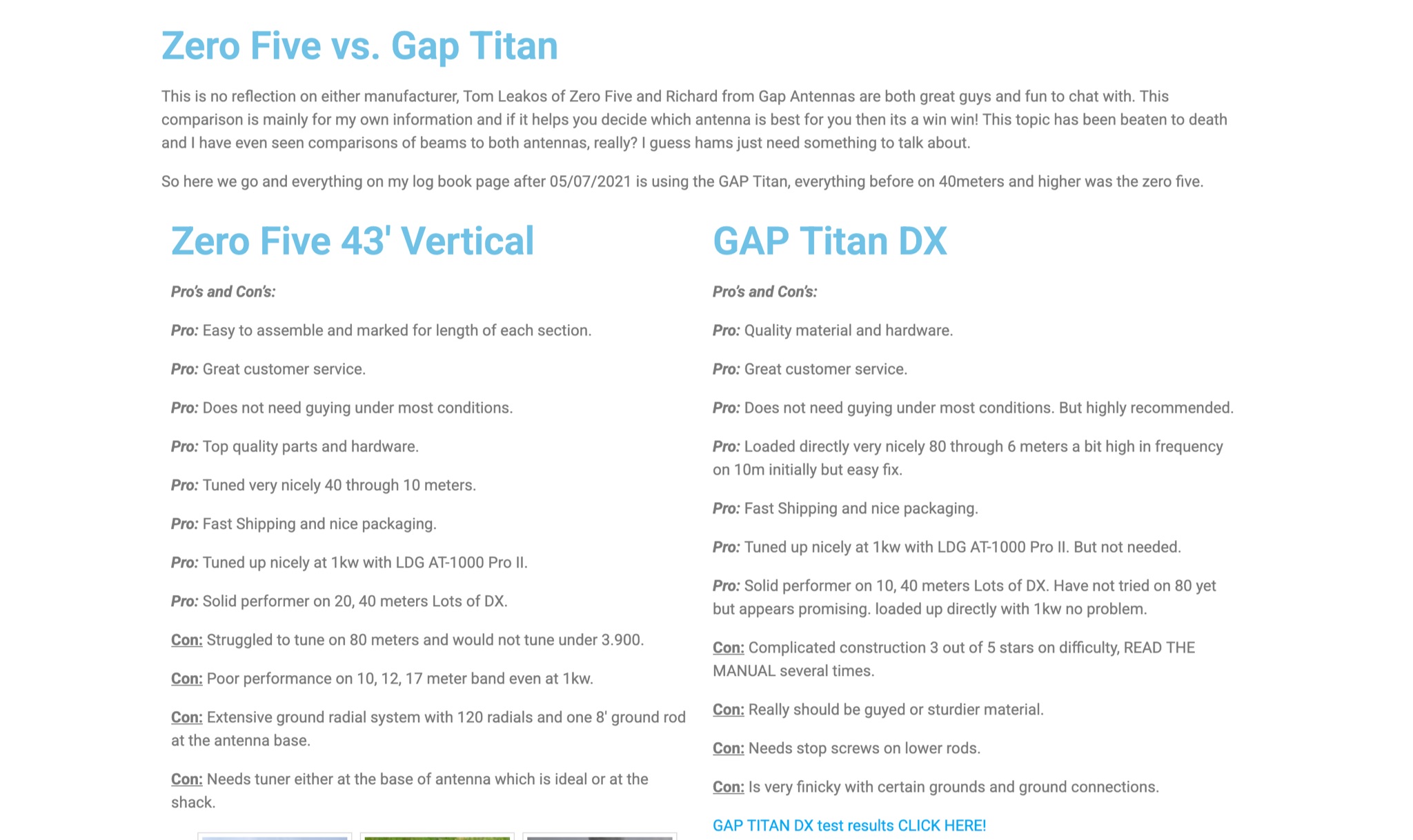 This page provides a detailed comparison between the Zero Five and Gap Titan ham radio antennas. The author shares their personal experience with both antennas, highlighting pros and cons for each. They discuss aspects such as ease of assembly, customer service, tuning capabilities, performance on different bands, and the need for grounding and tuning. The comparison aims to help readers make an informed decision on choosing the best antenna for their needs, based on real-world usage scenarios and feedback.
-
 This page discusses the construction and use of a low pass filter for MF/LF reception, specifically for the 630 meter and 2200 meter bands. The author, KA7OEI, shares technical insights and practical advice related to amateur radio, with a focus on improving reception in the low-frequency bands. This resource is useful for hams interested in building their own filters to enhance their MF/LF reception capabilities.
-
 HAMgpt offers a personalized amateur radio experience, leveraging AI to provide real-time operational guidance. It integrates live propagation data, current band conditions, and operator-specific context, including callsign, QTH, license class, and station equipment, to deliver relevant answers. The system can identify open HF, VHF, and UHF bands, suggest workable DXpeditions and POTA/SOTA activations, and provide accurate repeater offsets and CTCSS/DCS tones for local repeaters. Unlike general-purpose chatbots, HAMgpt avoids fabricating frequencies or license privileges, instead relying on actual data for its responses. It supports antenna design calculations for various types like Yagi, dipole, vertical, and magnetic loop antennas, offering to-scale dimensions. The platform also assists with license exam preparation and provides satellite pass predictions tailored to the user's location. It supports multiple countries, including the United States (FCC Technician, General, Extra), Canada, the United Kingdom, Australia, Japan, and Argentina, incorporating their specific band plans and power limits.
-
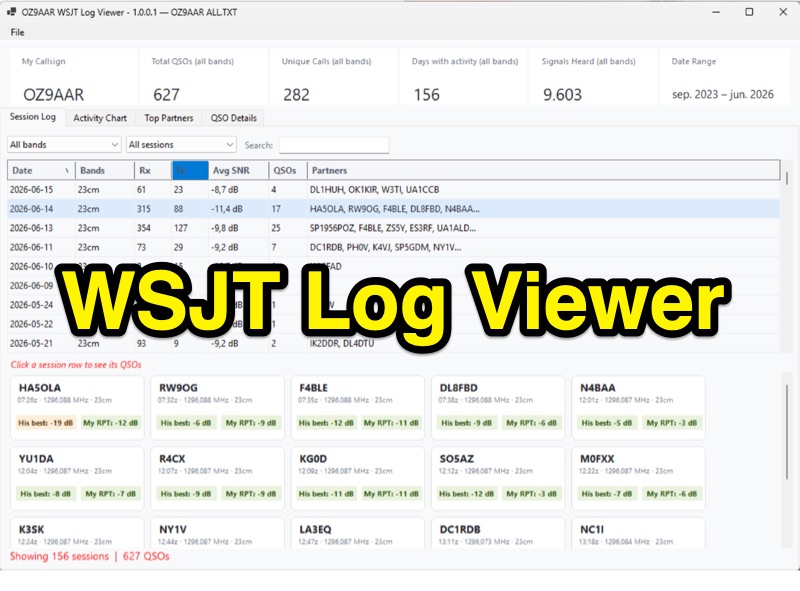 The WSJT Log Viewer, version 1.0.0.10 as of 2026-08-02, is a freeware Windows application developed by Carsten Groen (OZ9AAR) for analyzing signal strengths from WSJT digital mode contacts. It processes the ALL.TXT log file generated by WSJT-X, extracting and presenting data from decoded TX and RX messages. Initially designed for EME operations on 70cm and 23cm, the software has expanded to include all HF bands, 6m, 4m, 2m, 1.25m, 70cm, 23cm, 24GHz, and 47GHz. Key features include displaying total QSOs, unique callsigns, days with activity, and signals heard, with filtering options by band and completed QSOs. The application also monitors the ALL.TXT file for live updates every two seconds, reflecting new decodes in real-time. Users can view session logs, activity charts showing daily signal counts and decoded signals, and a "Top Partners" tab listing the 25 most frequent contacts. The software provides detailed QSO information, including best received SNR and sent reports, with graphical representations of SNR over time. It supports multiple "My Callsign" entries within a single ALL.TXT file and offers a function to generate a text list of initials worked per band. The program is distributed as a single executable file, requiring no installation, and stores its configuration in a LogViewer.cfg file, allowing for different setups via command-line arguments.
-
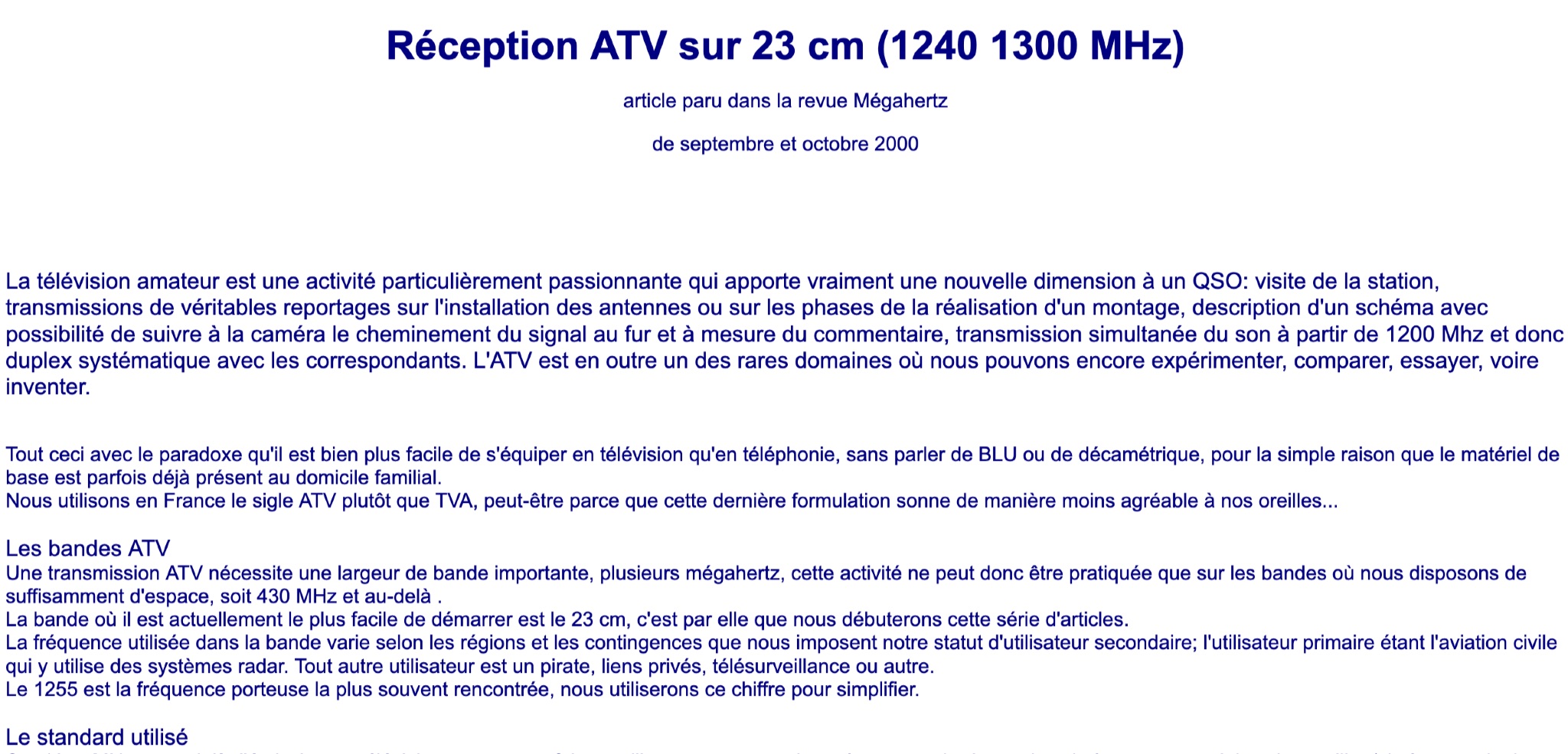 Learn about Amateur Television (ATV) on the 23 cm band (1240-1300 MHz) in this article from the September and October 2000 issue of Mégahertz magazine. Discover how ATV adds a new dimension to QSOs by allowing hams to visit stations, transmit real reports on antenna installations, follow signal paths on camera, and have simultaneous sound transmission. Explore the world of ATV experimentation, comparison, and innovation, made easier by existing equipment in many ham radio operators' homes. Find out about the ATV bands, bandwidth requirements, and the 23 cm band as a starting point for ATV activities.
-
 The LICW Challenge is a daily event for ham radio operators, with special weekly on-air classes. It resets quarterly and covers bands from 160m to 2m, focusing on CW only. The event offers various point values based on member categories and bonus opportunities. Participants use specific calling frequencies and a CQ format to exchange information. Bonus points are awarded for specific criteria like contacts outside North America or special monthly members. The goal is to work as many LICW members as possible on different bands to earn points and bonuses.
-
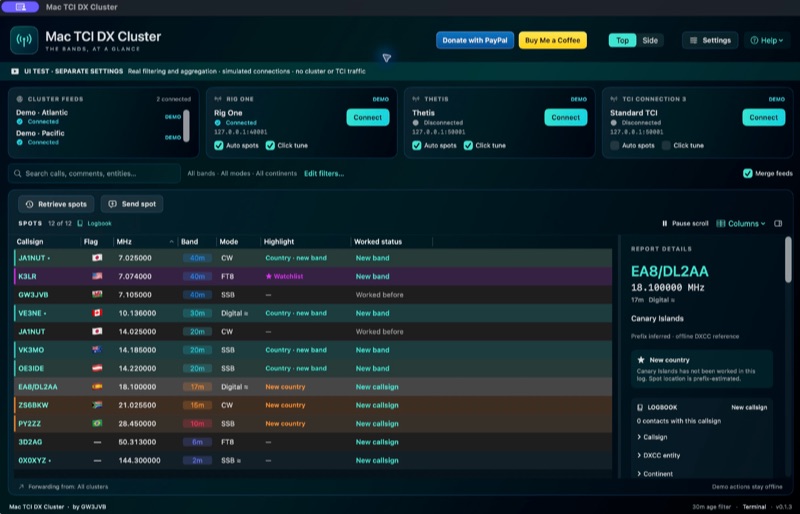 Presents the Mac TCI DX Cluster, a macOS application designed to streamline DX cluster activity for ham radio operators. GW3JVB developed this tool to provide a focused native Mac view of incoming spots, integrating local _RUMlogNG_ logbook context and selected TCI destinations. It allows users to save and connect to multiple Telnet cluster profiles simultaneously, merging feeds and filtering spots by bands, modes, and continents. The application features three independent outgoing TCI client slots for servers such as RigOne and Thetis, supporting spot forwarding and click-to-tune functionality. It reads local RUMlogNG logbooks for worked and needed checks without modification, offering callsign, DXCC entity, and continent checks. Watchlists, highlights, and optional alerts are included to emphasize important spots, helping operators find the next station worth working. Mac TCI DX Cluster complements existing station software, requiring macOS 14 or later on Apple silicon or Intel Macs. It is free to use, with downloads and release information available on GitHub, and optional donations are appreciated.
-
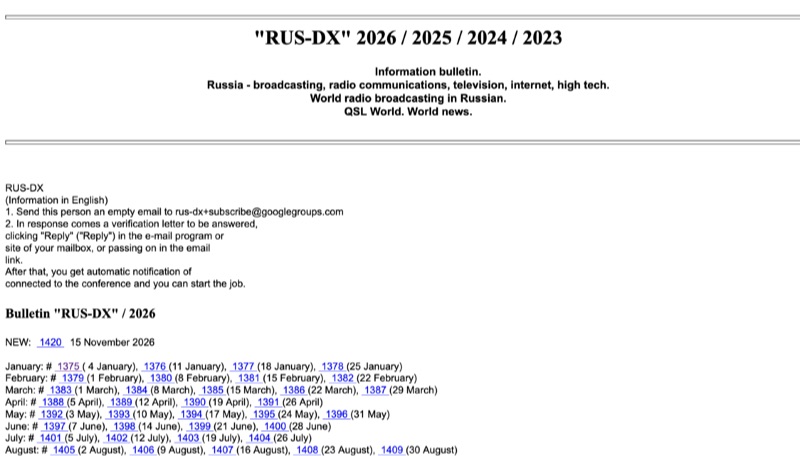 Accessing the RUS-DX PLUS Bulletin reveals a landing page that serves as a gateway to both Russian and English versions of the bulletin. This resource primarily functions as a newsletter, disseminating updates relevant to the amateur radio community. It focuses on general ham radio topics and DX-related activities, rather than specific technical measurements, equipment modifications, or detailed schematics. The content is presented in a textual format, offering news and announcements without performance data or software downloads. The bulletin acts as a communication channel for general amateur radio interest, without specifying particular operating modes like **FT8** or **CW**, or frequency bands such as 20 meters or 40 meters. The information is structured as a collection of articles or announcements, providing a concise overview of current events and interests within the ham radio world.