Search results
Query: ADS-B
Links: 11 | Categories: 2
Categories
-
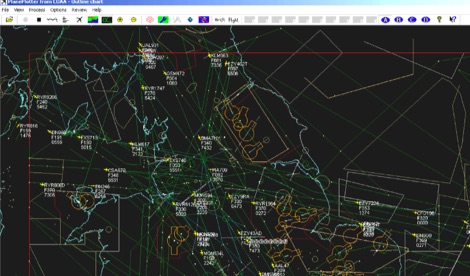 PlanePlotter is a windows decoder of live digital position reports from aircraft and plots them on a chart. Using PlanePlotter, you can see a radar-like display of all those aircraft around you that are transmitting the appropriate digital messages including ACARS, ADS-B and HFDL. Full Trial available for 21 days.
-
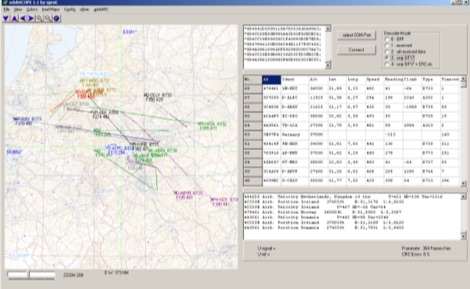 adsbScope is a freeware Windows application designed for processing _ADS-B_ (Automatic Dependent Surveillance-Broadcast) frames received from a compatible decoder. It identifies aircraft, calculates their real-time positions, and presents flight parameters in both alphanumeric tables and a graphical display. The software interfaces via a virtual COM port, receiving raw frames to provide detailed situational awareness, including a global coordinate grid, continental coastlines, over 4,000 **airport** locations, and major cities. Users can overlay OpenStreetMap tiles and view world state boundaries, with each tracked aircraft rendered with labels showing altitude, speed, heading, squawk code, and flight identifiers. When paired with the adsbPIC-decoder, adsbScope enables advanced hardware control, allowing users to toggle data filters for specific frames like DF17/18/19, adjust analog signal thresholds for reception fine-tuning, and manage system resets or bootloader activation directly from the PC. This functionality provides a customizable toolkit for hobbyist radar listeners, offering a robust alternative to commercial tools for processing aircraft data. The software displays up to **1090 MHz** transponder data and can track aircraft up to 250 nautical miles.
-
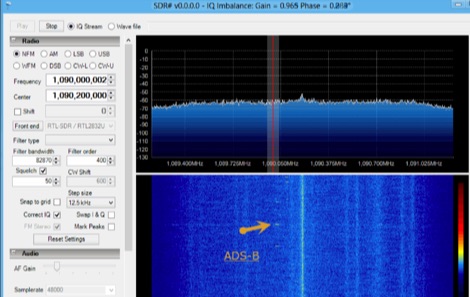 Free Windows ADS-B decoder for RTL-SDR dongles included in SDR#. It allow to broadcast data locally or to radar software sever such as Planeplotter, Virtual Radar Server, adsbSCOPE.
-
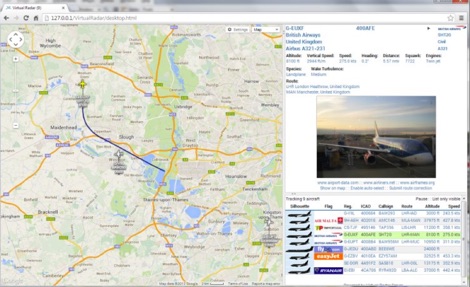 Virtual Radar Server is a free windows decoder of ADS-B signals received by several radio receivers and support even networked data feed. The Server publish a Google Maps-based display of aircraft positions and flight list
-
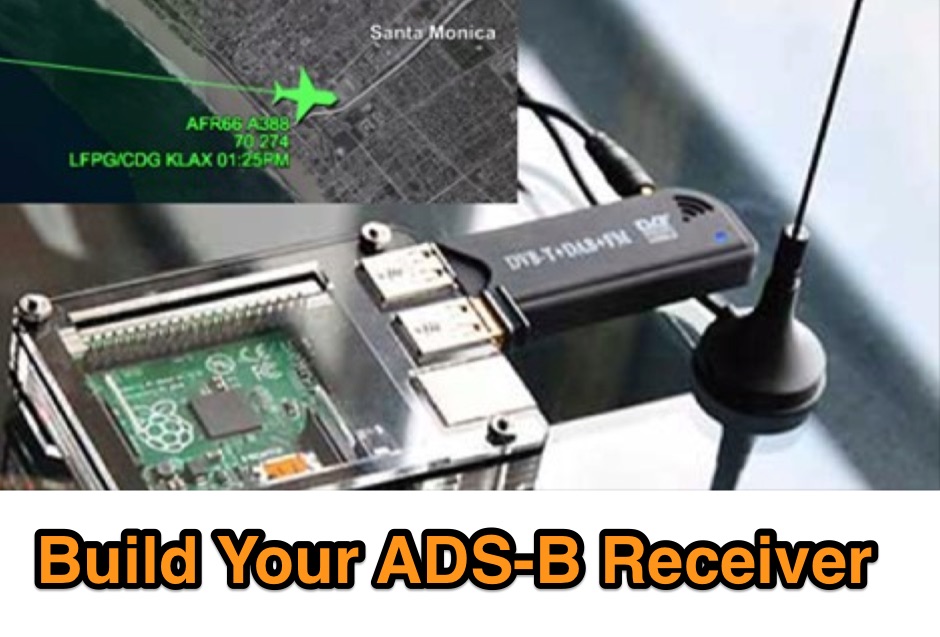 You can now build and run your own ADS-B ground station that can be installed anywhere and receive real-time data directly from airplanes on your computer
-
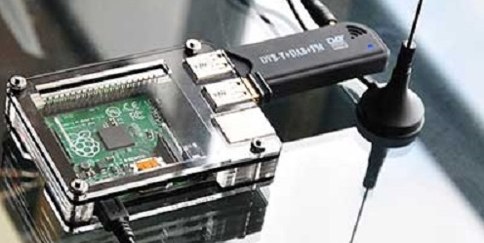 Build and run your own ADS-B receiver for 100 USD with a Raspberry Pi
-
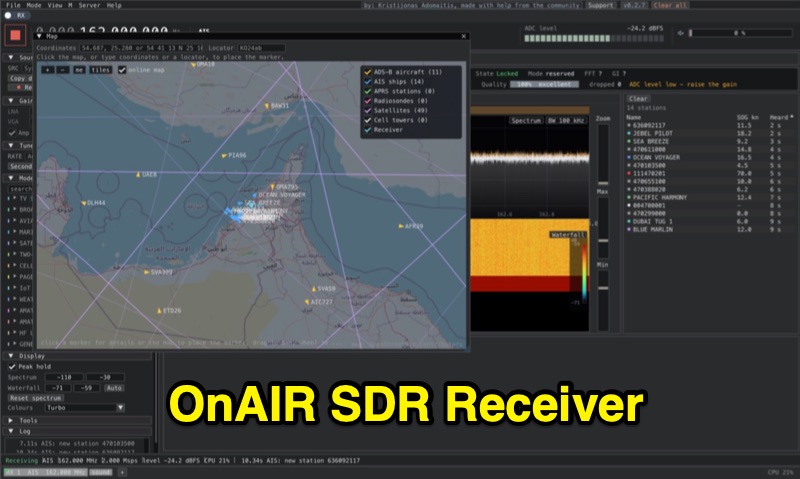 The OnAir SDR receiver application, hosted on GitHub, supports a broad range of digital and analog modes across macOS, Windows, and Linux platforms. It decodes various digital TV standards like DVB-T/T2, DVB-C, DVB-S/S2, ATSC, ISDB-T, and DTMB, alongside broadcast audio formats such as DAB+, FM, and DRM. For aviation enthusiasts, it processes ADS-B, ACARS, and VDL2 signals, while also offering satellite reception and GNSS capabilities. Amateur radio operators benefit from its support for modes including FT8, PSK31, and CW, in addition to general digital voice decoding and cell tower monitoring. A built-in spectrum analyzer provides visual analysis of received signals. The project demonstrates active development, evidenced by over **1,750 commits** to its codebase. OnAir is designed for compatibility with popular SDR hardware, including _HackRF_, RTL-SDR, Airspy, SDRplay, BladeRF, LimeSDR, Pluto, and USRP devices. This wide hardware support makes it a versatile tool for radio enthusiasts and professionals working with various SDR platforms.
-
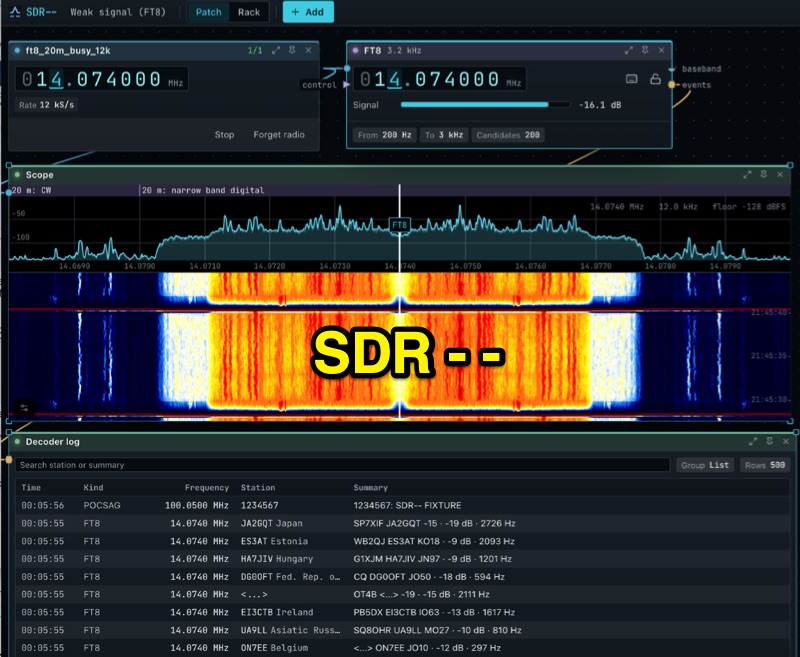 Boasting an FM demodulation rate of **1,235 Msps** and a DMR speed of **369x realtime**, SDR-- is a software-defined radio application designed for patching together radio components across macOS, Windows, and Linux platforms. It facilitates connecting a receiver to various channels, which then feed into speakers, maps, or recorders. The software supports a wide array of audio modes including AM, NFM, SSB, CW, FM stereo, RDS, DMR, FreeDV, D-STAR, Fusion, NXDNP, P25, and dPMR, alongside decoding numerous events and messages such as ADS-B, ACARS, VDL2, HFDLA, AIS, NAVTEX, DSC, POCSAG, FLEX, ERMES, FT8, FT4, WSPR, APRS, RTTY, PSK, ISM sensors, and time signals. Beyond audio and data, SDR-- also handles video modes like SSTV, ATVDVB-S, and DVB-S2. It provides comprehensive displays including spectrum, waterfall, constellation, and map views, all integrated with decoded messages. Advanced features include scanning, signal identification, satellite tracking, direction finding, and passive radar capabilities. The application offers remote control options via REST, WebSocket, MCP, and event forwarding, allowing integration with external tools. It can operate on a desktop computer or be deployed on a server, such as a _Raspberry Pi_, for remote access, providing flexibility for shack setups or antenna-side installations.
-
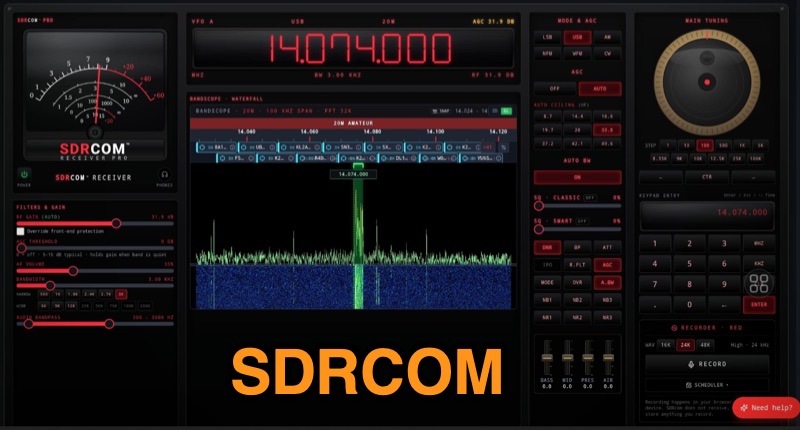 The SDRcom platform provides a unique browser-native Software Defined Radio experience, emulating a traditional radio with a physical VFO dial, switches, and an analog meter. It integrates a high-resolution 64k FFT waterfall display, supporting essential modes like AM, FM, SSB, and CW. The **SDRcom Blue** version interfaces with SDRplay® receivers via a local WebSocket, while the free **Red Lite** version supports RTL-SDR V3/V4 dongles through WebUSB, including basic audio EQ and 100 memory slots, along with FT8 decoding. For advanced operators, the Red Pro version expands capabilities with 1000 memory slots, upgraded high-resolution waterfalls, and enhanced W4PAH FT8, FT4, and WSPR decoder engines. It also incorporates 4-band DSP noise reduction and an intelligent band scanner, proving beneficial for weak-signal work. The Network edition extends functionality to access hundreds of global remote SDRs, and an ADS-B aircraft decoding feature with 3D positioning and mapping is also available. All SDRcom applications are designed to run directly in a web browser, eliminating the need for any software installation. This approach simplifies access and setup for radio enthusiasts, from casual SWLs to dedicated digital mode operators, allowing immediate engagement with the airwaves.
-
 This project focuses on testing and comparing various antennas for receiving ADS-B (Automatic Dependent Surveillance-Broadcast) signals, utilizing software tools like RTL1090 and Virtual Radar with an RTL-SDR dongle. The goal is to evaluate the reception range ("ReceiverRange") and performance of different antenna types when tracking aircraft signals, particularly around the Amersfoort area. The project includes a comprehensive photo album documenting the antenna designs and setup processes, serving as a valuable resource for enthusiasts building ADS-B reception systems
-
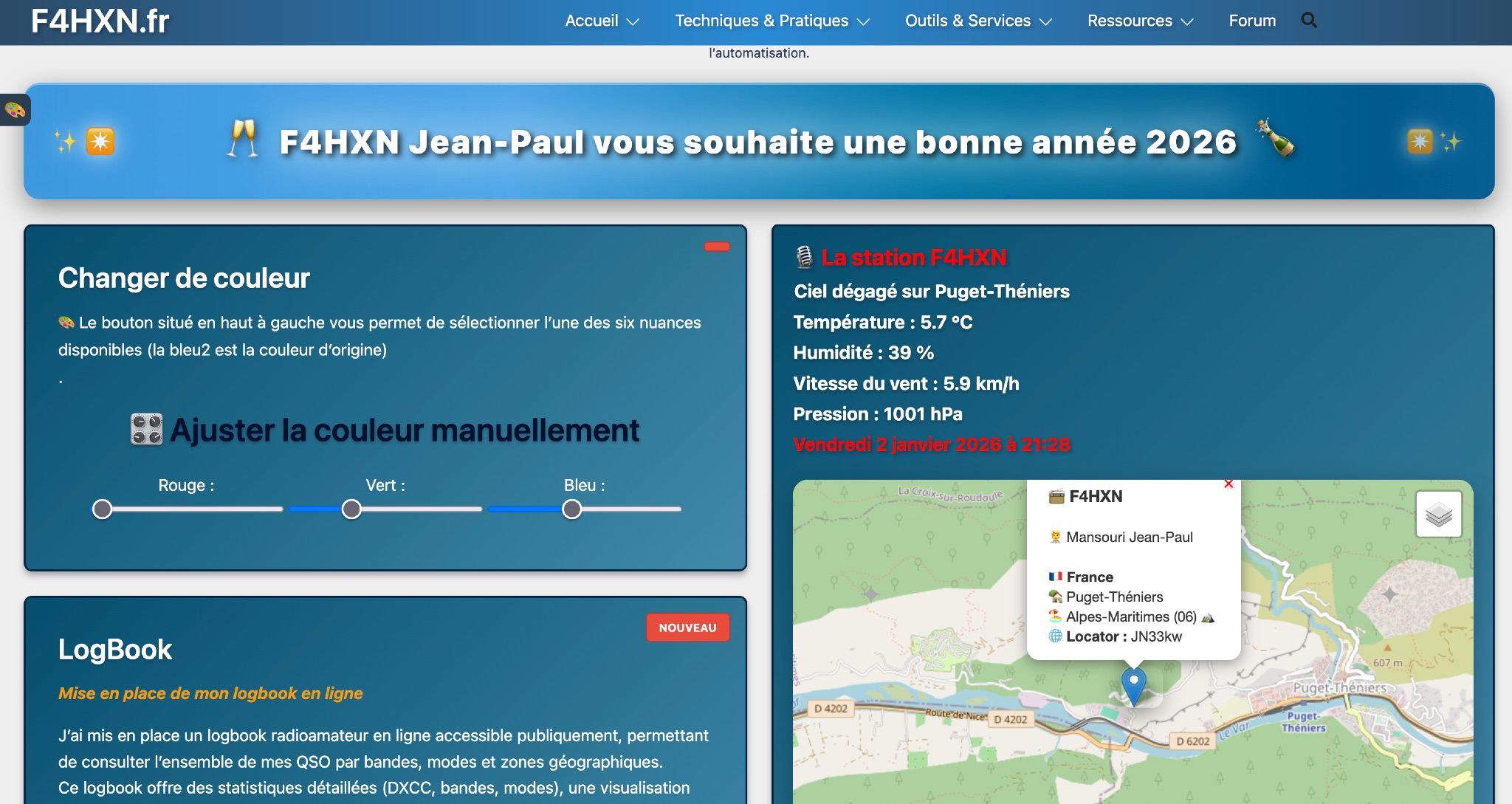 Demonstrates various technical projects and tutorials for amateur radio operators, focusing on digital modes, monitoring, and station setup. It covers topics such as implementing a _WSPR_ station, setting up ADS-B reception, configuring a _DXSpider_ cluster, and utilizing monitoring tools like Prometheus and Grafana. The resource provides practical guides for integrating modern IT solutions with ham radio activities, including Docker and Linux environments for radio applications. This site also features a publicly accessible online logbook, offering detailed statistics on QSOs by band, mode, and geographical zone, with visual mapping of contacts. It includes a comprehensive amateur radio lexicon, explaining hundreds of terms, and provides a real-time display of the F4HXN station's local weather conditions. The resource also aggregates information on upcoming ham radio events and offers a **SWR simulator** for antenna analysis, allowing users to visualize ROS changes based on frequency and antenna parameters.