Search results
Query: century
Links: 20 | Categories: 0
-
 The RTTY Net is one of several Nets run by the 3905 Century Club. There are SSB Nets on 160, 75, and 40 Meters and CW Nets on 80 and 40 Meters
 -
 The ARRL DXCC Challenge is a new program for all band DXers
 -
 A group of hams decided to make those wishes come true and founded the Straight Key Century Club - a/k/a SKCC.
 -
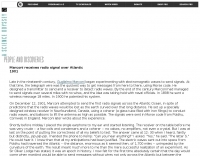 The early 20th century saw significant advancements in wireless communication, culminating in the first successful transatlantic radio signal. This historical account details Guglielmo Marconi's pioneering efforts, from his initial experiments with electromagnetic waves to his patented wireless system in 1900. It describes the technical challenges of long-distance radio transmission, particularly the prevailing belief that radio waves would be lost due to the Earth's curvature over vast distances. On December 12, 1901, Marconi established a receiving station in Newfoundland, Canada, utilizing a _coherer_ and balloons to elevate the antenna. Signals, consisting of the Morse code letter "S" (pip-pip-pip), were transmitted from Poldhu, Cornwall, England. The successful reception of these faint but distinct signals across **1,700 miles** confirmed Marconi's theories, marking an epoch in communication history. This achievement demonstrated the viability of global wireless communication, paving the way for future developments in radio technology.
 -
-
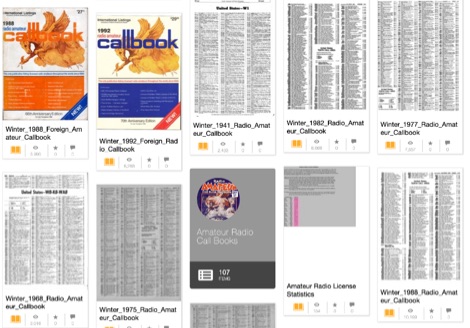 Indexes over 100 digitized amateur radio callbooks, primarily from the early to mid-20th century, providing a historical record of callsign assignments and licensee data. The collection facilitates research into past amateur radio operations, tracing callsign lineage, and identifying operators from specific eras. Each entry typically includes the callsign, licensee name, and geographic location as published in the original printed volumes. Users can browse the collection by publication date or utilize the search function to locate specific callsigns or names within the archived documents. The resource serves as a valuable repository for historical amateur radio data, supporting genealogical and operational research. Access to these scanned documents is provided directly through the Internet Archive platform, ensuring long-term preservation and availability of these historical amateur radio records.
 -
 21st Century telegraphy paddles, software defined telegraphy paddles by 9A5N. Following global trends in the application of the latest technology, HAM 9a5n has made a significant technological breakthrough in the field of CW paddles
 -
 Contest Club Ontario (CCO) is Ontario's entry into International Club competitions in the 21st Century, providing one vehicle to highlight Canadian participation in these contests.
 -
 Wild Rose Chapter 151 - Alberta
 -
 D-Start site sponsored by Icom Uk
 -
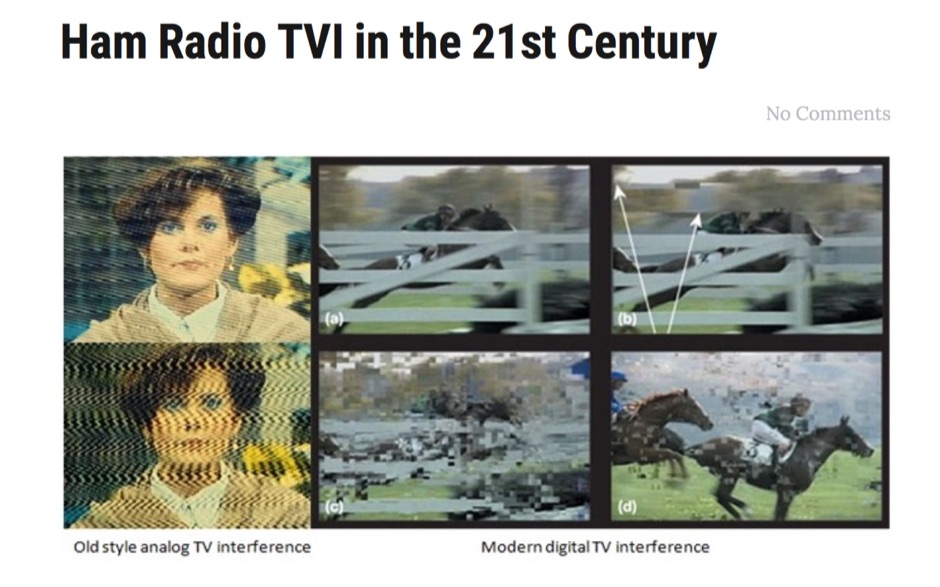 Ham radio transmissions can interfere with television reception. This is called television interference, or ham radio TVI. Consumer adoption of cable television has significantly reduced ham radio TVI. But the introduction of IPTV, or television over phone systems, has brought ham radio TVI back, often with a vengeance. Here's why
 -
 Chapter 73 fred hammond chapter of the quarter century wireless association
 -
 Quarter Century Wireless Association (QCWA) Founded 1947
 -
 For a century doing what we do best in support of the amateur radio community in Australia
 -
-
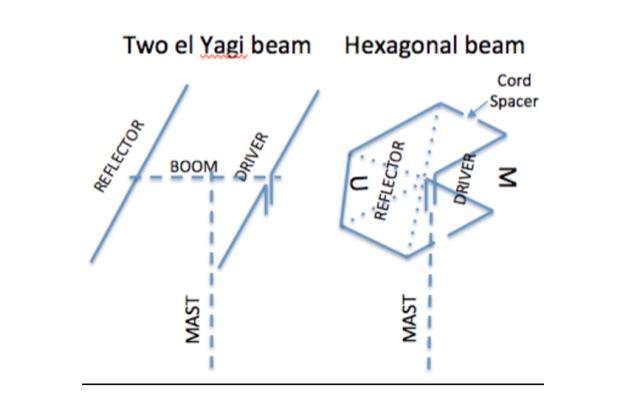 A hexagonal beam is a form of the Yagi antenna which is based on parasitic principles developed early in the last century in Japan for achieving gain in one direction.How HexBeam antennas works. A hexagonal beam operates exactly like Yagi antenna, but instead of a driven element that is straight like a dipole, it is a wire bent into the shape of the letter M.
 -
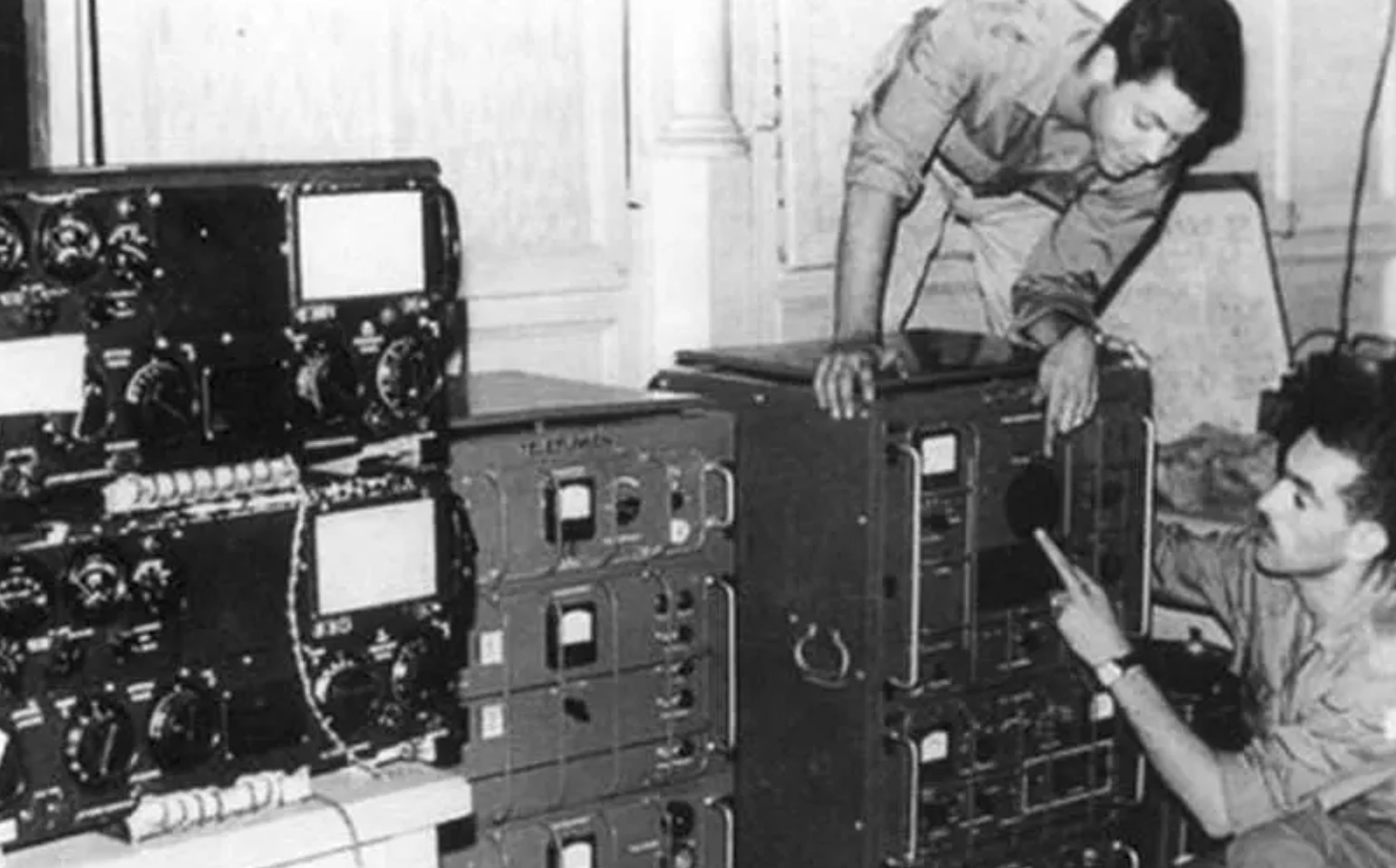 This article explores the historical importance of clandestine radio stations in Algeria's fight for independence. It discusses the power of radio as a tool for communication and public opinion shaping. The content delves into the impact of underground radio stations in times of crisis and their role in achieving power, revolution, independence, or democracy. The article reflects on the evolution of radio in Algeria throughout the 20th century and its adaptation to societal changes. It provides insights into the significant events witnessed by Algerian radio and the influence of clandestine broadcasting in the country's history.
 -
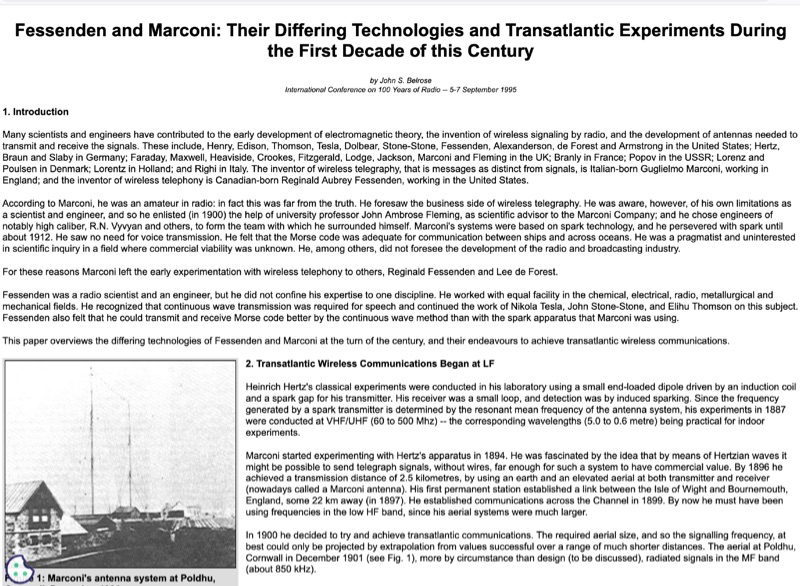 Early 20th-century transatlantic wireless communication efforts involved distinct technical approaches by Reginald Fessenden and Guglielmo Marconi. Marconi's systems, operational until approximately 1912, primarily utilized _spark technology_ for wireless telegraphy, facilitating Morse code communication between ships and across oceans. His Poldhu station in December 1901 radiated signals in the MF band around 850 kHz, later evolving to 272 kHz in October 1902, and eventually 45 kHz by late 1907 with increasingly larger antenna structures like the pyramidal monopole and capacitive top-loaded arrays. Fessenden, conversely, focused on _continuous wave transmission_ for wireless telephony, recognizing its necessity for speech. His transatlantic experiments in 1906 employed synchronous rotary-spark-gap transmitters and 420-foot umbrella top-loaded antennas at Brant Rock, MA, and Machrihanish, Scotland, tuned to approximately 80 kHz. Fessenden later utilized the _Alexanderson HF alternator_ at 75 kHz by late 1906 for pure CW transmission, integrating a carbon microphone for amplitude modulation. Receiver technology also differed, with Marconi initially relying on untuned coherer-type detectors, later developing the magnetic detector in 1902, while Fessenden's CW approach necessitated more advanced detection methods.
 -
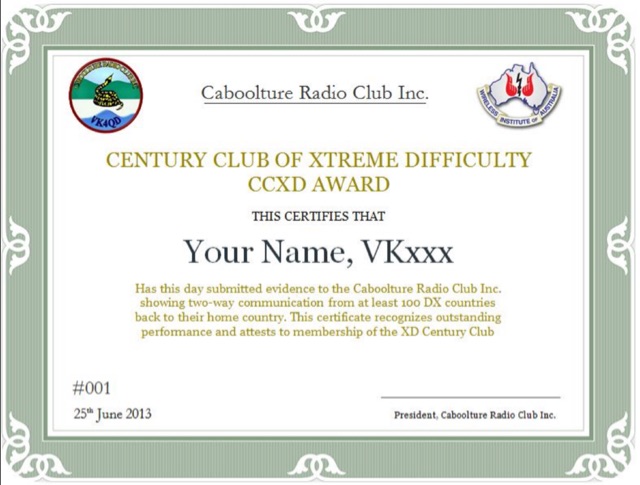 The CCXD Award (The Century Club of eXtreme difficulty is one of the most difficult awards to achieve. You are required to operate your home country from 100 DXCC countries. Founded in 2013, awards certificate is still awaiting presentation.