Search results
Query: university
Links: 50 | Categories: 2
-
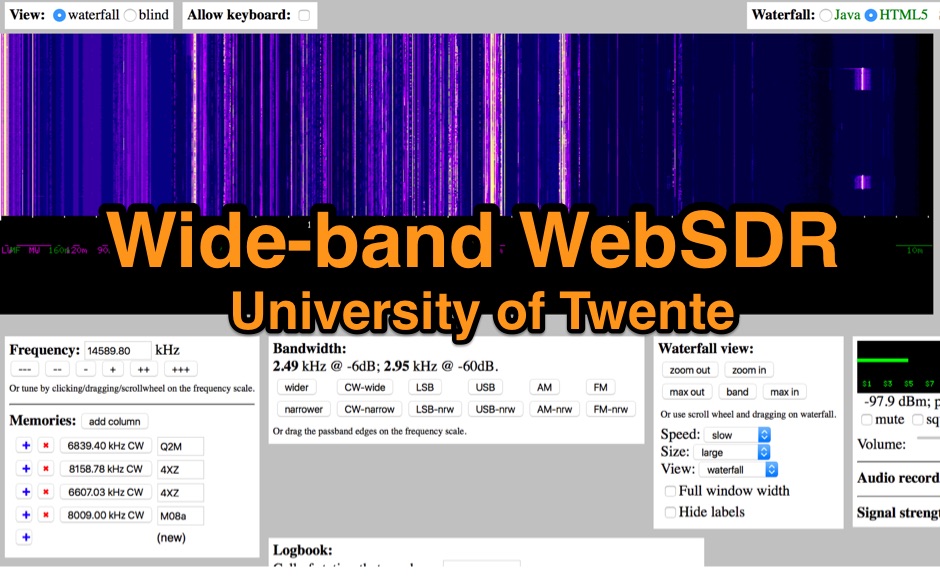 On this page you can listen to and control a short-wave receiver located at the amateur radio club ETGD at the University of Twente. In contrast to other web-controlled receivers, this receiver can be tuned by multiple users simultaneously, thanks to the use of Software-Defined Radio. Provided by PI4THT
 -
 Demonstrates _Freq51_ and _Specgrm2_, two analysis programs from the Biomedical Ultrasonics Laboratory at the University of Michigan, available for DOS or Linux. The _Spectrum Analyser (Freq51)_ provides power spectrum levels as a function of frequency, configurable for absolute values (e.g., dB re 1 volt) with sound card calibration. _Spectrogram (Specgrm2)_ generates a real-time, full-screen spectrogram (sonagram) with various color options. These programs analyze incoming signals in real time, not stored files, and offer extensive settings for sampling rate, FFT points, and averaging time, making them highly versatile for acoustic analysis. The DOS version of _Freq51_ and _Specgrm2_ can operate under Windows 95, requiring users to configure sound card switches via a text file. The resource also briefly mentions other acoustic analysis software like Gianni Pavan's DOS-based bioacoustic tools, _Gram_ by R.S. Horne for Windows, _SASLab_ (Light and Pro versions), _Cool Edit_, and _GoldWave_, providing a comparative overview of available tools for real-time and file-based spectral analysis and waveform manipulation.
 -
 University of Texas Amateur Radio Club RF-Calculator. This is a main beam power density estimation program intended for use as part of a routine evaluation of RF safety compliance with FCC regulations
 -
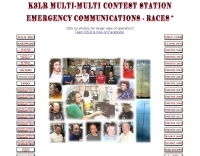 A web site dedicated to the K3LR contest station, a Multi Multi Station with 9 towers located in Western Pennsylvania. It provides information about the station components, antenna construction company, radio equipment used, and upcoming events like the Top Band Dinner at Dayton. The site also includes links to related resources like Contest University, Dayton Contest Dinner, and World Wide Radio Operators Foundation. The intended audience is amateur radio operators interested in contesting and DXing. The content is focused on promoting the K3LR station and sharing news and updates related to its activities.
 -
 This resource details the computer-optimized design of the _ZS6BKW_ multiband dipole, an evolution of the classic _G5RV_ antenna. It begins by referencing the original 1958 RSGB Bulletin article by Louis Varney G5RV, explaining the operational principles of the G5RV's flat-top and open-wire feedline on 20m and 40m, noting its impedance transformation characteristics for valve amplifiers of that era. The article then transitions to the rationale for optimizing the design for contemporary solid-state transceivers requiring a 50 Ohm match. The core of the project involves using computer modeling to determine optimal lengths for the flat-top and matching section, aiming for a VSWR of less than 2:1 on multiple HF bands. It discusses the process of calculating feedpoint impedance based on antenna length and frequency, referencing professional literature from Professor R.W.P. King at Harvard University. The analysis also considers the characteristic impedance (Z(O)) of the open-wire line, identifying a broad peak of adequate values between 275 and 400 Ohms. Specific design parameters for the improved ZS6BKW are presented, including a shorter flat-top and a longer matching section compared to the original G5RV, with a velocity factor of 0.85 for the 300 Ohm tape. The article confirms acceptable matches on 7, 14, 18, 24, and 28 MHz bands when erected horizontally at 13m, and also discusses performance in an inverted-V configuration, noting frequency shifts. The author, Brian Austin ZS6BKW, emphasizes the antenna's suitability for modern 50 Ohm coaxial cable without a balun.
 -
 Police and Security Broadcasts at Harvard University, Boston-Area University Police Radio. Cambridge; Boston.
 -
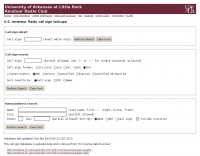 The U.S. Amateur Radio Callsign Lookup service, hosted by the University of Arkansas at Little Rock (UALR), offers a direct interface for querying the FCC's amateur radio license database. This resource is specifically designed for rapid retrieval of licensee information, including callsign, name, address, license class, and expiration date, all critical data points for QSLing and contact verification. The underlying database is refreshed daily, ensuring that the presented information reflects the most current FCC licensing records available. This service distinguishes itself by its direct reliance on official FCC data, processed and maintained by a university institution, which lends a degree of authoritative accuracy to its lookups. Users can input a specific callsign to instantly access detailed license particulars, facilitating efficient station identification and record-keeping for DXers and contesters alike. The daily update cycle minimizes discrepancies often found in less frequently synchronized callbook services. The UALR callsign lookup functions as a straightforward, no-frills utility, prioritizing data integrity and accessibility for the amateur radio community. Its operational simplicity and consistent data refresh schedule make it a reliable reference for verifying U.S. amateur radio licenses.
 -
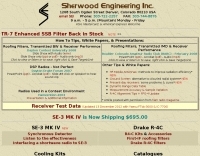 Sherwood Engineering Inc. (SEI) offers a repository of technical presentations and white papers focused on optimizing amateur radio transceiver and receiver performance. Content includes detailed analyses of _roofing filters_, transmitted IMD, and receiver characteristics, with specific discussions on products like the Drake R-4C and Icom IC-781. Presentations from events such as Dayton Contest University (2008-2014) cover topics like "How To Optimize Rig Performance," "Transceiver Performance: 10 Years of Change," and "Choosing a Transceiver: Far from Simple." Additional white papers address HF mobile antenna efficiency, ground screen alternatives to buried radial systems, and common receiver problems with solutions. The site also provides historical product information for items like the SE-3 MK IV synchronous AM detector and various 455 kHz mechanical and crystal filters, though many products are no longer in production. Receiver test data and alignment tips for the R-4C are also available, offering insights into rig modifications and performance enhancements.
 -
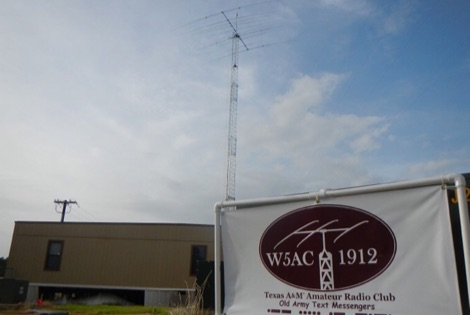 W5AC is the Texas A&M University Amateur or "Ham" Radio Club. This club, founded in 1912, is one of the oldest university radio clubs in existence.
 -
 Information about the AKAFUNK, our activities and our amateur radio station DK0SU
 -
 The California Polytechnic State University Amateur (Ham) Radio Club (CPARC) has a long tradition of communications service on campus and in the community of San Luis Obispo. The club was founded in 1947, making the Cal Poly Amateur Radio Club the second oldest club on campus
 -
 Over 45 years of dedicated work by Robert Sherwood, NC0B, culminated in a wealth of technical insights, particularly concerning **receiver performance** and the intricacies of transceiver design. The site provides access to numerous presentations from events like Dayton Contest University and W4DXCC, covering topics such as optimizing rig performance, the evolution of lab testing, and the impact of roofing filters on transmitted IMD and receiver characteristics. These resources offer detailed analyses and practical advice for serious operators and contesters. While product manufacturing, including the SE-3 MK IV synchronous detector and various Drake R-4C accessories like roofing filters and cooling kits, has ceased, the legacy of technical documentation remains. The site details specific products like the Icom IC-781 and R-9000, and offers insights into 455 kHz mechanical and crystal filters, along with DSP protection strategies. Crucially, the site features extensive receiver test data, allowing radio amateurs to compare the performance of various transceivers. This data, often presented in white papers and slide shows, includes detailed measurements and explanations of key performance metrics, serving as a valuable reference for understanding and selecting high-performance HF gear.
 -
 Radio astronomy research at the University of Calgary
 -
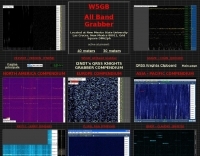 Observing extremely slow CW (QRSS) signals requires specialized reception and display techniques, often involving long-term signal integration to make faint traces visible. This resource compiles numerous screenshots from active QRSS grabbers globally, providing a visual record of signal propagation and operational activity on specific amateur bands. Each entry typically includes the callsign of the grabber station, its grid square, and often the band being monitored, such as 40 meters or 30 meters. The compendium presents a diverse array of grabber outputs, with examples from North America, Asia-Pacific, and Europe. Notable stations featured include _W5GB_ at New Mexico State University, _VE1VDM_ in Canada, and _I2NDT_ (the author's own grabber). The collection illustrates the unique visual signatures of QRSS transmissions, where signals appear as faint lines or patterns against a noise floor, often over extended periods. The utility of such a collection lies in its ability to demonstrate real-world QRSS signal characteristics and the geographical distribution of active grabber sites. It serves as a historical snapshot of QRSS activity, allowing operators to compare signal traces and observe propagation phenomena across different continents.
 -
 A recognized organization of Murray State University providing programs and activities that promote interest in Amateur Radio within the campus and community.
 -
 On-line resource that provides practical battery knowledge for engineers, educators, students and battery users alike. The papers address battery chemistries, best battery choices and ways to make your battery last longer.
 -
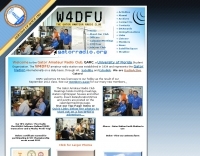 A University of Florida Student Organization. The W4DFU amateur radio station was established in 1934 and represents the Gator Nation internationally on a daily basis.
 -
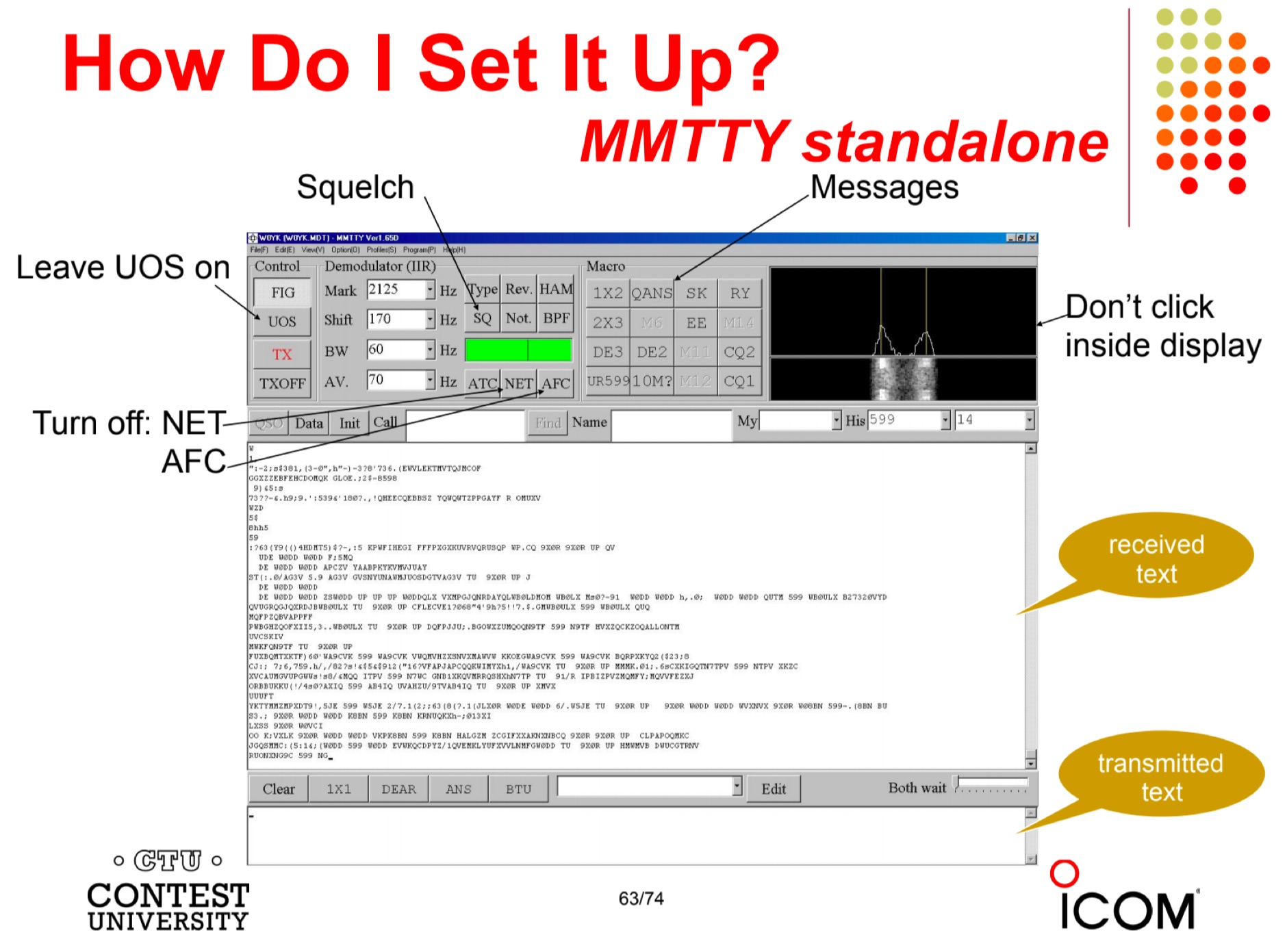 Getting started on RTTY contesting. A PDF by ED Muns, presented at CTU conterst university, about amateur radio RTTY Contesting
 -
 After a year of preparation, 150 students and 11 professors participated in 10 hours of intense Contesting instruction covering some 22 topics, with over 400 pages of text
 -
 NRAL at Jodrell Bank are a part of the University of Manchester's Department of Physics and Astronomy. The Laboratories are home to the Lovell Telescope and the MERLIN & VLBI National Facility which is operated by the University on behalf of PPARC.
 -
 Servicing the University Park campus of The Pennsylvania State University, and the Penn State Amateur Radio Club.
 -
 UTARC amateur radio club
 -
 The Auburn University ARC station gets its power from the sky
 -
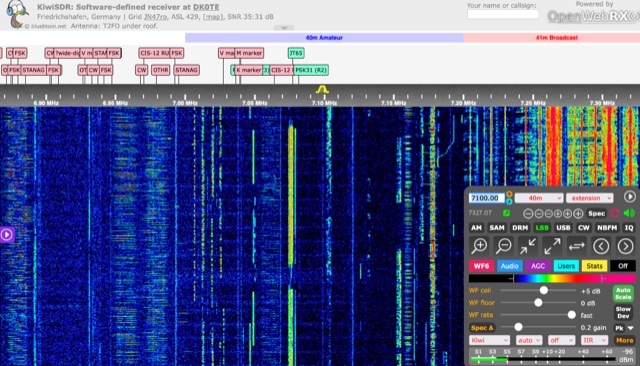 Online internet HF LW MF web receiver based in Baden-Wuerttemberg cooperative state university Ravensburg Campus Friedrichshafen running a T2FD antennan under roof.
 -
 The K9IU Indiana University amateur radio club provides a robust station environment for its members, located within the Indiana Memorial Union. This setup includes a variety of radio resources, making it accessible for students and faculty interested in two-way radio communication, from local ragchews to international DXing. The club's facilities are available for use at any time, fostering an active amateur radio community on campus. Members can engage in various aspects of the hobby, utilizing the club's equipment for operating on different bands and modes. This hands-on access supports learning and practical experience in radio theory and operation, which is crucial for new hams and seasoned operators alike. The K9IU club serves as a central point for amateur radio activities at Indiana University Bloomington, aligning with the university's broader academic and extracurricular offerings.
 -
 DK0TUI Radio Club Station at Technical University of Ilmenau Germany
 -
 The University of Texas Amateur Radio Club
 -
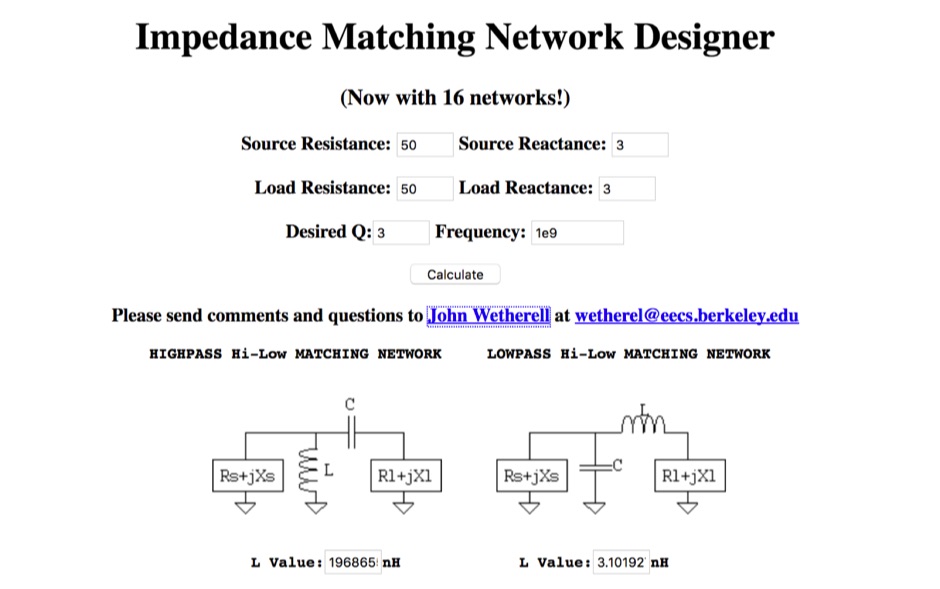 An online multiple calculator of 16 impedance matching networks
 -
 The Cambridge University Wireless Society (CUWS) serves as the amateur radio society for students and staff at Cambridge and Anglia Ruskin Universities, fostering interest and activity in two-way radio communication. It provides a platform for members to engage with various aspects of amateur radio, including operating, technical experimentation, and community building within the university environment. The society's activities typically encompass station operation, antenna construction, and participation in contests and DXing. As a university-affiliated club, CUWS offers practical experience in radio theory and application, often utilizing the club callsign _G6UW_. Members learn about different modes of operation, such as CW, SSB, and digital modes, and gain hands-on experience with transceivers and associated equipment. The society's focus includes preparing members for amateur radio licensing exams and promoting ethical operating practices. Participation in CUWS provides a foundation for future involvement in the broader amateur radio community.
 -
 A website for college and university amateur radio clubs to showcase themselves, work together, and promote amateur radio. Alumni and interested people can learn more about what college and university amateur radio clubs are doing.
 -
 Temple University Amateur Radio Club
 -
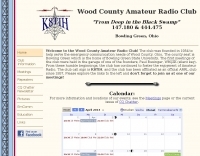 The club was founded in 1954 to help serve the emergency communication needs of Wood County, Ohio. The county seat is Bowling Green which is the home of Bowling Green State University.
 -
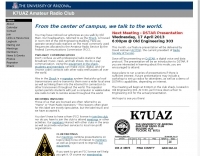 K7UAZ: The Amateur Radio Club at the University of Arizona
 -
 15 possible explanations for Long Delayed Echoes by University of Oslo
 -
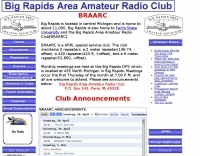 Big Rapids is located in central Michigan and is home to about 11,000. Big Rapids is also home to Ferris State University and the Big Rapids Area Amateur Radio Club
 -
 Students amateur radio club SPORADIC of Kursk's state technical university . In entire lifetime the radio station worked under the main calls: UA3KUO, UK3WAF, UZ3WWW, RW3WWW, and also used more than 60 calls in radio-expeditions(RC3W, R6SE, RP3W, RI1OP, RI1SI, R6SC). The chief of radio station since 1977 is Pikkiev Valery RW3WW.
 -
 The YM2XBU Bilkent University Amateur Radio Club website details the club's activities and operational focus within the amateur radio community. It serves as the primary online presence for the university's ham radio enthusiasts, showcasing their involvement in various aspects of the hobby. The site provides insights into the club's station setup, operational modes, and participation in local and international amateur radio events. Club members engage in DXing, contesting, and educational initiatives, fostering practical skills in radio communication and electronics. The _YM2XBU_ club callsign is actively used for on-air operations, contributing to the global amateur radio network. Information regarding membership, meeting schedules, and contact details for _Kagan SIRDAR_ are available, facilitating engagement for students and faculty interested in amateur radio.
 -
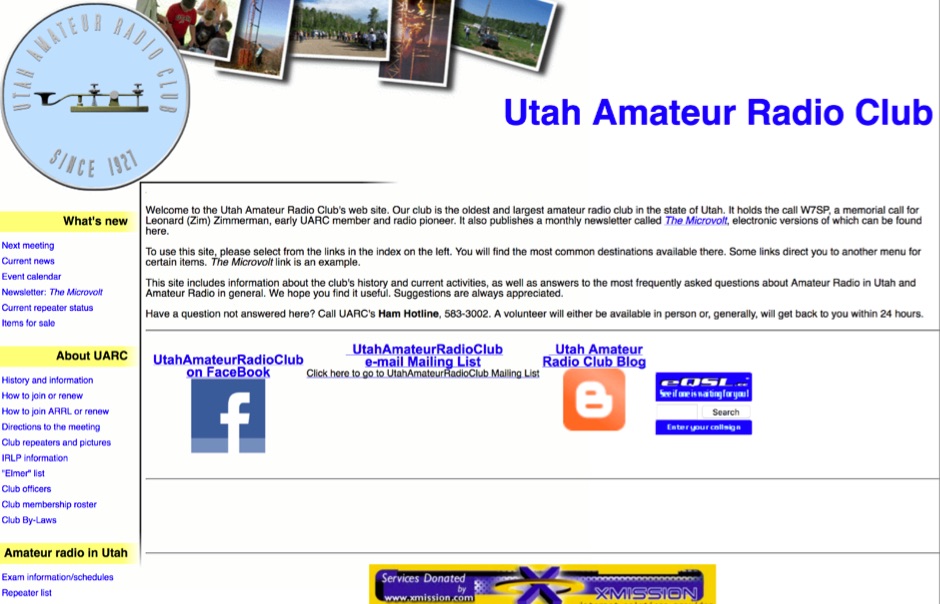 The Utah Amateur Radio Club (UARC), holding the callsign _W7SP_, provides a comprehensive resource for amateur radio operators, particularly within Utah. It details club activities such as Field Day, Winter Field Day, and annual social events like the Steak Fry and Christmas Dinner. The site also lists club resources including repeaters, _IRLP_ information, HF remotes, and a lending library. Information on becoming a ham, exam schedules, and a local repeater list are also available, catering to both new and experienced operators in the region. UARC hosts regular meetings on the second Thursday of each month, excluding July and August, at the University of Utah's Warnock Engineering Building, with presentations on topics like weather and _Skywarn_. The club publishes the monthly _Microvolt_ newsletter and maintains a YouTube channel for meeting playback. Additionally, UARC offers a Ham Hotline for questions and provides access to an "Elmer" list for mentorship, supporting the local amateur radio community.
 -
 University of Bristol Amateur Radio Society
 -
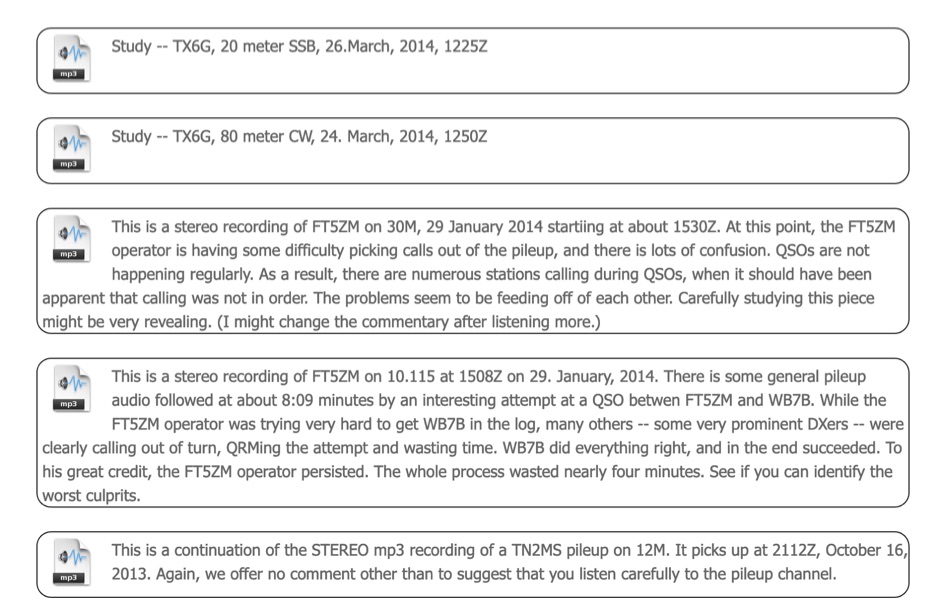 A collection of audio recordings of some DX Peditions used as case studies to evaluate dxspedition operatios behaviour and calling stations. These audio files are excerpts from real pileups recorded directly off the air in MP3 format
 -
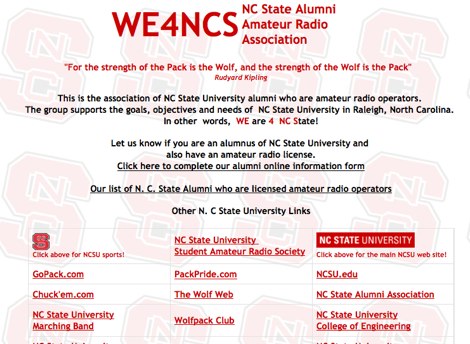 Association of NC State University alumni who are amateur radio operators.
 -
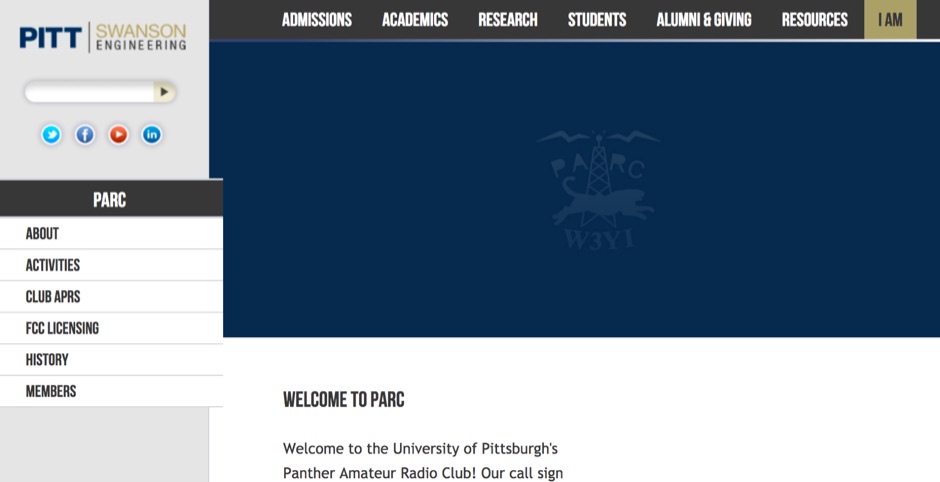 The Panther Amateur Radio Club is the student run radio club on Pitt's campus. The club's repeater sits 535 feet above the campus on top of the Cathedral of Learning.
 -
 Eaton provides a comprehensive suite of power quality solutions, ranging from compact single-phase isolation units to high-capacity megawatt sag correction systems. The resource details Eaton's engineering expertise in addressing diverse power quality challenges, emphasizing the distinction between DC resistance and apparent AC resistance under heavy current loads within AC power distribution systems. Specific **Marine-Grade surge protective solutions (SPD)** are highlighted, designed to safeguard critical safety and navigation equipment on vessels and rigs against unpredictable power transients in harsh environmental conditions. The company's commitment extends to providing appropriate solutions for critical power systems, ensuring quality installation. The site also features customer testimonials from entities like Federal Express, Kutztown University, J. C. Penney, and Fairchild Aircraft, attesting to the effectiveness of products such as 'The Protector' in preventing equipment damage and downtime.
 -
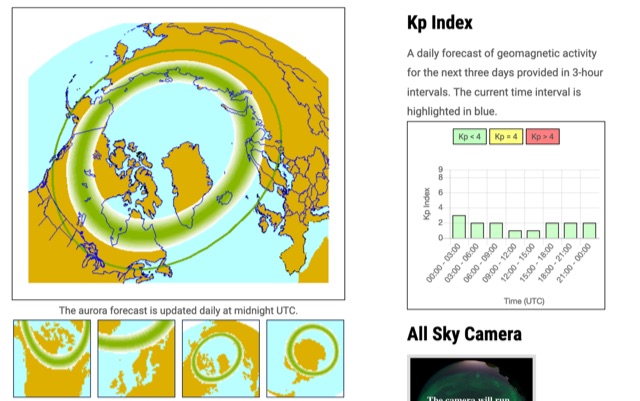 Aurora forecast is updated daily at midnight UTC includes Kp Index forecast for next 3 days
 -
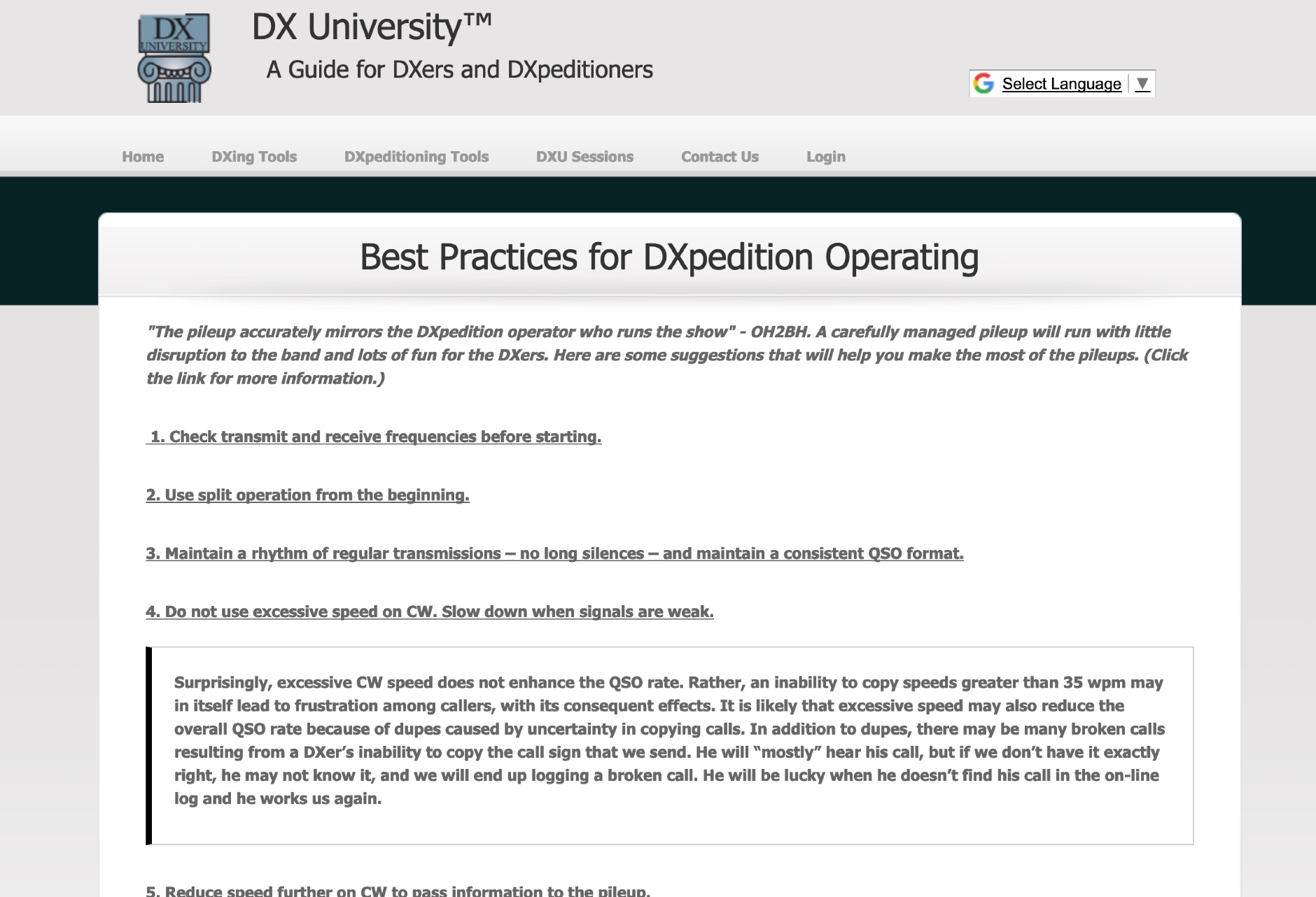 DX University publishes an operating guide for DXPeditions with 13 hints and tips on managing pileup
 -
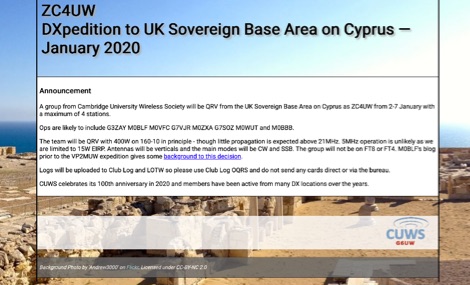 A group from Cambridge University Wireless Society will be QRV from the UK Sovereign Base Area on Cyprus as ZC4UW from 2-7 January 2020 with a maximum of 4 stations.
 -
 A free educational website offering hands-on battery information. The tutorials evaluate the advantages and limitations of diverse battery chemistries, advise on best choices, and suggest ways to extend life.
 -
 The **CubeSat** standard, developed by California Polytechnic State University (Cal Poly) and Stanford University, facilitates frequent and affordable access to space for small satellites. This resource serves as a central hub for the CubeSat community, offering a comprehensive directory of active and past CubeSat projects, technical specifications, and educational materials. It details the standardized dimensions and mass constraints for these pico-satellites, which typically range from 1U (10x10x10 cm, 1.33 kg) to 12U configurations, enabling their deployment as secondary payloads on various launch vehicles. The site also provides insights into mission planning, component selection, and regulatory considerations for amateur radio satellite operations. Operators and developers can utilize the project directory to research existing CubeSat missions, understand their communication protocols, and identify potential collaboration opportunities. The platform's forum section allows for direct engagement with other enthusiasts and experts, fostering knowledge exchange on topics such as **AMSAT** frequency coordination, telemetry decoding, and ground station setup. This collaborative environment supports the development of new CubeSat projects, promoting innovation in amateur radio satellite communication and space exploration.