Understanding Long-Delayed Echoes (LDE) Phenomena
Learn about the theories, reports, and scientific explanations behind radio signals that return to the sender after several seconds.

Long-delayed echoes (LDEs) are a perplexing phenomenon in radio propagation, characterized by radio signals returning to the sender several seconds after their initial transmission. Unlike typical short-path or long-path echoes, LDEs exhibit delays that cannot be readily explained by conventional ionospheric or terrestrial reflection mechanisms. This unusual behavior has intrigued radio amateurs and scientists for decades, prompting various theories and extensive observational studies to understand the underlying physical processes responsible for these delayed returns.
Resources in this category delve into the various hypotheses proposed to explain LDEs, ranging from magnetospheric ducting and plasma effects to more exotic explanations involving lunar reflections or even extraterrestrial origins. These materials provide access to research papers, observational reports, and theoretical models that analyze the characteristics of LDEs, their reported occurrences, and potential mechanisms such as ionospheric focusing or complex wave interactions. They are valuable for those seeking to understand the scientific discourse and ongoing investigations into this enigmatic aspect of radio wave propagation.
-
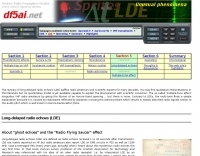 LDE articles and reports about long delayes radio echoes by DF5AI
 -
 15 possible explanations for Long Delayed Echoes by University of Oslo
 -
 Long delayes radio echoes reports
 -
 Long-delayed echoes are radio echoes which return to the sender several seconds after transmission.
 -
 LA3ZA on magnetospheric ducting as an explanation for delayed signals on 3.5 MHz
 -
 The Five Most Likely Explanations for Long Delayed Echoes
 -
 This page has a collection of audio samples from unusual HF propagation phenomena, from round-the-world propagation to moonbounced signals , and to ducted transmission.