Search results
Query: data radio
Links: 458 | Categories: 18
Categories
- Technical Reference > Components > Component Database
- Ham Radio > Regional > Brazil
- DX Resources > Callsigns
- Technical Reference > Coax Cables and Connectors
- Technical Reference > Components
- DX Resources > Contest > Contest Results
- Operating Modes > D-STAR
- Operating Aids > Grid Squares
- Operating Aids > Log Formats
- DX Resources > Logs Search Services
- Propagation > MUF Indicators
- Operating Modes > NBEMS
- Propagation > Observatories
- Propagation > Propagation Forecast
- DX Resources > QSL manager
- Technical Reference > Repeater
- Operating Modes > System Fusion
- Technical Reference > Vacuum tube
-
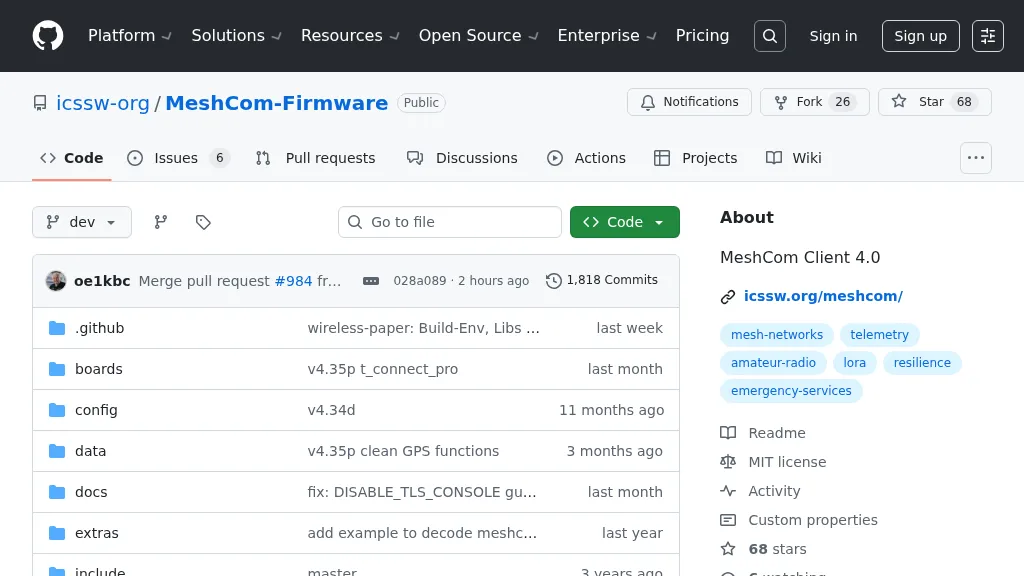 For amateur radio operators seeking resilient, off-grid communication, the _MeshCom_ firmware provides a robust solution for text-based messaging over a mesh network. Utilizing LoRa modulation and the APRS protocol, this firmware is designed for low-energy consumption and cost-effective hardware, primarily operating in the 70cm band. Nodes, identified by amateur radio callsigns, can send short text messages to all participants or directly to specific callsigns, functioning as repeaters to extend network reach. The system supports automatic status and position messages, with optional sensor data for WX-Data and Telemetry. MeshCom nodes can be configured as gateways to HAMNET or the internet, enhancing connectivity options. The project emphasizes a self-building and self-healing mesh network architecture, crucial for emergency communication scenarios. Operating frequencies include **433.175 MHz** (EU, USA, Africa), 439.9125 MHz (UK), and 433.925 MHz (Norway). The firmware is compatible with hardware platforms such as ESP32/LoRa modules, RAK-WISBLOCK, and ESP32-DEV4/E22-LoRa, offering a flexible deployment for various amateur radio applications.
-
 The Yaesu FTDX-10 transceiver features a hybrid receiver design, integrating a dual superheterodyne front end with an SDR chip for advanced DSP. This architecture aims to mitigate front-end overload, a critical consideration for HF operations. Performance data indicates a Reciprocal Mixing Dynamic Range (RMDR) that places the FTDX-10 at number two on Sherwood Engineering's ranking, highlighting its strong signal handling capabilities. The unit includes a 5-inch TFT touch screen and an internal antenna tuner effective up to 3:1 SWR, covering receiver frequencies from 30 kHz to 75 MHz. Operational aspects include a spectrum scope with 2D and 3DSS display modes, offering adjustable frequency spans from 1 kHz to 1000 kHz and five waterfall speeds. The review evaluates the efficacy of the noise blanker and Digital Noise Reduction (DNR) functions, essential for mitigating interference in various operating environments. Connectivity is supported via USB drivers for N1MM and HRD software, alongside DVI output for external display mirroring. The Multi-Purpose VFO Outer Dial (MPVD) enhances user interaction. The FTDX-10's design and features cater to serious amateur radio operators seeking high performance in a compact HF/50 MHz platform.
-
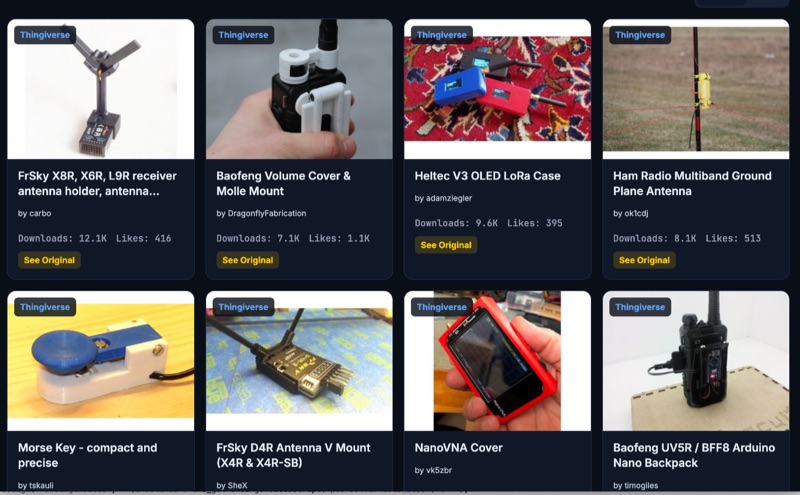 The resource provides a curated database of free **STL files** for amateur radio 3D printing, sourced from platforms such as Printables, Thingiverse, and Cults3D. This collection includes designs for antenna winders, EFHW transformer enclosures, HT and Baofeng accessories, key bases, Meshtastic cases, and POTA/SOTA field gear. The database is updated every six hours, ensuring access to current designs. Each entry specifies the original source platform, download count, and applicable license type (CC0, CC-BY, CC-BY-NC), with clear guidelines for attribution and commercial use. Additionally, a comprehensive filament guide details material properties crucial for ham radio applications. For instance, ASA offers 248°F (120°C) heat resistance and excellent UV stability, making it suitable for outdoor antenna components. ASA-GF provides enhanced stiffness while retaining RF transparency, beneficial for structural parts near feedlines. The guide addresses material selection for specific uses, such as antenna winders and transformer enclosures operating with 100W FT8 transmissions, highlighting the importance of heat deflection temperature (HDT) and UV resistance to prevent warping in hot environments like vehicle trunks. It explicitly warns against carbon fiber (CF) filaments due to their electrical conductivity, which attenuates RF signals, recommending glass fiber (GF) variants for RF-transparent structural components.
-
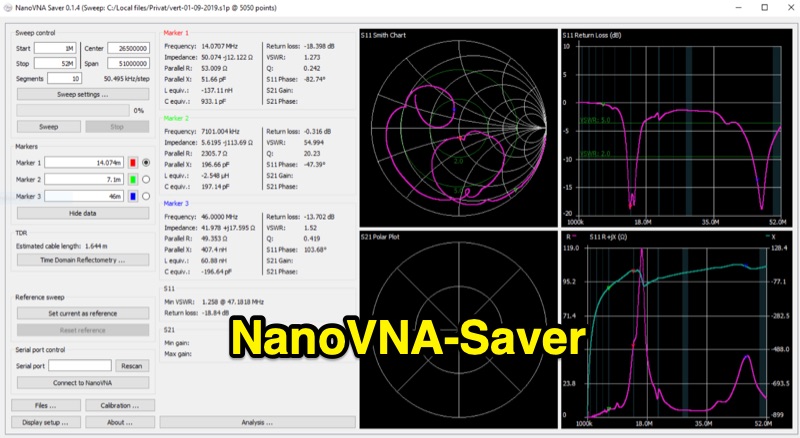 Facilitates interfacing with various NanoVNA models, including NanoVNA-H, NanoVNA-H4, NanoVNA-F, AVNA, and LiteVNA, to extract and display measurement data on a computer. The application supports splitting frequency ranges into multiple segments, increasing resolution beyond the standard 101 data points, with reported tests achieving up to 10,000 points for detailed analysis. Data averaging is also implemented to improve measurement accuracy, particularly beneficial at higher frequencies where noise can be more prevalent. Displays data across several chart types, such as Smith, LogMag, Phase, and VSWR charts, for both S11 and S21 parameters. Markers provide specific readouts for impedance, VSWR, Q factor, and equivalent capacitance or inductance at selected frequency points. Users can define and display customizable frequency bands as reference overlays on the charts. Developed in Python 3 (specifically >=3.10), the software leverages pyside6 for its graphical user interface, numpy for numerical operations, and scipy for scientific computing. This robust framework ensures stable performance and accurate data processing for amateur radio operators and electronics enthusiasts performing antenna and circuit characterization.
-
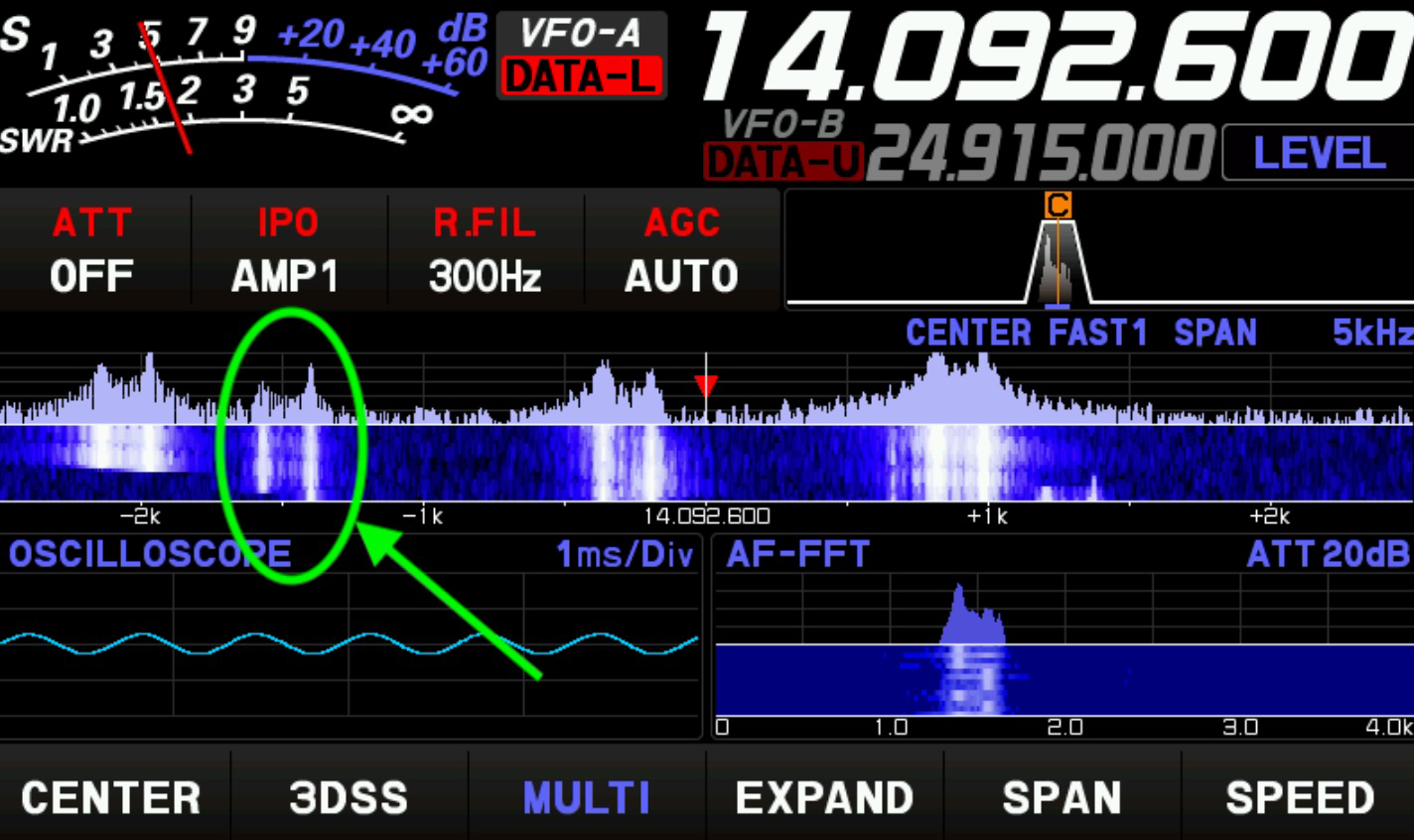 Setting up a digital mode station for Radioteletype (RTTY) contesting requires careful integration of transceiver and logging software. This guide outlines the specific configuration for a Yaesu FTDX10 and N1MM Logger, focusing on settings relevant for the 2025 CQ WW RTTY contest. It covers digital mode setup within N1MM, mode control, and RTTY-specific parameters, including the use of the FTDX10's DATA-L or RTTY-L modes. Operational guidance includes leveraging the 300Hz CW roofing filter for enhanced adjacent signal rejection and proper MMTTY window resizing to ensure accurate FFT and XYScope displays. The author notes a consistent received signal offset of -1.5 kHz from the VFO frequency during operation. Specific software versions used are N1MM V1.0.10936.0, MMTTY 1.70, and various FTDX10 firmware versions. The document also mentions an unsuccessful attempt to integrate a WinKeyer USB (WKSMT, firmware 31.03) for FSK waveform generation, where N1MM could key the radio and 100W was measured, but no tones were observed on the FTDX10's scope displays.
-
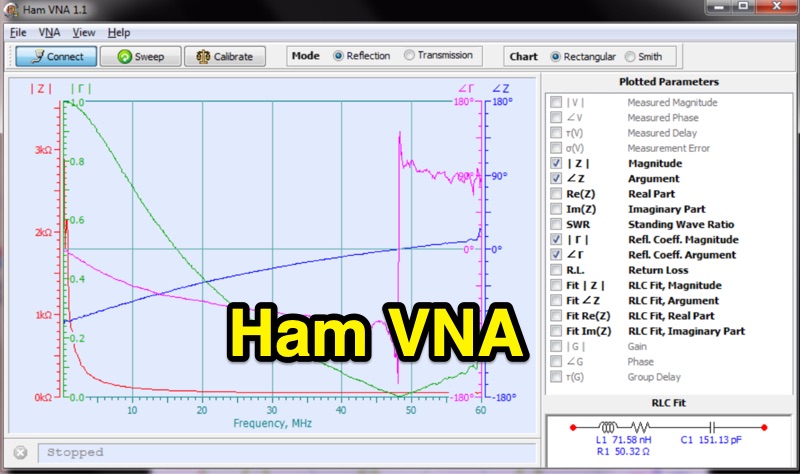 HamVNA presents an alternative Vector Network Analyzer (VNA) software tailored for the Hermes SDR RX/TX board, enhancing its utility for analyzing antenna systems and radio circuits. The software processes measurement data from two distinct sources: direct acquisition via the Hermes hardware, leveraging fixtures like Sam Wetterlin's Series Fixture or reflection bridge, or by importing existing TouchStone format files (*.s1p, *.s2p) from other VNA hardware. It operates on Win2000/WinXP/Vista/Win7 platforms, supporting both 32 and 64-bit architectures. The program incorporates standard Open-Short-Load calibration for reflection mode and Short Circuit calibration for transmission mode, with the capability to save and reload calibration data. A key distinguishing feature is its RLC Fit function, which automatically generates an equivalent RLC circuit matching the impedance-vs-frequency curve of the Device Under Test (DUT), a capability noted as unique among VNA software. This function allows control over circuit complexity via an 'Order' slider. HamVNA also supports remote calibration, enabling the removal of coaxial cable effects from measurements for clearer analysis, as demonstrated with an 80m vertical antenna example. The software is an open-source project, distributed under the MPL v.2.0 license, with both the installation package and source code available for download.
-
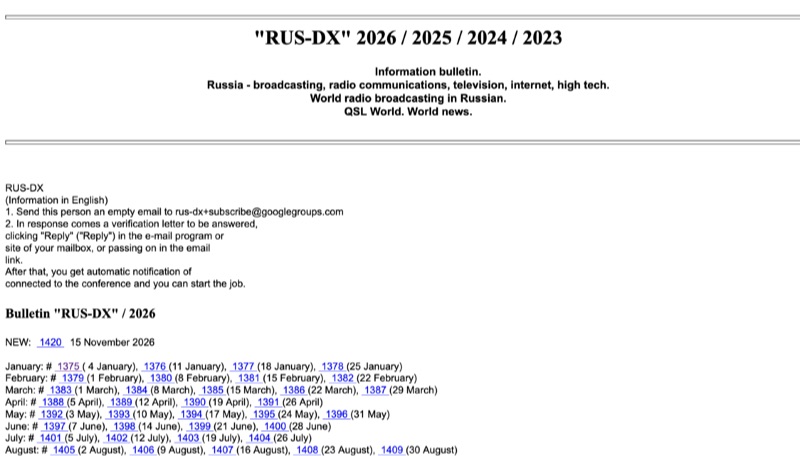 Accessing the RUS-DX PLUS Bulletin reveals a landing page that serves as a gateway to both Russian and English versions of the bulletin. This resource primarily functions as a newsletter, disseminating updates relevant to the amateur radio community. It focuses on general ham radio topics and DX-related activities, rather than specific technical measurements, equipment modifications, or detailed schematics. The content is presented in a textual format, offering news and announcements without performance data or software downloads. The bulletin acts as a communication channel for general amateur radio interest, without specifying particular operating modes like **FT8** or **CW**, or frequency bands such as 20 meters or 40 meters. The information is structured as a collection of articles or announcements, providing a concise overview of current events and interests within the ham radio world.
-
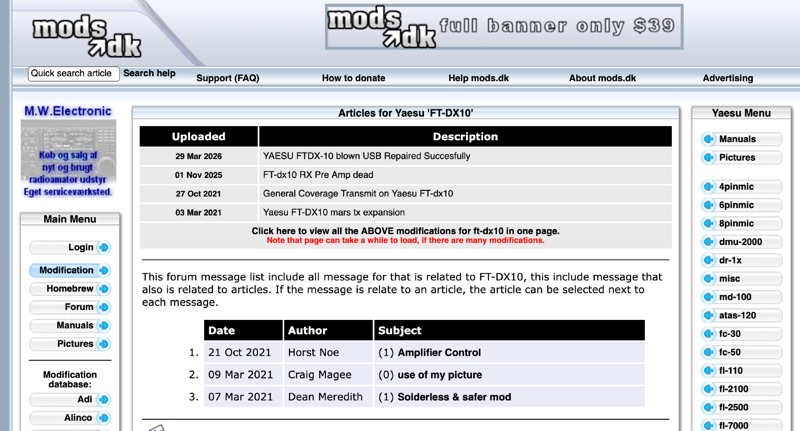 The Yaesu FT-DX10 Transceiver Modifications and Repair Database compiles technical articles and user-contributed messages specifically for the FT-DX10 HF transceiver. It features documented procedures such as "YAESU FTDX-10 blown USB Repaired Succesfully" and an entry detailing a "FT-dx10 RX Pre Amp dead" issue. The resource also includes instructions for "General Coverage Transmit on Yaesu FT-dx10" and "Yaesu FT-DX10 mars tx expansion," providing specific adjustments for the radio's operational parameters. This platform organizes content to allow viewing all modifications for the FT-DX10 on a single page, streamlining access to various technical adjustments. Users can find discussions on topics like amplifier control and solderless modifications, offering practical insights from the amateur radio community. The database serves as a central point for operators seeking to enhance or repair their FT-DX10 units. Each entry is dated, with examples like a March 2026 article on USB repair and a November 2025 entry concerning the RX pre-amplifier. The site also facilitates user interaction through a message board, where operators can post comments or new modification ideas not yet documented.