Maximum Usable Frequency (MUF) for Ham Radio
Access real-time and historical data for Maximum Usable Frequency (MUF) to optimize your HF radio propagation predictions and operations.

Understanding and predicting radio wave propagation is fundamental for effective amateur radio communication, particularly on HF bands. Maximum Usable Frequency (MUF) indicators are crucial tools that assist operators in determining the highest frequency that will support skywave propagation between two points via the ionosphere. These resources provide essential insights into current and forecasted ionospheric conditions, which directly influence signal paths and reliability for long-distance contacts, enabling more effective communication planning.
Resources within this category typically include real-time maps, charts, and dashboards that display MUF values, critical frequencies, and optimal working frequencies for various regions. These online tools often leverage data from ionosondes and other atmospheric sensors to generate dynamic visualizations of ionospheric layers, such as the F2-layer. Operators utilize these indicators to make informed decisions about band selection, optimizing their chances for successful DX operations and NVIS (Near Vertical Incidence Skywave) communications by identifying favorable propagation windows and enhancing overall operational efficiency.
-
 The website offers a comprehensive guide on high-frequency (HF) skywave propagation for amateur radio operators. It explains HF radio propagation fundamentals, including electromagnetic wave properties, HF bands, and propagation modes like skywave, ground wave, and line-of-sight. The site focuses on the ionosphere's critical role, influenced by solar activity, in refracting HF waves for long-distance communication. Real-time monitoring tools such as DX clusters, beacons, and digital modes like FT8 assist users in tracking band activity and propagation conditions globally. Forecasting methods are detailed, highlighting scientific insights into solar-terrestrial interactions and ionospheric variability. The guide also covers advanced topics like NVIS and gray line propagation, ionosonde data, and propagation prediction models, making it a valuable resource for ham radio enthusiasts aiming to optimize communications
 -
 Optimal Working Frequencies (MHz) for High Frequency (HF) / Shortwave Radio. By region, updated monthy.
 -
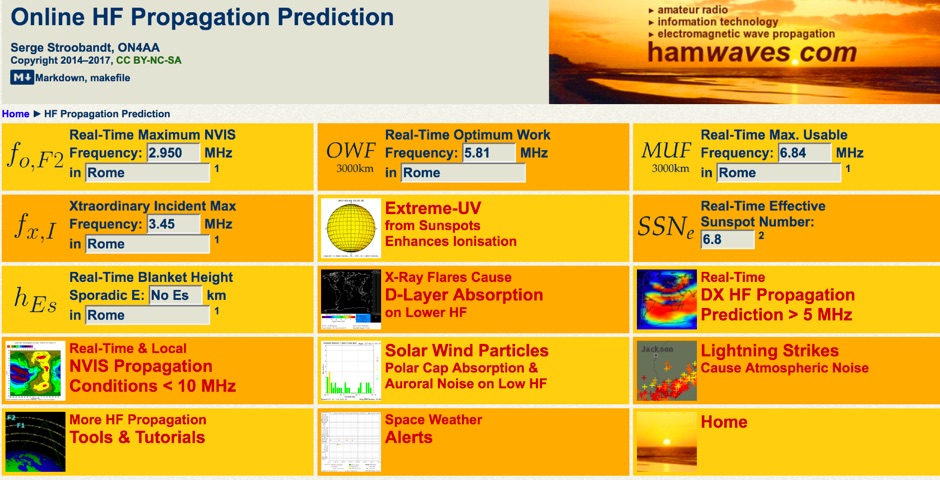 Real-time dashboard with 3000km optimal working & maximum usable frequency as well as maximum NVIS frequency; all for your internet access location.
 -
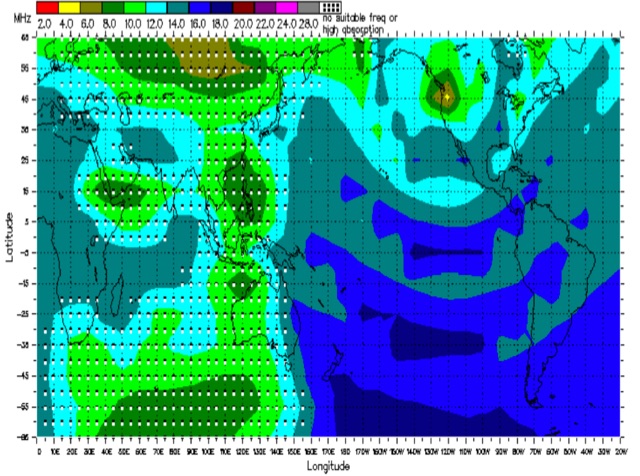 This paper presents the method of calculating the maximum usable frequency (MUF) and field strength of radio waves reflecting 2 times at the F2 ionosphere layer under inhomogeneous conditions of the ionosphere. The comparison between predicted and measured MUF has shown that the proposed method significantly increases the accuracy of calculation MUF.
 -
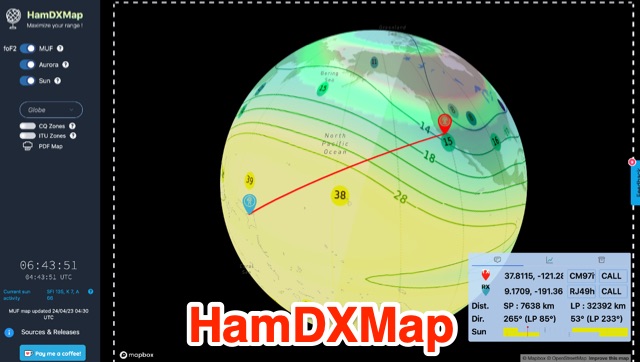 This dynamic DX Map aggregates various resources that will help radio amateurs to operate their stations in search of long distance contacts, DX. HamDXMap displays current MUF values and foF2 critical frequency values around the globe.
 -
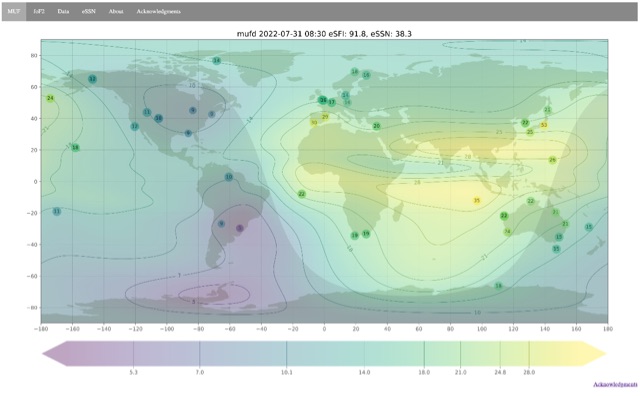 Ionospheric propagation maps MUF and critical frequency
 -
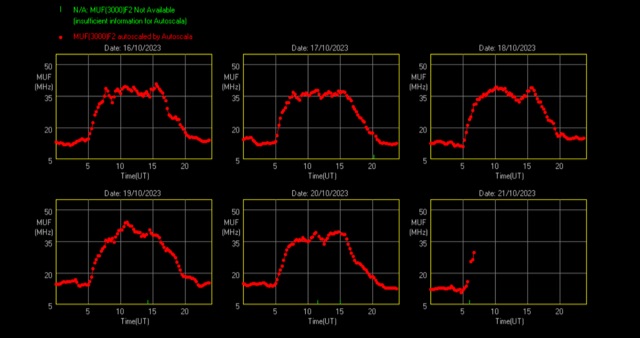 This page reports the last six daily MUF(3000)F2 plots recorded at Rome observatory by the AIS-INGV ionosonde. Provided Istituto Nazionale di Geofisica e Vulcanologia (INGV) Italy.
 -
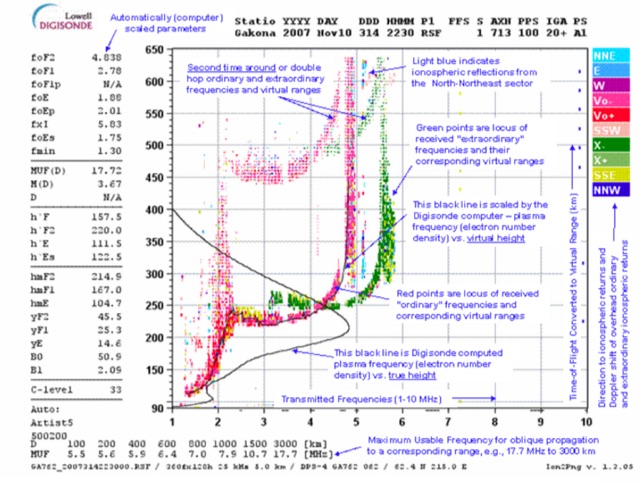 This page displays the current ionogram and tries to determine the nearest digisonde report to your location. Data coming from this sondes are used to determine the MUF for oblique propagation on HF spectrum