NVIS Propagation: Understanding Skywave Communication
Mastering Near Vertical Incidence Skywave

Near Vertical Incidence Skywave (NVIS) propagation is a crucial technique for amateur radio operators, particularly on the HF bands. This method allows for reliable communication over short distances, making it ideal in terrains with obstacles. NVIS utilizes high-angle radiation to reflect radio waves off the ionosphere, enabling operators to establish contacts within a 300-mile radius. Understanding the principles of NVIS is essential for optimizing antenna design and operational strategies, particularly in emergency communications and local events.
Key concepts in NVIS propagation include ionospheric reflection, line of sight, and surface wave propagation. Resources such as the ARRL Antenna Book and military manuals provide comprehensive insights into NVIS techniques. Additionally, propagation maps and indices can assist operators in predicting effective communication windows, enhancing overall operational efficiency.
Related Categories
-
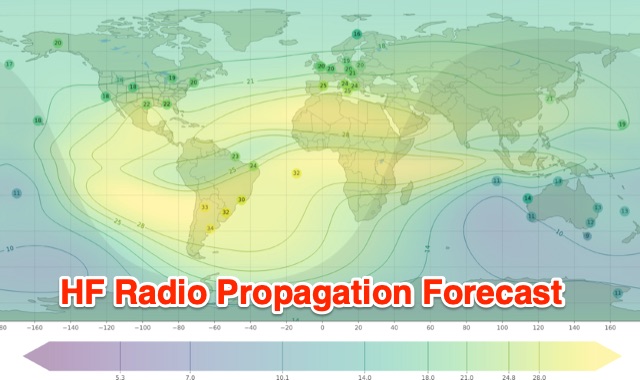 The website offers a comprehensive guide on high-frequency (HF) skywave propagation for amateur radio operators. It explains HF radio propagation fundamentals, including electromagnetic wave properties, HF bands, and propagation modes like skywave, ground wave, and line-of-sight. The site focuses on the ionosphere's critical role, influenced by solar activity, in refracting HF waves for long-distance communication. Real-time monitoring tools such as DX clusters, beacons, and digital modes like FT8 assist users in tracking band activity and propagation conditions globally. Forecasting methods are detailed, highlighting scientific insights into solar-terrestrial interactions and ionospheric variability. The guide also covers advanced topics like NVIS and gray line propagation, ionosonde data, and propagation prediction models, making it a valuable resource for ham radio enthusiasts aiming to optimize communications
 -
 NVIS definition at Wikipedia
 -
 Kingston Amateur Radio Club Articles Dave Lawrence, VA3ORP
 -
 Army Field Manual 24-18 Appendix M with Graphics
 -
 Maps and propagation indices
 -
 Understanding Amateur Radio NVIS Antennas and Propagation, derived from The ARRL Antenna Book and QST Articles
 -
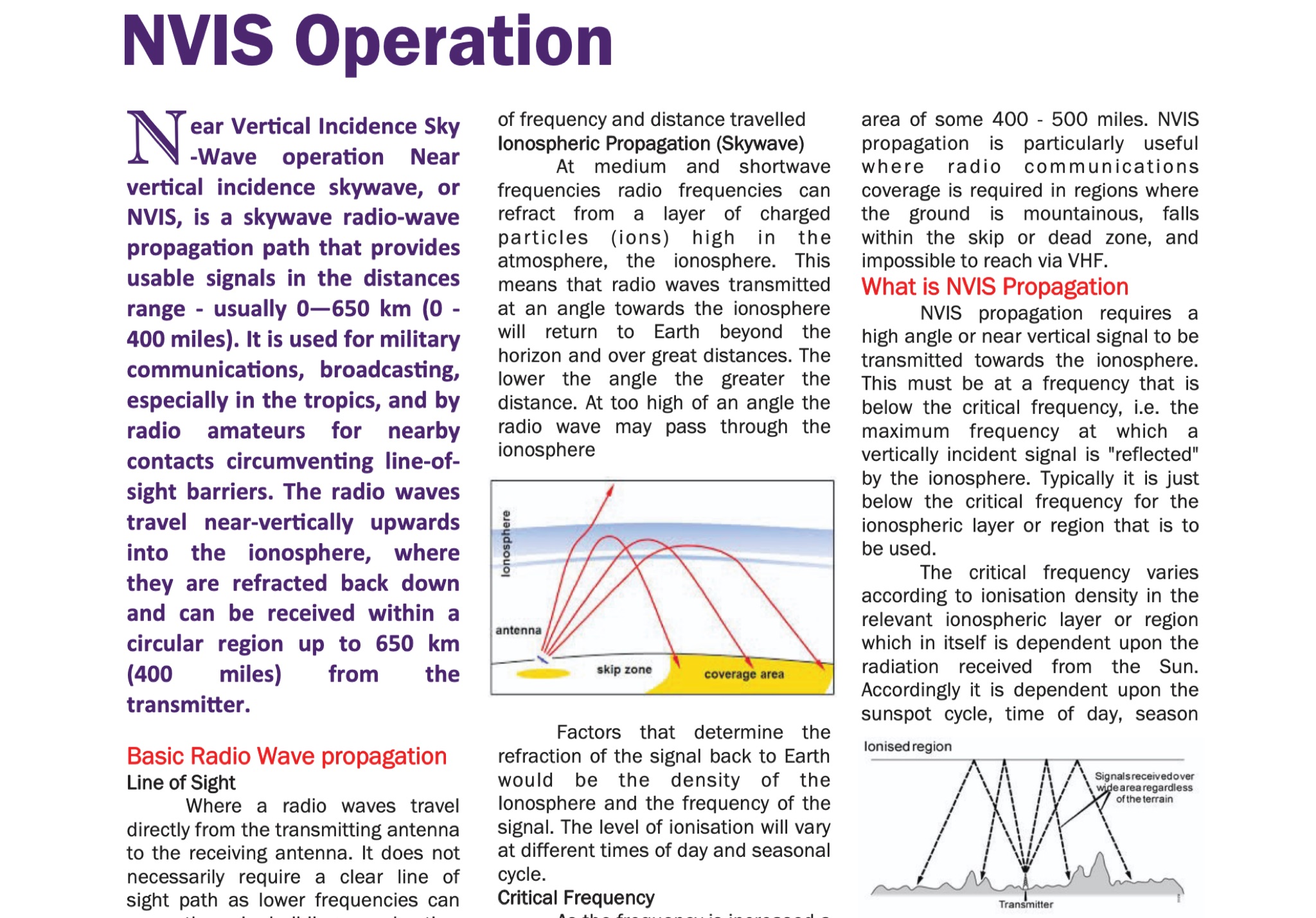 The document provides fundamental information on radio wave propagation and NVIS communication, covering line of sight, surface waves, and ionospheric reflection.<p> It focuses on the Near Vertical Incidence Skywave (NVIS) method for reliable coverage in mountainous or skip zones, especially for regional and emergency communications.
 -
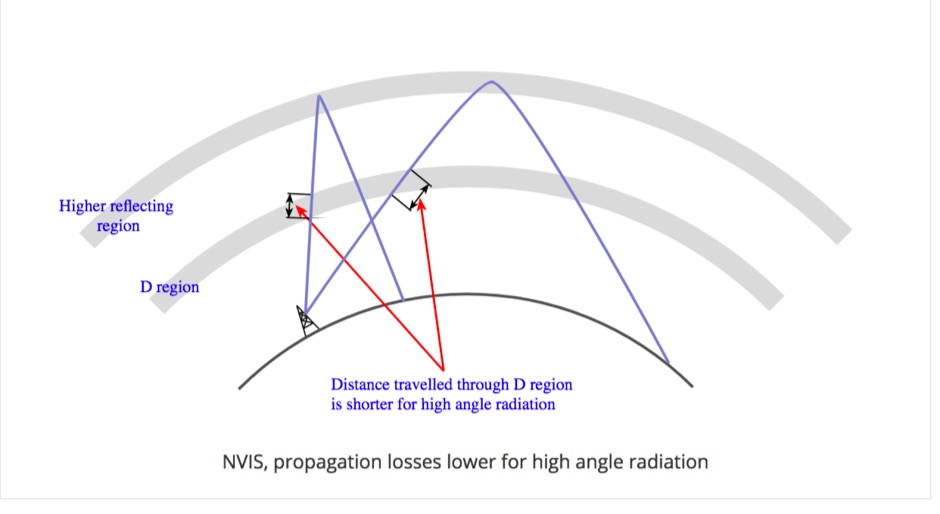 Near Vertical Incidence Skywave propagation is a form of radio wave propagation used on the MF and HF bands to provide radio communications and broadcasting coverage over short distances, especially where the terrain contains obstacles.