Understanding Sporadic E Propagation in Amateur Radio
Learn how Sporadic E propagation affects VHF bands, enabling long-distance contacts and unexpected openings for ham radio enthusiasts.

Sporadic E refers to a form of radio propagation that occurs when patches of unusually dense ionization form in the E-layer of the ionosphere, typically at altitudes between 90 and 120 kilometers. These ionized clouds can reflect radio signals, enabling communication over distances far exceeding normal line-of-sight or tropospheric propagation, particularly on VHF bands. This phenomenon is characterized by its sudden appearance and disappearance, often leading to unexpected openings for DX communication.
Resources in this category provide insights into the mechanisms and characteristics of Sporadic E propagation, including scientific explanations and observational data. Operators can find tools for real-time monitoring of E-skip events, such as maps indicating cloud locations and estimated Maximum Usable Frequencies (MUF), alongside alert systems for detecting openings. The collection also includes articles and studies detailing operational experiences and technical analyses of this propagation mode across various amateur radio bands, aiding in understanding and predicting its occurrences for effective DXing.
-
 Automatic 144MHz E-skip Alerts for North America
 -
 Sound clips and notes on sporadic E on four meter band
 -
 Amateur radio propagation studies (science, research, engineering, operating) and the BeamFinder propagation analysis software
 -
 2 Meter Es spots detected by the DXrobot
 -
 Automatic 144MHz E-skip Warnings via Email for European Region
 -
 About Sporadic E propagation at wikipedia
 -
 Sporadic-E clouds location and estimated MUF real time map
 -
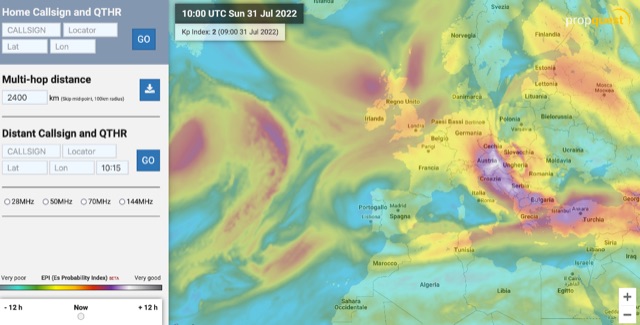 The map display allows you to select by locator, or clicking on the map, where you want to calculate the probability of Sporadic-E by building a combination EPI, Es Probability Index, based on factors using many of the known parameters which can effect Es. T
 -
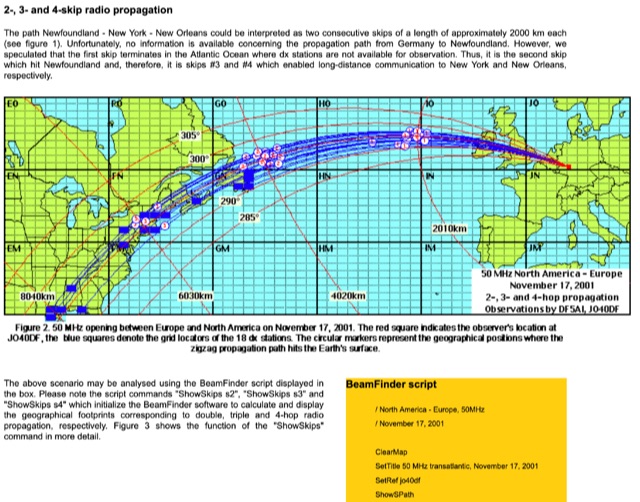 Thunderstorm effects on sporadic E propagation, Very long distance propagation in the 144 MHz band, Analysing the number of skips in multiple hop propagation
 -
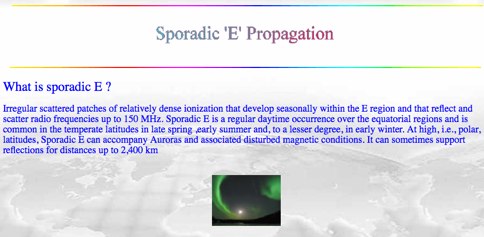 Sporadic E is a form of propagation that can arise with little warning, and enable radio frequencies of 150 MHz and more to travel over distances of a thousand kilometres and more.
 -
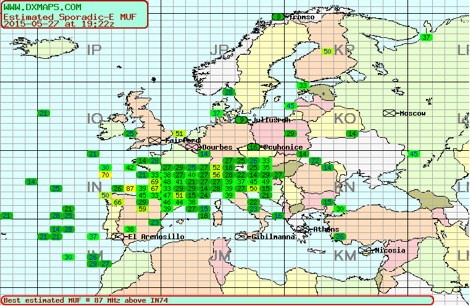 Sporadic-E clouds location and estimated MUF real time map by DXMAPS
 -
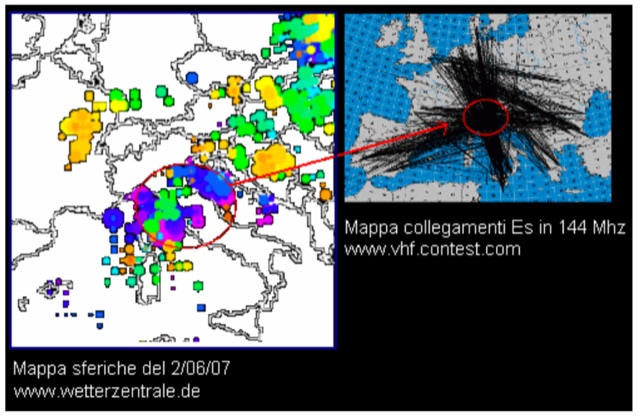 Recent researches seem to support the hypothesis that Sporadic E propagation could be connected to presence of thunderstorms.
 -
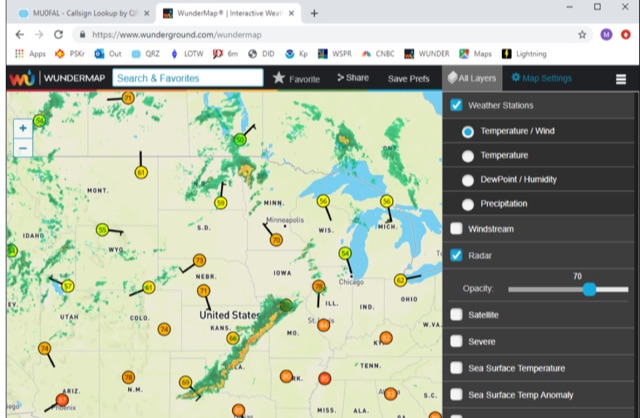 A Case For Thunderstorms Causing Sporadic E on 6 Meters. In Propagation and Radio Science, Eric Nichols explains one possible mechanism is thunderstorms that are strong enough to break electrons free forming a cloud of free electrons.