Search results
Query: azimuth
Links: 57 | Categories: 1
Categories
-
 The Beam project offers various features for controlling antenna rotators, including support for 2 or 4 line LCD displays, software or hardware clocks, open collector drives for azimuth and elevation control, and internal calculations for tracking the sun and moon. It can also track satellites and supports "Flip Mode" for inverted antennas. The 4-line version provides detailed readouts while the 2-line version offers a more compact display. New versions now support PWM and I2C H-bridge modes for adjustable speed control at the end of a move.
-
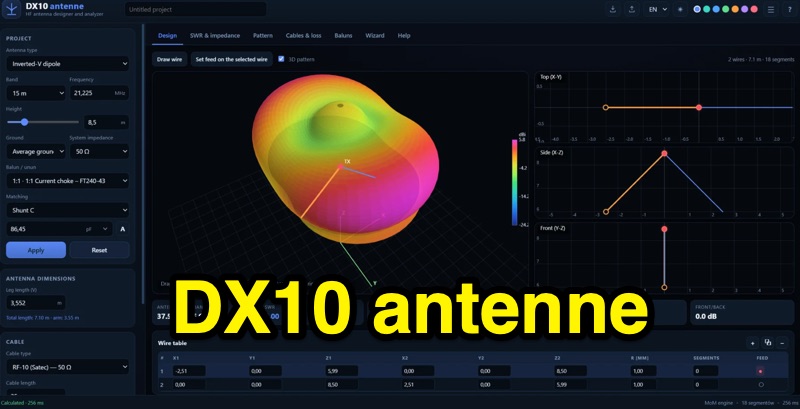 DX10Antenne, version 1.6.2, functions as a freeware **HF antenna designer** and analyzer for Windows 10/11. It enables users to graphically define antenna geometry in both 2D and 3D environments, subsequently calculating critical parameters such as SWR, impedance, and displaying results on a Smith chart. The software also generates comprehensive 3D radiation patterns, providing a visual representation of antenna performance across various azimuth and elevation angles. A distinctive feature is its multiband dipole wizard, capable of designing antennas for 2 to 5 bands with up to 8 integrated traps. The program incorporates traps and coils directly into its Method of Moments (MoM) solver, automating inductance selection for optimal performance. It supports multiband tuning, allowing adjustments to balun ratios (1:1 to 9:1), L/C values, and geometry corrections. Users can import SWR measurement data from external antenna analyzers via CSV files, facilitating direct comparison between modeled and real-world antenna characteristics. The software provides specific recommendations for antenna improvements based on its analysis. It features an integrated help center and supports multiple interface languages, including Polish, English, and German. Available as either an installer (116 MB) or a portable version (105 MB), DX10Antenne offers a robust toolkit for amateur radio operators focused on HF antenna optimization.
-
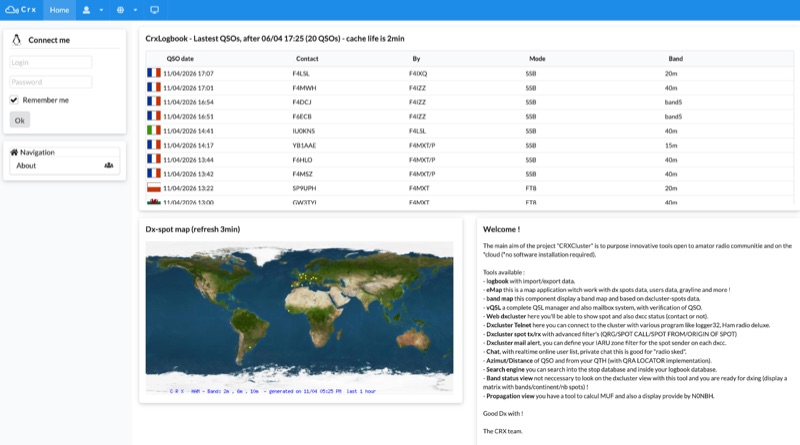 Demonstrates a cloud-based suite of tools for amateur radio operations, eliminating local software installation. The platform integrates a comprehensive logbook with import/export functionality, an _eMap_ application displaying DX spots, user locations, and grayline data, alongside a dynamic band map derived from DX cluster information. It also provides a _vQSL_ system for QSL management and a mailbox with QSO verification. Users can access a Web DX cluster to monitor spots and _DXCC_ status, or connect via Telnet using external programs like _Logger32_ or Ham Radio Deluxe. The cluster supports advanced spot filtering by QRG, spot call, spot from, and origin, with configurable mail alerts based on IARU zone filters. Additional features include a real-time chat for skeds, azimuth/distance calculations from a user's QTH (with QRA locator), a search engine for spot and logbook databases, a band status matrix, and a propagation tool for MUF calculations, leveraging data from N0NBH.
-
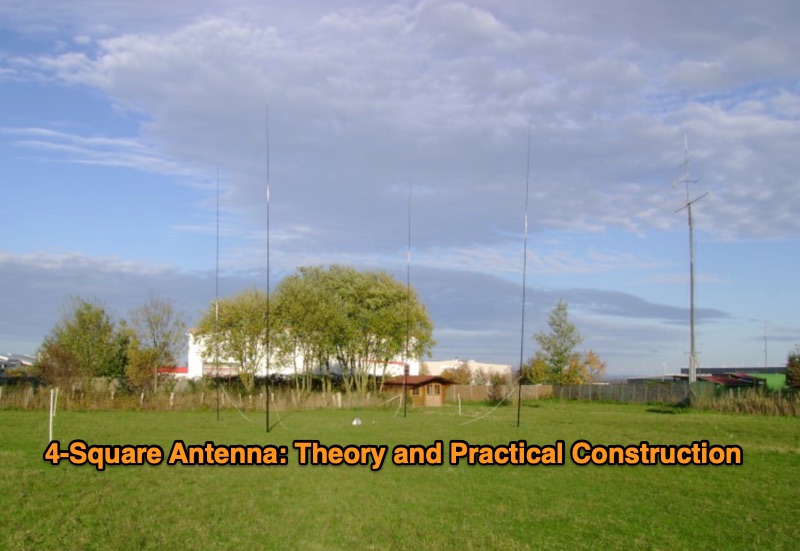 DF6QV's 4-Square antenna analysis begins with a two-element array simulation, demonstrating azimuth and elevation plots for various phase differences, including a 75-135 degree range. The document then delves into the core components of a 4-Square system, such as radiators, couplers, phasing lines, and ground systems, referencing W1HKK's 1965 QST article on an 80m phased array. It explores the influence of ground conditions and element spacing on antenna performance, presenting EZNEC analysis for an 80m 4-Square with an elevated radial, showing how gain and beamwidth vary with spacing. Various 90-degree couplers, including the 3 dB hybrid coupler and the Reed Fisher coupler, are analyzed using LTSpice, detailing power splitting, phasing, and bandwidth characteristics. The resource quantifies power, voltage, current, and losses within a 4-Square system, addressing relays, capacitors, inductors, radiator radial systems, and cable losses. System impedance, bandwidth, SWR, isolation, and mutual coupling are discussed with practical construction aspects covering common mode chokes, phasing boxes, and remote control systems. Field test observations for 40m 4-Square antennas are included, with specific examples from DXpedition operations like 5A7A and VP6DX, providing real-world context to the theoretical and simulated results.
-
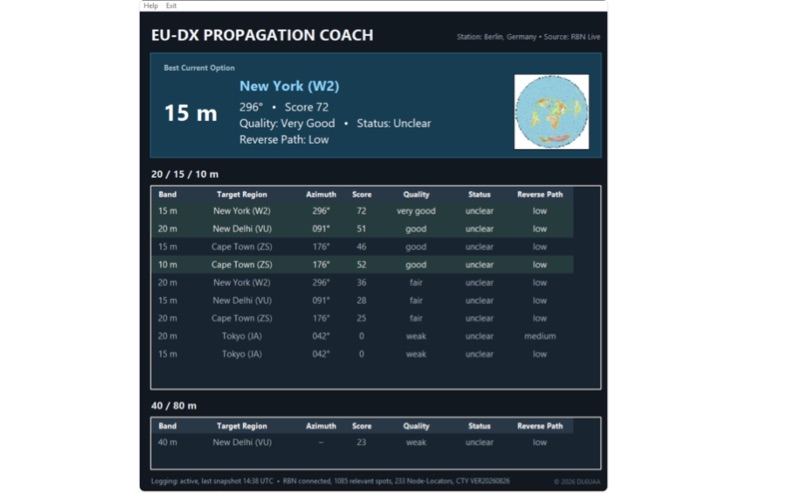 EU-DX Propagation Coach v0.9.3 processes live _Reverse Beacon Network_ (RBN) spot data, providing practical DX propagation guidance for European radio amateurs. The software offers a real-time RBN-based propagation overview, including directional guidance, enabling users to optimize band usage based on current conditions. It features five selectable European station locations and ten global DX reference centers, delivering propagation scoring for the 10, 15, and 20-meter bands, alongside a 40/80-meter overview. Dynamic azimuth and reverse-path information are calculated for each DX direction, assisting operators in precise antenna aiming. The application is distributed as a Windows ZIP archive, requiring full extraction before execution. A SHA-256 hash is provided for download integrity verification, ensuring the downloaded file matches the original. Users should note the software is provided "AS IS," and DL6UAA disclaims liability for any resulting damage or data loss. The tool is designed to run on Windows platforms, offering a dedicated utility for real-time propagation analysis.
-
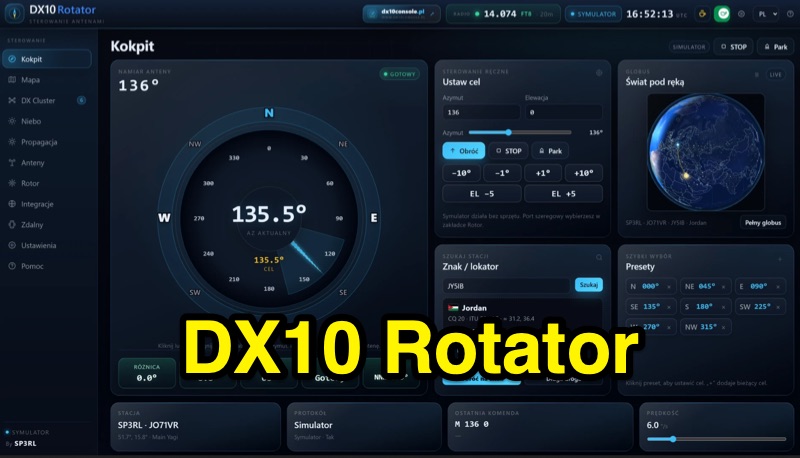 DX10 Rotator, a freeware application, provides comprehensive control for amateur radio antenna rotators, addressing the need for precise antenna positioning in various operating scenarios. It supports a wide array of popular rotor protocols, including **Yaesu GS-232**, Hy-Gain DCU-1/2, MDS RC-1, Green Heron, AlfaSpid, Prosistel, M2, and Easycomm, facilitating connectivity via serial COM port. Additionally, it offers wireless control capabilities through ESP32 via Wi-Fi (TCP 8765), enhancing operational flexibility. The software features a detailed cockpit display showing compass, azimuth, target, and beam information, alongside user-definable presets. It integrates a 3D globe and a 2D map with satellite pass predictions, crucial for satellite operations, and includes Doppler RX/TX and AZ/EL tracking. Operators can create custom antenna profiles, specifying beam width, gain, and offset, which aids in optimizing signal reception and transmission. Beyond rotor control, DX10 Rotator displays live propagation data such as SFI, SN, A, K, X-ray, Bz, and band conditions for 160-10m, along with Kp forecasts. It also provides local wind conditions from Open-Meteo. The software integrates with DX10 Console for automatic antenna rotation based on radio frequency and station bearing via rigctld (127.0.0.1:4532), streamlining station automation.
-
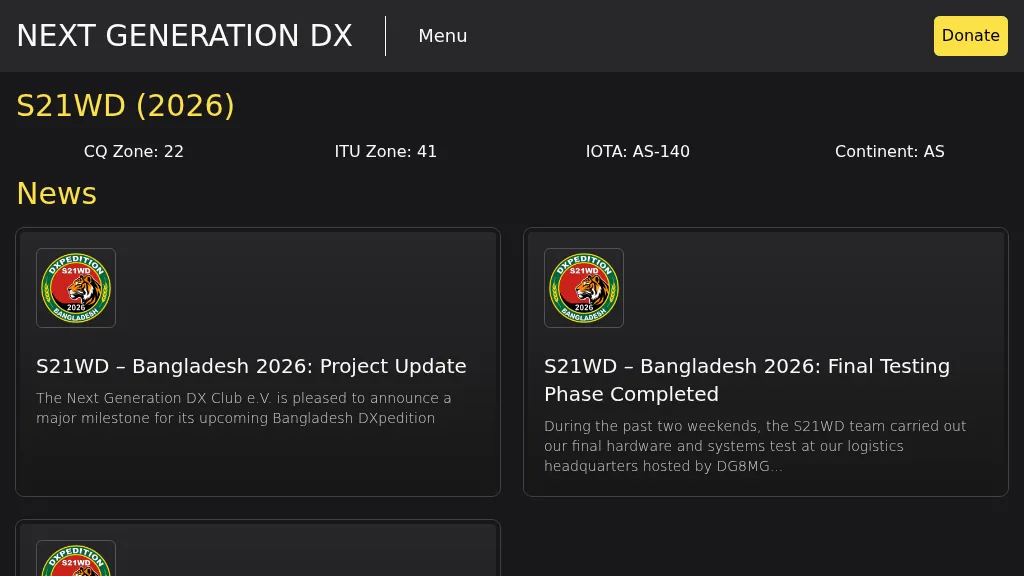 Presents the S21WD DXpedition to Bangladesh (IOTA **AS-140**) scheduled for 2026, organized by the Next Generation DX Club e.V. It outlines the project's progress, including final hardware and systems testing, and the team's successful arrival and activation from the target location. The resource provides a concise summary of Bangladesh, covering its geography, cultural aspects, and economic landscape. The page includes the Clublog Most Wanted ranking for Bangladesh, categorized by continent and mode, as of January 2026. The DXpedition aims to achieve over 70,000 QSOs across CW, SSB, RTTY, and FT8 modes, with a specific focus on RTTY (targeting over 2,000 QSOs) and **lowband** operations. The team plans a Multi-Single entry in the ARRL CW 2026 contest. QSO data will be uploaded to Clublog and LoTW, with Clublog livestream and daily free LoTW uploads anticipated, contingent on stable internet connectivity. The S21WD callsign corresponds to CQ Zone 22 and ITU Zone 41. Further details include a preliminary bandplan, FT8 operating guidelines using MSHV software, a VOACAP DX Prediction link, and an azimuthal map centered on Bangladesh. QSL services are managed by DJ4MX via Clublog OQRS, offering direct, bureau, and LoTW options, with daily LoTW uploads expected.