Current & Future Propagation Conditions for Amateur Radio
Access real-time data and predictive models for HF, VHF, and UHF propagation to optimize your amateur radio operations.

Accurate prediction of radio wave behavior is fundamental for effective amateur radio communication, particularly across varying distances and frequencies. Propagation forecasts provide critical insights into the conditions that influence signal paths, enabling operators to optimize their transmission strategies. These forecasts consider a range of environmental factors that affect how radio waves travel through the atmosphere, from the ionosphere to the troposphere, impacting everything from local VHF/UHF contacts to intercontinental HF DX.
Resources in this category offer various tools and data sets designed to predict future propagation conditions. These include models for HF skywave propagation, which account for solar activity and ionospheric layers, as well as forecasts for tropospheric ducting that can extend VHF/UHF ranges. Operators can access real-time solar-terrestrial indices, projected band openings, and graphical representations of signal-to-noise ratio (SNR) to anticipate favorable communication windows. Such tools are invaluable for planning contests, scheduling DX contacts, and generally enhancing operational success by aligning transmission times with optimal propagation.
-
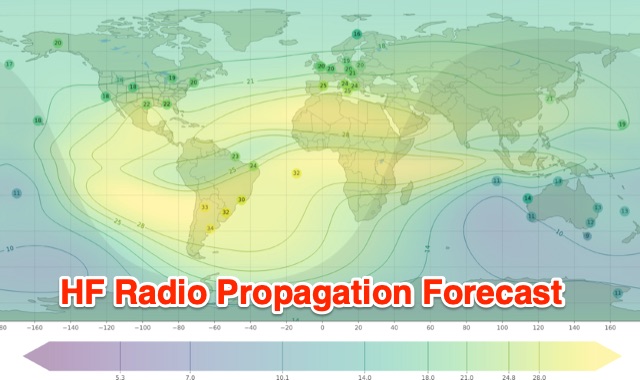 The website offers a comprehensive guide on high-frequency (HF) skywave propagation for amateur radio operators. It explains HF radio propagation fundamentals, including electromagnetic wave properties, HF bands, and propagation modes like skywave, ground wave, and line-of-sight. The site focuses on the ionosphere's critical role, influenced by solar activity, in refracting HF waves for long-distance communication. Real-time monitoring tools such as DX clusters, beacons, and digital modes like FT8 assist users in tracking band activity and propagation conditions globally. Forecasting methods are detailed, highlighting scientific insights into solar-terrestrial interactions and ionospheric variability. The guide also covers advanced topics like NVIS and gray line propagation, ionosonde data, and propagation prediction models, making it a valuable resource for ham radio enthusiasts aiming to optimize communications
 -
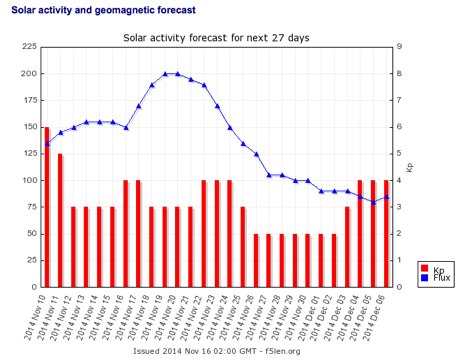 Display solar activity forecast for next 27 days, display A-index, Sunspot Numbers and Flux forecast including graphs for solar activity and geomagnetic forecast. All forecasts are updated daily.
 -
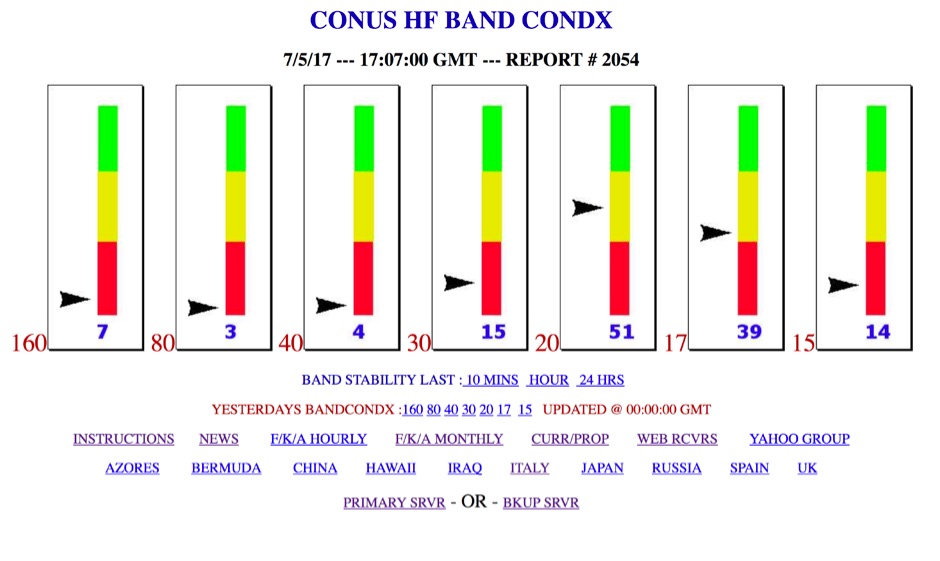 Current HF band conditions online report and graphs. This page provides band condition information to CW and SSB Contesters. It can also be of benefit to other Radio Amateurs to determine band condtions for Nets and casual QSO
 -
 Web based VHF-UHF RF planning powered by SPLAT! and Google Maps. Access via website, Android App or dynamic Google Earth interface.
 -
 DX Propagation by DR2W! High resolution SNR maps in pseudo color. Propagation based on the actual sunspot number.
 -
 Broadcast via WWV and WWVH at 18 and 45 minutes past the hour. This message is updated every 3 hours. Reports current Solar-terrestrial indinces, Solar Flux, A-index, K-Index, forecast for space weather storms. Prepared by the US Dept. of Commerce, NOAA, Space Environment Center
 -
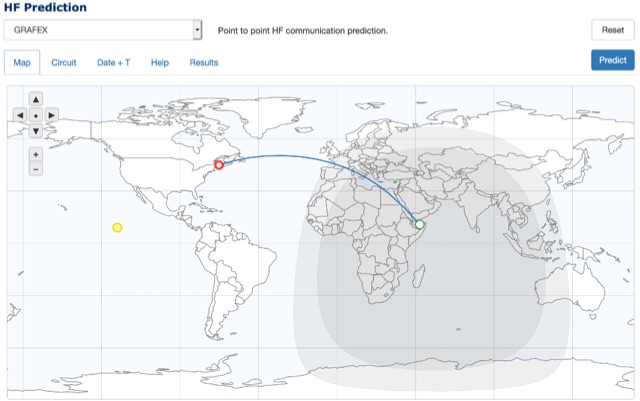 Online HF Communication prediction system provided by the Australian Governament Buerau of Metereology allow to predict usable frequency rage for radiocommunications between two stations allowing to specify frequency and date range. This tool allow calculation with different methods and algorithms
 -
 These pages provide general propagation advice for HF communicators. Information available includes inferred global propagation conditions, real time HF fadeout coverage charts, regional ionospheric vertical MUF maps and Hourly Area Prediction charts for Astralia and Asia, Europe and North America
 -
 *One single page* gives you an immediate overview of current shortwave propagation conditions at your location.
 -
 This is a propagation prediction program tailored to the serious contester
 -
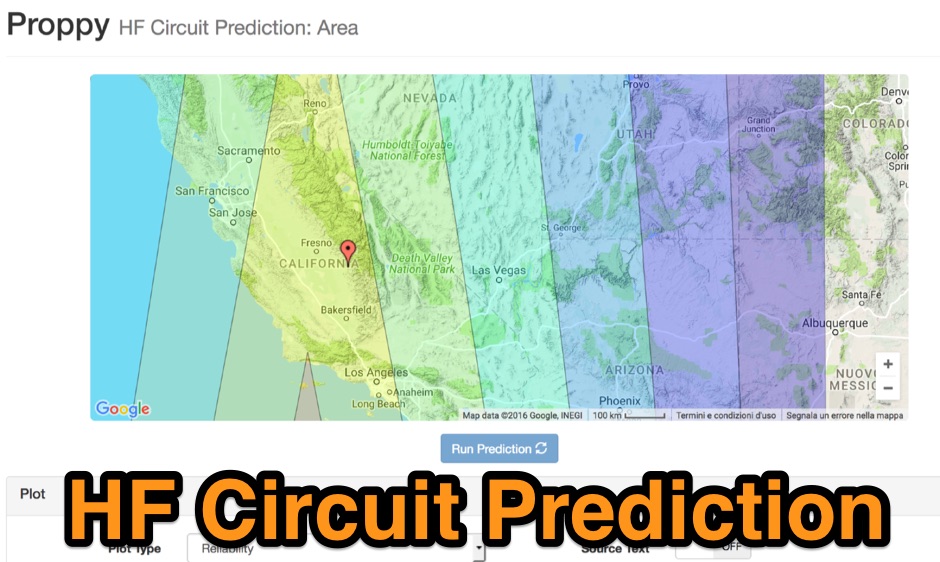 Proppy: Online HF propagation predictions using the ITU Recommendation P.533-13 Propagation Prediction Application.
 -
 Refractive Index maps forecast for Europe
 -
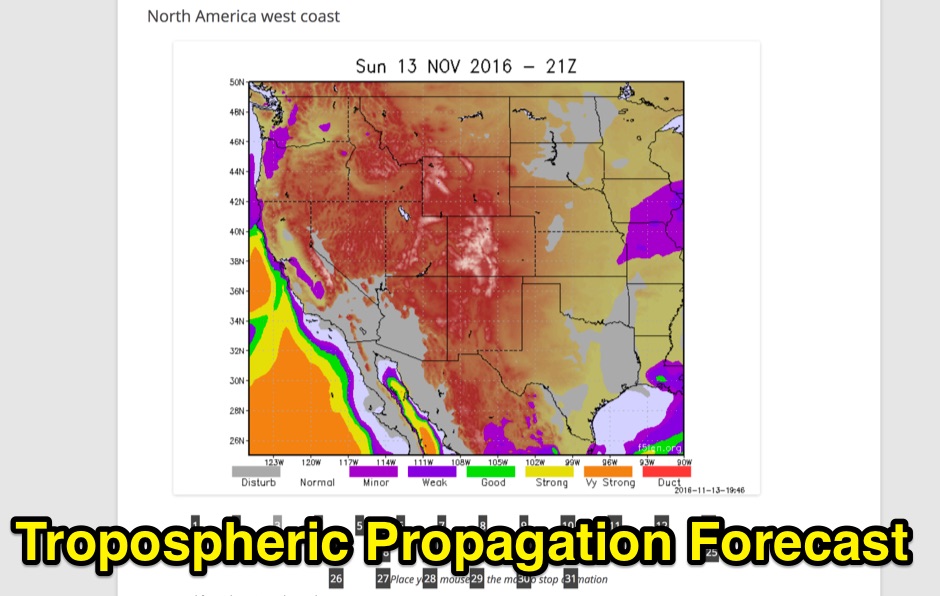 Tropospheric Propagation Forecast for several areas. Base on a computed refractive index 4 times a day.
 -
 Notes on using the QST propagation charts to determine propagation conditions
 -
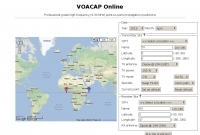 Online professional-grade high-frequency (3-30 MHz) propagation predictions
 -
 W1AW Propagation Bulletins for 2001
 -
 This article examines how geomagnetic activity influences 160-meter radio propagation. K9LA analyzes observations of enhanced signals preceding K-index increases. Modeling shows that as ionospheric electric fields rise from 0 to 75 mV/meter during early geomagnetic storms, they create an electron density valley above the E region, enabling signal "ducting" between the E and F regions. This effect vanishes at higher field strengths (100 mV/meter). The phenomenon may explain both exceptional 160m openings preceding 6m propagation and possibly Marconi's contested 1901 transatlantic reception, which occurred during a small geomagnetic disturbance.
 -
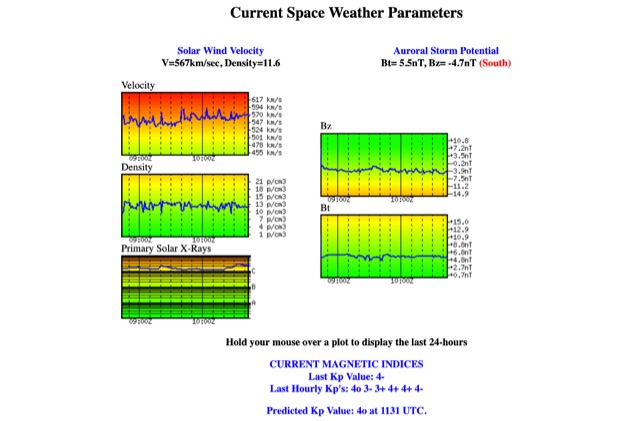 Solar Wind Velocity and Auroral Storm Potential the website provides also current magnetic indices like last Kp values and predicted Kp values.
 -
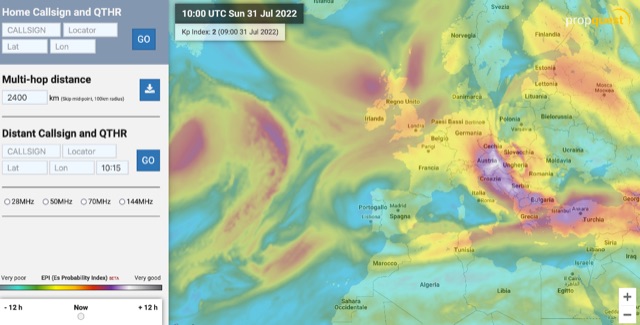 The map display allows you to select by locator, or clicking on the map, where you want to calculate the probability of Sporadic-E by building a combination EPI, Es Probability Index, based on factors using many of the known parameters which can effect Es. T
 -
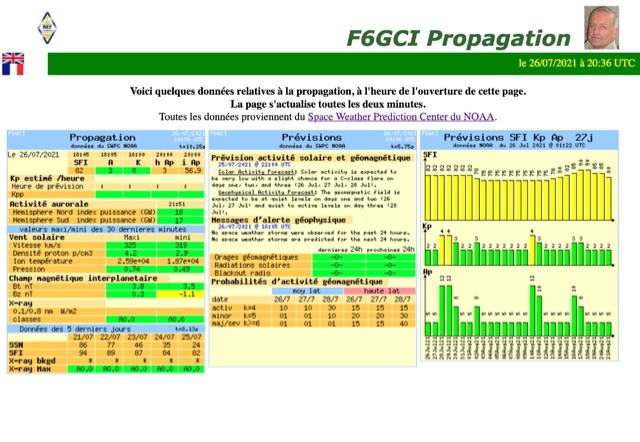 A collection of dynamically produced images based on the daily data of the NOAA Space Weather Prediction Center
 -
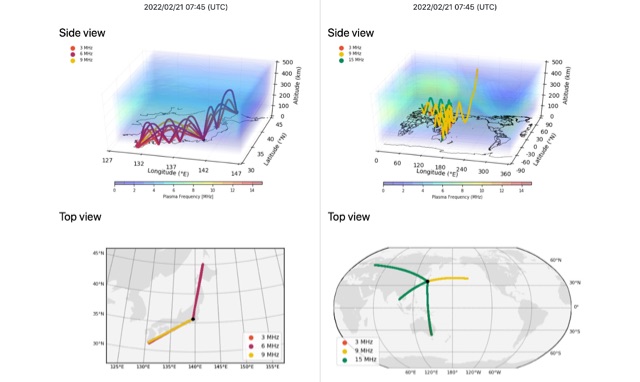 HF-START can estimate HF propagation between any given 2 points over Japan in real-time by using GNSS tomography, and can be used to forecast HF propagation 1 day in advance between any given 2 points globally by using GAIA model.
 -
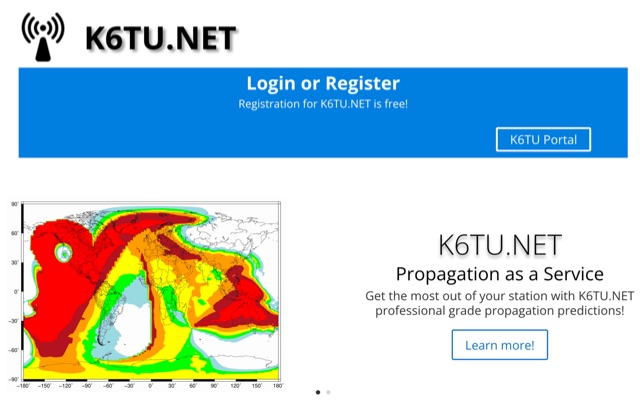 Get the most out of your station with K6TU.NET professional grade propagation prediction, and model your antenna performance over actual terrain using high resolution elevation data
 -
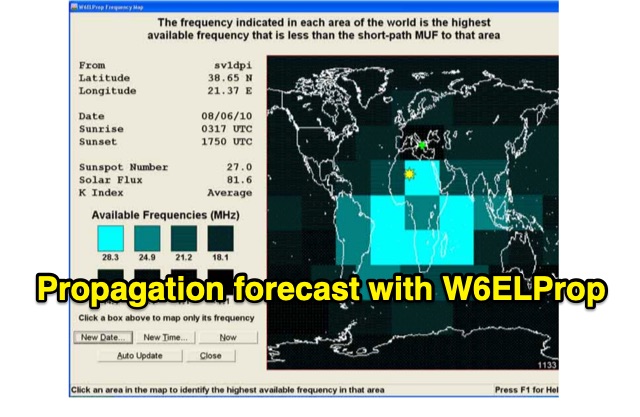 In 2004, Carl Luetzelschwab, K9LA, wrote a guide on using W6ELProp for radio wave propagation predictions. This tutorial, translated for broader accessibility, explains initial setup, configuration, and daily use. It emphasizes using mean solar index values for accuracy, helping users effectively predict and interpret propagation for improved amateur radio operations.
 -
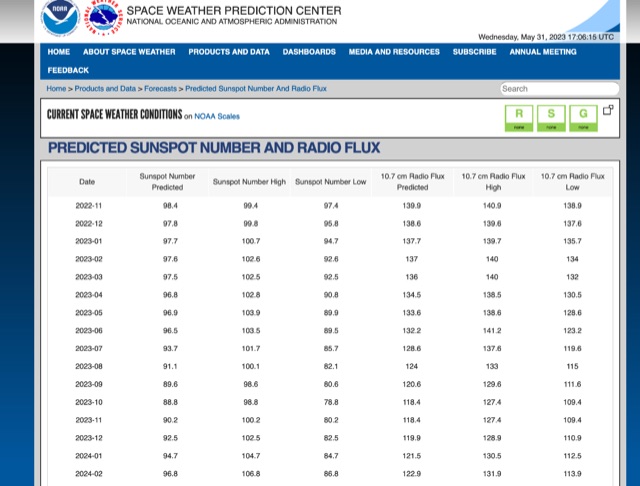 Predicted Solar Cycle: Sunspot Number And Radio Flux Values with Expected Ranges, sources are Penticton, B.C., Canada, S.I.D.C. Brussels
 -
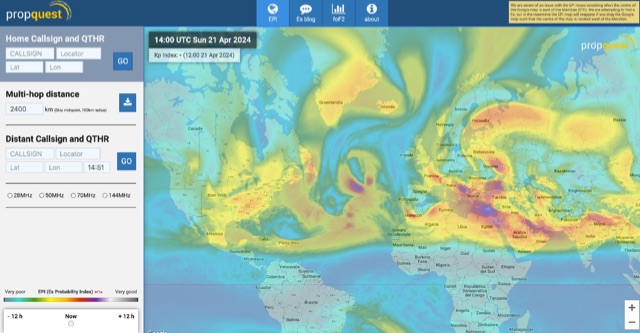 This website explains signal variations on a local radio net by tracking the foF2, a measure of ionosphere's ability to reflect radio waves. The website shows daily foF2 variations and how it affects Near Vertical Incidence Skywave (NVIS) propagation for local nets. It also considers D-layer absorption affecting lower bands and F2 MUF distance for long-distance communication. Additionally, the website tracks foEs for E-layer propagation and an EPI index for predicting Es chances.
 -
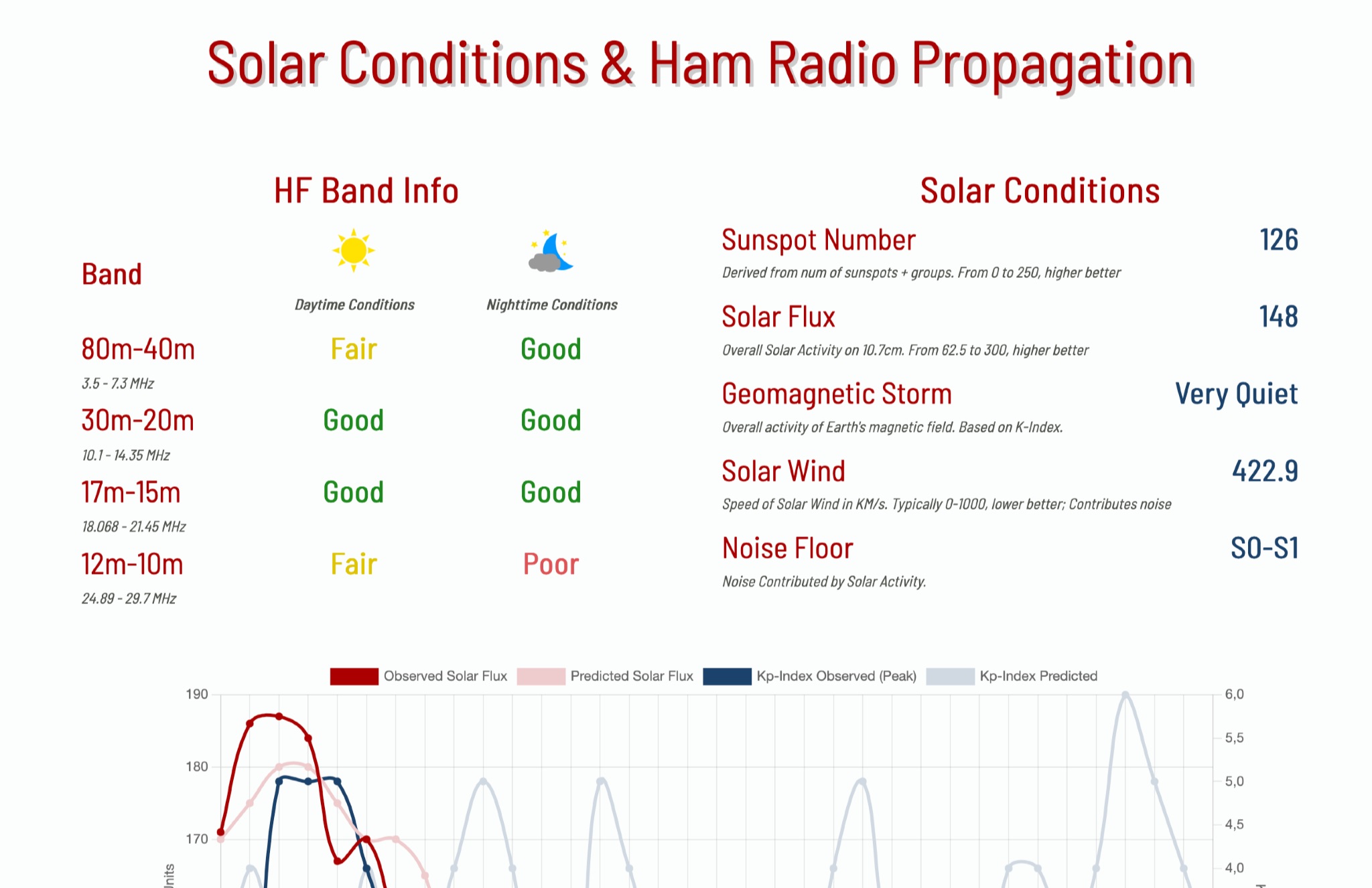 This page provides information on solar conditions and their impact on ham radio propagation, specifically focusing on the HF bands. A daily graph show the predicted solar flux and Kp Indexes
 -
 Solar data with current solar status, forecast and propagation report
 -
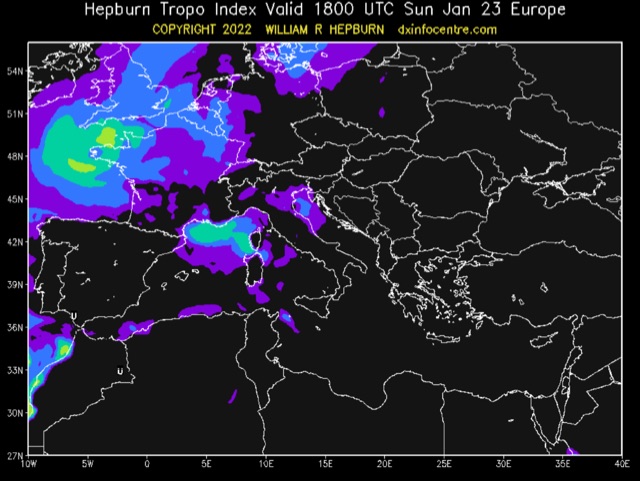 The areas noted in the forecast have the necessary atmospheric conditions to produce tropospheric bending of VHF, UHF and/or microwave radio waves. Tropospheric bending extends the range of radio & TV stations well beyond their normal limit and thus increases interference amongst stations as well.
 -
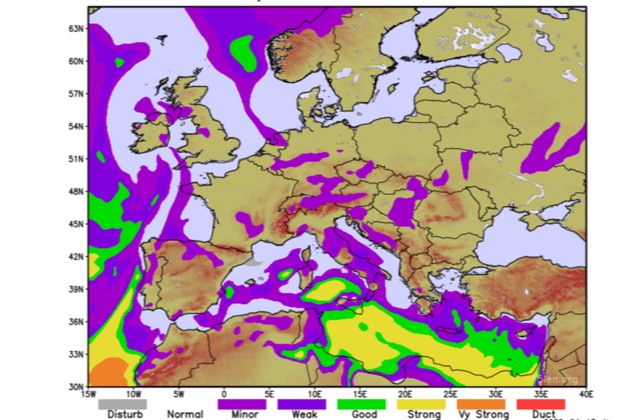 Forecasts for Europe and mediterranean sea
 -
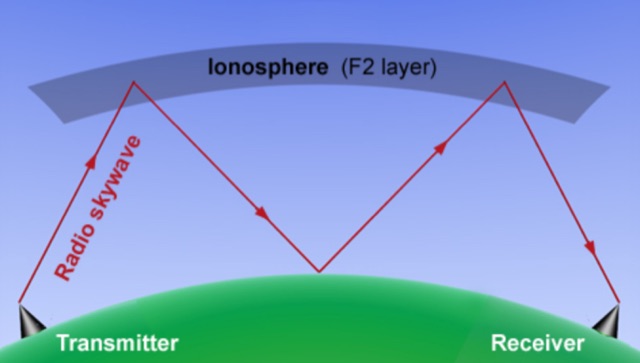 Comments on the irrelevance of WWV numbers to 50 MHz F2 propagation