Search results
Query: national
Links: 328 | Categories: 31
Categories
- DX Resources > QSLing > International reply coupons
- Operating Modes > International Space Station
- Ham Radio > Clubs > Australia
- Shortwave Radio > Broadcasters
- DX Resources > Callsigns
- Ham Radio > Clubs
- Operating Modes > Satellites > Clubs
- Shortwave Radio > Clubs
- Operating Modes > Radio Direction Finding > Clubs
- Operating Modes > Amateur Television > Clubs
- DX Resources > Contest > Contest Rules
- Ham Radio > Clubs > Societies
- Ham Radio > Regional > Japan
- Manufacturers > Transceivers > Kenwood
- Ham Radio > Licensing
- Operating Modes > Mobile > Maritime Mobile
- Operating Modes > Navtex
- Ham Radio > Clubs > North America
- Ham Radio > Clubs > Europe > Norway
- Shortwave Radio > Press Services
- Ham Radio > Resources
- Radio Scanning > Scanner Frequencies
- Shortwave Radio > Schedules
- Shortwave Radio > Broadcasters > Time Signal Radios
- Operating Aids > Traffic Handling
- Operating Aids > Travelling
- Ham Radio > Regional > Ukraine
- Ham Radio > Clubs > Europe > Ukraine
- Ham Radio > Clubs > North America > USA
- DX Resources > Ham Radio Awards > WorldWide Flora and Fauna
-
 The Pickens County Communications Group are volunteers for the Pickens County Emergency Management Agency in Pickens, S.C. and members of R.A.C.E.S.-Radio Amateur Civil Emergency Service, with the South Carolina State Guard. We are not a club. We are a group of amateurs radio enthusiasts with similar interests, dedicated in providing emergency communications for public service, public safety, and commercial communications for local agencies. We also provide Skywarn communications for Pickens County and the National Weather Service in Greer, S.C.
 -
 An international Radar network for studying the Earth\'s upper atmosphere, ionosphere, and connection into space.
 -
 29 May to 4 June 2010, WFF comprehensive expedition in Kazakhstan-Zhetisu-2010 WFF expedition on national parks and wildlife reserve of Almaty oblast- Zhetisu-2010
 -
 Yamuna Cable Accessories Pvt. Ltd. specializes in the development, manufacturing, and marketing of power cable accessories, including a comprehensive range of cable jointing kits and components. The product line encompasses _Heat Shrink_ and _Cold Shrink_ cable joints, heat shrinkable tubing, pre-moulded slip-on joints, resin pour, and Tapex systems, all designed for applications up to 66 kV. The company highlights its ISO 9001-2015 certification, signifying adherence to international quality management standards in its manufacturing processes. The resource details specific product categories such as end caps, insulation piercing connectors, copper mesh, fireproof coatings, tubing and components, lugs and ferrules, and safety products. It also features specialized items like _Elbow Connectors_ rated for 25 kV-250, 400, and 630 amps, and various types of tinned copper braid used for grounding and electrical shielding. The site provides an overview of their manufacturing capabilities and global presence across 40+ countries. Established in 1973, Yamuna Densons has over four decades of experience in the industry, positioning itself as a significant designer, manufacturer, and supplier of insulators, tabs, and cable jointing systems in India. The company emphasizes its role as a leading exporter of these products, serving both domestic and international clients.
 -
 The document delineates the operational framework for the Auxiliary Communications Service (ACS) and the Amateur Radio Emergency Service (ARES), specifically detailing their integration into the National Incident Management System (NIMS) for emergency communications. It explains NIMS as a standardized, comprehensive national approach to incident management, emphasizing its applicability across all jurisdictional levels and functional disciplines to enhance coordination among responding agencies. The resource highlights that ACS/ARES operates within this NIMS structure for all events, emergencies, and disasters, aligning with federal requirements for emergency preparedness grants. Specific sections address the dual management structures typical in emergency response: an administrative management structure for day-to-day operations and an emergency management structure activated during specific disasters. It illustrates how ARES provides the administrative framework, while the ACS emergency management structure adopts the NIMS/Incident Command System (ICS) model when activated by entities like the Ventura County Office of Emergency Services. The content further breaks down the ARES organizational hierarchy from national ARRL divisions down to local Ventura County districts and areas, identifying roles such as Section Emergency Coordinator (SEC) and District Emergency Coordinator (DEC). Each of the eight Ventura County administrative areas, such as Simi and Thousand Oaks, is shown to have its own Emergency Coordinator and specific communication plans, all coordinated under a broader District Emergency Communications Plan.
 -
 Operating ham radio in international waters
 -
 The YM2XBU Bilkent University Amateur Radio Club website details the club's activities and operational focus within the amateur radio community. It serves as the primary online presence for the university's ham radio enthusiasts, showcasing their involvement in various aspects of the hobby. The site provides insights into the club's station setup, operational modes, and participation in local and international amateur radio events. Club members engage in DXing, contesting, and educational initiatives, fostering practical skills in radio communication and electronics. The _YM2XBU_ club callsign is actively used for on-air operations, contributing to the global amateur radio network. Information regarding membership, meeting schedules, and contact details for _Kagan SIRDAR_ are available, facilitating engagement for students and faculty interested in amateur radio.
 -
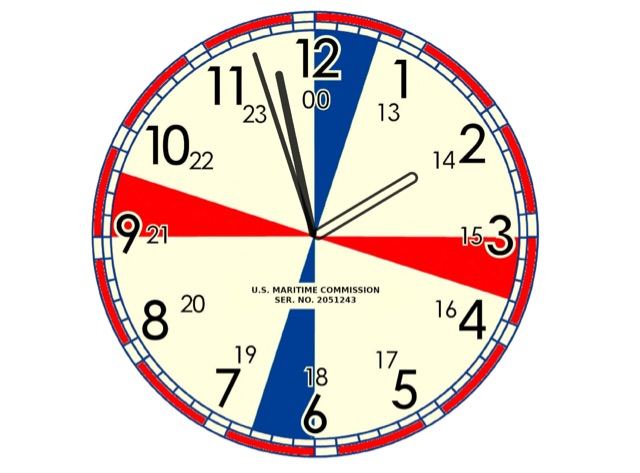 Before the advent of satellite communication, maritime communication adhered to an international protocol requiring ships and coastal stations to observe silent periods twice an hour, reserved specifically for emergencies. These silent periods were marked by red sectors on the 500 kHz frequency and green sectors on the 2182 kHz frequency. The 4-second red bars facilitated the manual transmission of the SOLAS distress signal.
 -
 Presents the official online presence for CT1ARR, the Associação de Radioamadores do Ribatejo, a recognized amateur radio club based in Portugal. The site serves as a central hub for members and interested parties, detailing the club's objectives and operational scope within the Ribatejo region. It outlines the organizational structure and provides contact information for club officers, facilitating communication among the amateur radio community. The resource documents the club's engagement in various amateur radio activities, including local nets, field days, and participation in national and international contests. It also lists any public service events or training initiatives undertaken by CT1ARR, supporting the development of amateur radio skills and fostering community involvement. The site functions as a digital archive for club news and announcements, ensuring members remain informed about upcoming events and operational changes.
 -

-
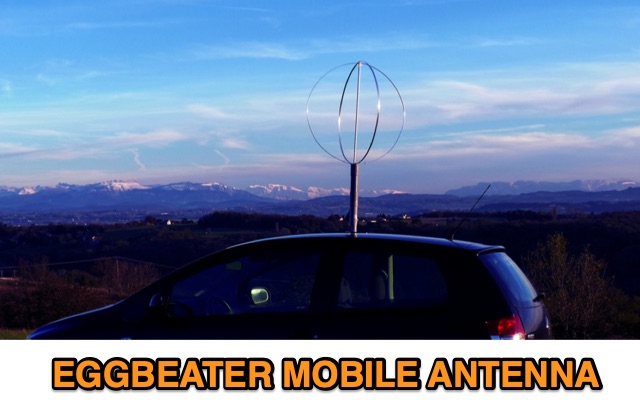 A distance of 1/8 lambda between the antenna and the vehicle roof is suggested for optimal performance, with slight adjustments possible to lower the take-off angle for terrestrial contacts. This resource details the adaptation of an _Eggbeater_ antenna for mobile use, specifically for VHF operation, leveraging the car's metal roof as a ground plane. It illustrates the mounting method, repurposing a magnetic ski carrier base, and describes the integration of coaxial relays for polarization reversal, a feature also applicable to UHF versions as discussed in "_Eggbeater Antenna VHF/UHF – Part 2_". This mobile configuration proves effective for satellite communications, such as through the International Space Station (ISS), while also maintaining strong performance for land-based radio contacts. The inclusion of switches with indicator lights for VHF and UHF polarization control, powered by the vehicle's battery, highlights practical considerations for field deployment. The system's adaptability for portable operations underscores its versatility beyond fixed mobile installations.
 -
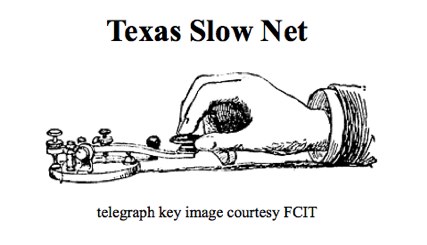 The Texas Slow Net (TSN) operates daily at 7:45 PM local time on 3570 KHz, serving as a dedicated traffic handling training net within the National Traffic System. It specifically caters to operators aiming to enhance their **International Morse Code** skills and learn proper CW traffic net procedures. Each session incorporates a traffic handling lesson delivered as a radiogram to all participants, reinforcing practical application. The resource provides guidance on effective Morse Code learning, emphasizing sound recognition over visual dot/dash counting, suggesting characters be sent at 15 words per minute with adjusted spacing. It recommends listening to W1AW code practice transmissions, setting goals with ARRL's Code Proficiency Program qualifying runs, and regular participation in NTS traffic nets. The content also references the ARRL's Public Service Communications Manual, particularly Section 2, which details the **National Traffic System**.
 -
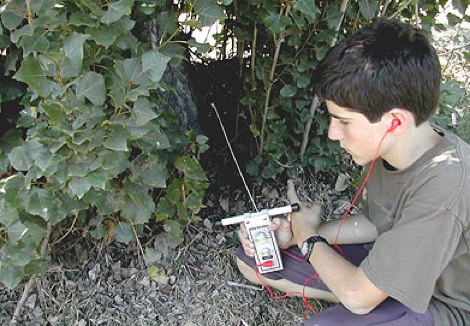 If your club holds only two-meter ARDF events, you are missing half the fun. There is another international foxhunting band, too.
 -

-
 AMSAT-DL International Satellites for Communication, Science and Education.
 -
 The Narrabeen JOTA and JOTI camp facilitates global communication for Sydney North Region Scouts and Northern Sydney Girl Guides, utilizing amateur radio and internet technologies. Participants engage in two-way radio contacts, often on **HF** bands, to connect with other scouting and guiding groups worldwide, fostering international goodwill and technical skill development. The event integrates both traditional **ham radio** operations and modern internet-based communication methods, providing a diverse experience for youth members. The resource outlines the specific activities undertaken at the Narrabeen site, including station setup, operating procedures, and the use of digital modes for JOTI. It highlights the educational aspects of the event, such as learning about radio propagation, antenna theory, and basic electronics, all within a structured camp environment. The page also provides logistical information relevant to the Australian context of the event.
 -
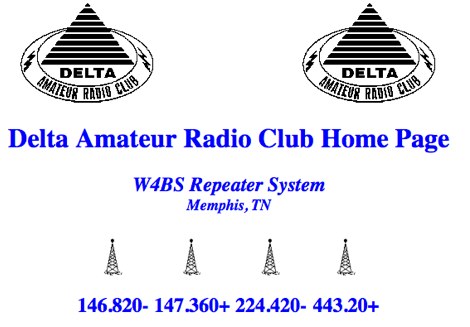 The Delta Amateur Radio Club (DARC) serves as a community organization for amateur radio operators in the Memphis, Tennessee area, providing resources and activities centered around two-way radio communication. The club maintains the W4BS repeater system, which operates on 147.060 MHz with a +600 kHz offset and a 100 Hz PL tone, facilitating local VHF communications. DARC actively supports the Amateur Radio Emergency Service (ARES), preparing members for public service and disaster response through training and coordinated drills. The club also hosts regular meetings and events, fostering camaraderie and technical skill development among its members. Membership in the Delta Amateur Radio Club offers opportunities for participation in various amateur radio activities, including field day operations and local nets. The W4BS repeater provides reliable coverage across the Memphis metropolitan area, serving as a critical asset for both daily ragchewing and emergency traffic handling. DARC's affiliation with the Amateur Radio Relay League (ARRL) ensures access to national resources and advocacy, reinforcing the club's commitment to promoting amateur radio and public service within the community. The club's focus on emergency communications strengthens local preparedness.
 -
 Documents the XR0ZR DXpedition to Juan Fernandez Island (SA-005) in November 2013, providing insights into activating a highly sought-after DXCC entity. The team's efforts focused on maximizing QSO opportunities across various bands and modes, a critical aspect for stations aiming to complete their DXCC or IOTA awards. Operating from a remote location like Juan Fernandez presents unique logistical and technical challenges, which the expedition successfully navigated to put this entity on the air for thousands of eager DXers worldwide. The resource outlines the operational period, the callsign XR0ZR, and the specific island group activated. Such DXpeditions are vital for the global amateur radio community, enabling hams in less accessible regions to achieve their award goals and fostering international communication. The detailed account serves as a historical record of a significant activation.
 -
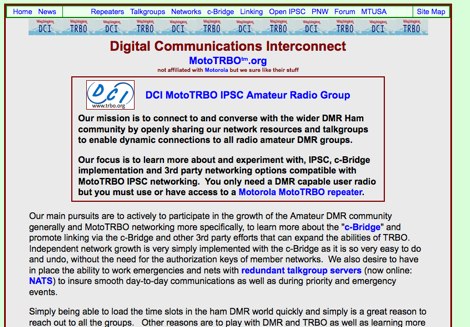 The Digital Communications Interconnect (DCI) resource details the operational philosophy and technical implementation of an open _MotoTRBO_ IPSC network, emphasizing the use of _c-Bridge_ technology for interconnecting DMR repeaters and talkgroups. It outlines the group's mission to facilitate dynamic connections within the regional DMR amateur radio community by openly sharing network resources and talkgroups, promoting independent network growth and exploring the capabilities of c-Bridge linking. The site provides insights into the technical advantages of c-Bridges, such as breaking the finite peer slot limitation of simple IPSC networks and enabling more flexible talkgroup routing beyond two timeslots. This legacy asset, last updated in October 2022, also reflects on the group's history and challenges encountered in national DMR efforts, citing political divisiveness among major c-Bridge groups. It discusses the practical application of c-Bridges for emergency communications and nets, ensuring redundant talkgroup servers for smooth day-to-day operations and priority events. The resource encourages other c-Bridge operators to adopt international talkgroups like "_iCall Talkgroup_" and a nationwide "Emergency Talkgroup," while also offering guidance on affiliating repeaters or IPSC networks with DCI's open network.
 -
 When planning your operating schedule, a reliable contest calendar is an essential tool for any serious contester. This DARC-maintained resource compiles current contest announcements for both HF and VHF/UHF operations, making it straightforward to identify upcoming opportunities for competitive radio sport. My own experience has shown that having a centralized, well-organized calendar saves significant time, especially when targeting specific events like the Clubmeisterschaft Classic (CMC) or the KW-Pokal. The DARC calendar highlights these German and European scoring contests in yellow, providing immediate visual cues for participants. HF contests are clearly marked in blue, while VHF/UHF events appear in red, simplifying band-specific planning. Beyond the major international contests, the calendar emphasizes regional events, which can be particularly useful for those aiming to improve their standing in local club competitions or explore less common contest formats. Special activity periods, such as those spanning multiple days, are also noted with a green background, ensuring operators are aware of extended operating windows.
 -
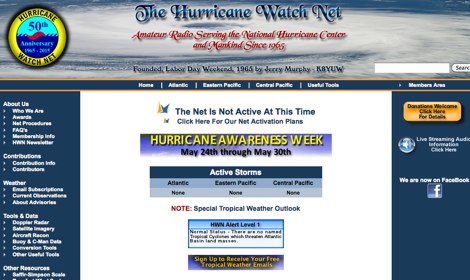 The Hurricane Watch Net (HWN) is an amateur radio organization dedicated to serving the National Hurricane Center and the public since 1965. It plays a crucial role in disseminating real-time tropical weather information for the Atlantic and Eastern Pacific regions. The HWN operates during hurricane events, providing updates and facilitating communication among amateur radio operators and emergency services. This network is essential for ensuring that communities are informed and prepared for severe weather conditions. In addition to its operational role, the HWN offers educational resources and outreach programs aimed at enhancing public awareness about hurricane preparedness. This includes providing access to tracking maps, storm surge information, and safety guidelines. The HWN encourages amateur radio operators to participate in its activities, fostering a spirit of community and collaboration in the face of natural disasters. By subscribing to their email updates, individuals can stay informed about active storms and receive vital safety information.
 -
 Cape otway lighthouse, home of vk3owl during the international lighthouse amateur radio weekend
 -
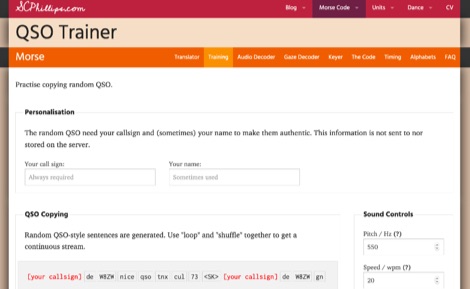 This online web application allows you to train the decoding of Morse code by copying random QSO sentences that can be looped or even mixed.
 -
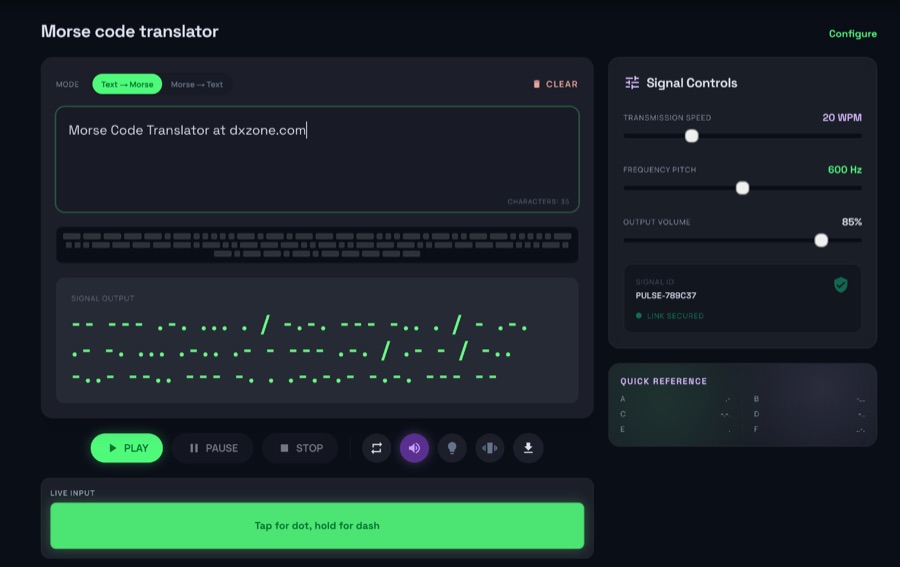 The morsecodeworld.org web application provides an online Morse code decoder and encoder, facilitating real-time conversion between text and International Morse code. It supports adjustable transmission speed (Words Per Minute), sidetone frequency pitch (Hz), and output volume, allowing users to customize their learning and practice environment. The tool includes a quick reference chart for the Morse alphabet and focuses exclusively on International Morse, aligning with contemporary amateur radio licensing and on-air practices, distinguishing it from historical American Morse code. This web-based utility enables users to type text for encoding into Morse audio or paste Morse code for decoding into plain text, offering immediate feedback on timing and character spacing. It supports both visual and auditory learning by providing adjustable parameters for speed and tone. The platform is designed for self-assessment, encouraging users to practice copying and sending, and to identify and correct common errors in character recognition and timing.
 -
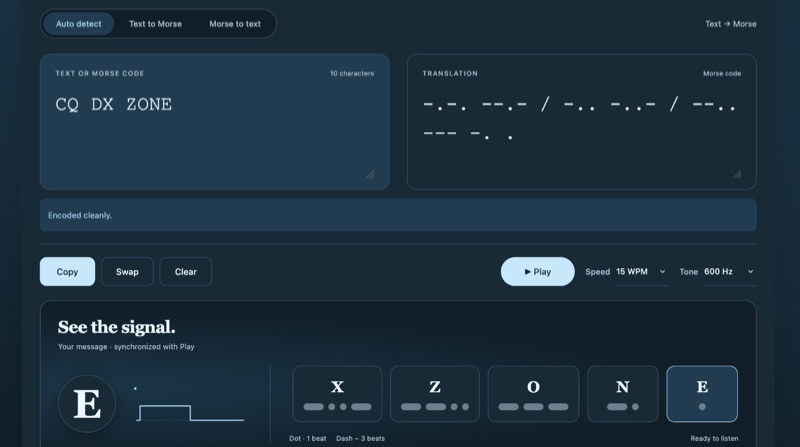 Txtopia provides a browser-based Morse code translator that converts plain text to International Morse Code and decodes Morse back into text, supporting various Unicode dot and dash representations. The tool automatically detects translation direction, normalizes common input variations like middle dots (·), bullets (•), em dashes, and underscores, and explicitly flags unsupported characters or ambiguous sequences with visible placeholders rather than silently dropping them. It accepts spaces, tabs, newlines, and pipes as letter separators, and slashes or blank lines for word boundaries, recording collapsed separators for user review. Users can adjust playback speed from 5 to 40 WPM and tone frequency from 300 to 1000 Hz for CW practice, with playback adhering to international Morse timing. The application operates entirely client-side, ensuring user input remains in the browser without server transmission. It includes a comprehensive reference for the supported Morse alphabet, numbers, and punctuation, aiding in learning and verification. The tool is suitable for checking game clues, verifying tattoo designs, and transcribing messages for ham radio CW practice.
 -
 An International Educational and Scientific Organization Founded in August of 1952
 -
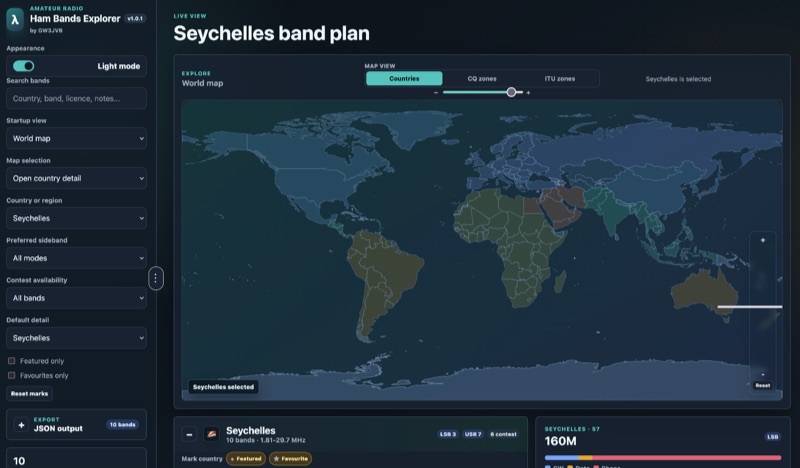 Presents an interactive **Ham Bands Explorer** web application, offering a live view of all amateur radio bands overlaid on a world map. This resource displays **CQ zones** and **ITU zones**, with geographical data sourced from HB9HIL/hamradio-zones-geojson under an MIT license. The interface provides a dynamic visualization of global band conditions, enabling operators to observe activity patterns across different regions. Users can select individual countries to retrieve and display their specific band plans, with frequency coverage details loaded from CountryData.json. The tool indicates 100% frequency coverage, ensuring comprehensive data presentation for selected regions. This functionality supports detailed analysis of national regulatory variations within the amateur spectrum. The application integrates both a map view and a live view, facilitating real-time monitoring and geographical context for band usage. It serves as a practical reference for understanding international amateur radio regulations and visualizing propagation characteristics across various frequency allocations.
 -
 The Maine QSO Party is designed to encourage Maine stations to expand their knowledge of DX propagation on the HF and MF bands, improve their operating skills, and improve station capability by creating a competition in which W/VE, and DX stations have the incentive to work Maine. The MEQP is Maine's Premier International HF Contest.
 -
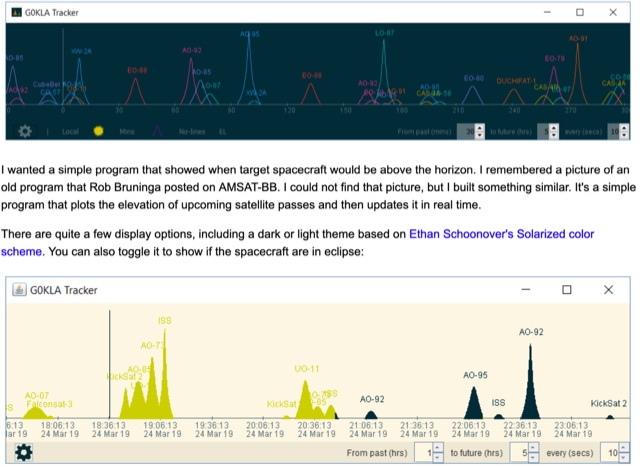 KlaTrack is a Windows-based software application designed to assist amateur radio operators with satellite communication by predicting spacecraft visibility. It provides a simple interface to determine when specific satellites will be above the local horizon, a critical factor for successful two-way contacts via amateur radio satellites. The program processes _Two-Line Element_ (TLE) data to calculate orbital mechanics, offering a practical tool for satellite operators to plan their operating windows. It supports real-time tracking and displays essential pass information. This utility simplifies the complex task of satellite tracking, allowing operators to focus on making contacts rather than manual orbital calculations. While specific gain figures or distances are not quantified, the software's core function directly supports achieving successful satellite QSOs by providing precise pass predictions. It is particularly useful for operators engaging in activities like working the International Space Station (ISS) or other low-Earth orbit (LEO) satellites, where short pass times and precise timing are crucial for maximizing contact opportunities.
 -
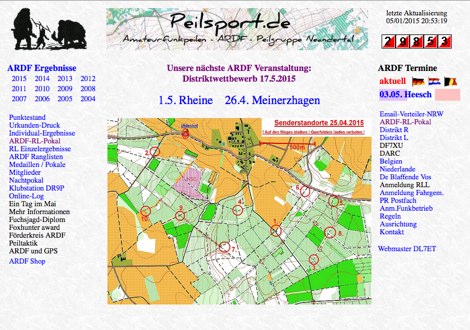 The Peilgruppe Neandertal, featured on Peilsport.de, actively promotes _Amateur Radio Direction Finding_ (ARDF), also known as fox hunting. This German group combines radio technology with outdoor sport, participating in regional and national ARDF events. Members access current ARDF schedules, competition results, and downloadable certificates directly from the site. The content highlights the adventurous spirit of ARDF, emphasizing the blend of technical skill and nature exploration. DL7ET and DR9P are noted callsigns associated with the group, indicating active participation from experienced operators. The site also covers related activities like Foxoring, a variation of ARDF that integrates orienteering with radio direction finding. This resource serves as a central hub for the Neandertal group's activities, documenting their involvement in a sport that challenges both physical endurance and radio proficiency.
 -
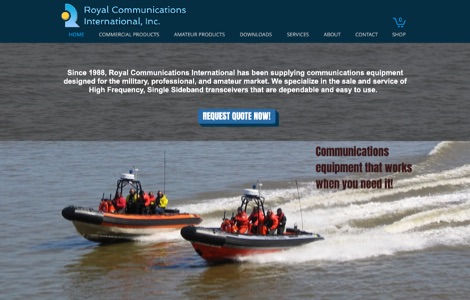 Since 1988, Royal Communications International has been supplying communications equipment designed for the military, professional, and amateur market. We specialize in the sale and service of High Frequency, Single Sideband transceivers that are dependable and easy to use.
 -
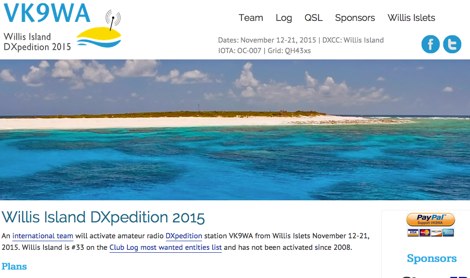 An international team will activate amateur radio DXpedition station VK9WA from Willis Islets November 12-21, 2015
 -
 International Police Association Radio Club, OO6P
 -
 Dedicated to improving the skills of amateur radio operators around the world, utilizing education, competition, advancement of technology and scientific research, promoting international friendship and goodwill, and preparing them to better serve society in times of communication need.
 -
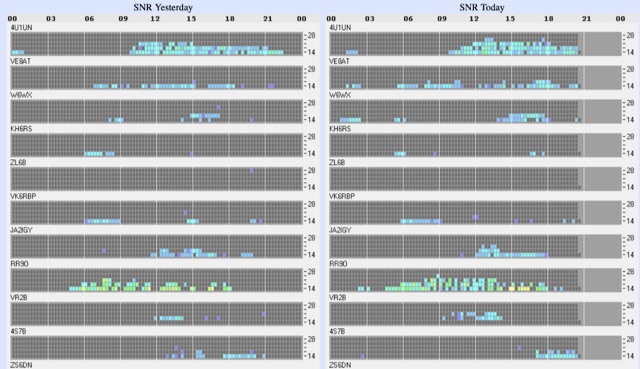 Reception of the IARU/NCDXF International Beacon Project from Trent, Germany with daily reception reports of HF IARU/NCDXF beacons.
 -
 Recommendation M.1677-1 (10/2009), General transmission rules, Morse code, signals, spacing and length of the signals.
 -
 VFC has grown to become the national leader in the lightning protection industry. Protecting facilities and equipment from lightning and transient current by designing and installing lightning protection, grounding, surge protection and lightning warning systems.
 -
 An information paper by the International Amateur Radio Union. The amateur service seeks the return to an exclusive, worldwide allocation of no less than 300 kHz in the vicinity of 7 MHz.
 -
 Official Rules of the ARI International DX Contest in Italian and English.
 -
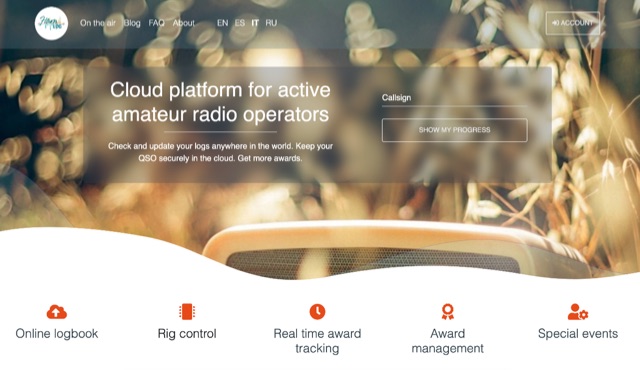 Hamlog is online cloud platform for active amateur radio operators. It supports various on the air activities of various clubs, associations and national amateur radio organizations, allows them to create award programs and deliver awards to those who earned them. Hamlog also has a built-in real-time logger, which allows operators to enter QSO in the system as they make them. It supports multiple callsigns, multiple locations, multi-station activities, etc. Soon it will allow to connect transceivers and other ham radio devices right to the browser, allowing easy online logging virtually anywhere.
 -
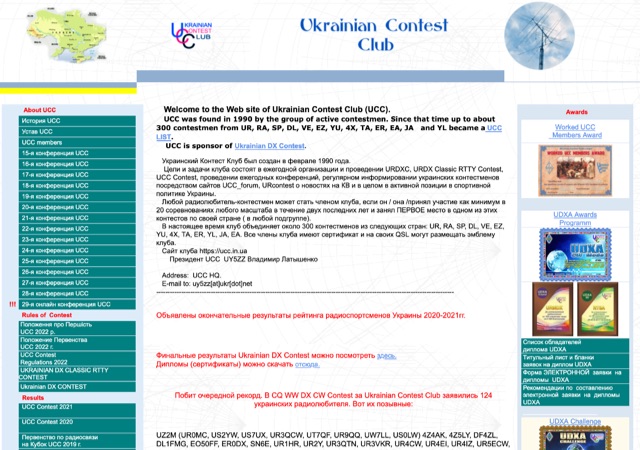 The Ukrainian Contest Club (UCC) website details contest activities, including a March 2026 contest calendar compiled by _UW3WF_ that excludes specific "exotic" tests, mini-tests, sprints, VHF competitions, and events organized by Russian entities. It lists major contests such as the ARRL International DX Contest, Stew Perry Topband Contest, and CQ WPX SSB Contest, providing dates, times, modes, bands (e.g., **10-160m**), organizers, log submission methods, and deadlines. The resource also highlights Ukrainian participation in various international contests, noting specific callsigns that represented the UCC, and acknowledges new Ukrainian records, such as UW5Y's new record in the ARRL DX CW Contest. The site presents contest results and rankings, including the top 20 Ukrainian contesters in the World Amateur Radio Contesting Association (WARCA) rating for 2019-2024, with _UW1M_ ranked #18 globally and #1 in Ukraine with **26,490.32** points. It also details the club's 12th place finish among 155 clubs worldwide in the CQ WPX Contest 2024 (CW + SSB). The resource includes information on WRTC 2026 participants from the club and lists members excluded due to collaboration with adversarial entities, reflecting the current geopolitical context.
 -
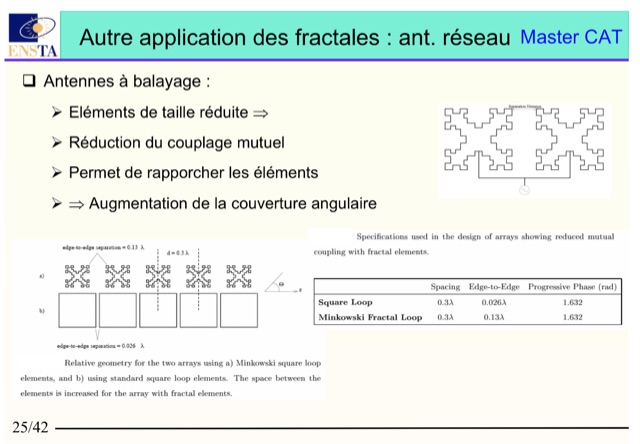 A course on fractals antennas theory provided by La Ecole nationale superieure de techniques avancees in France. Course is in French.
 -
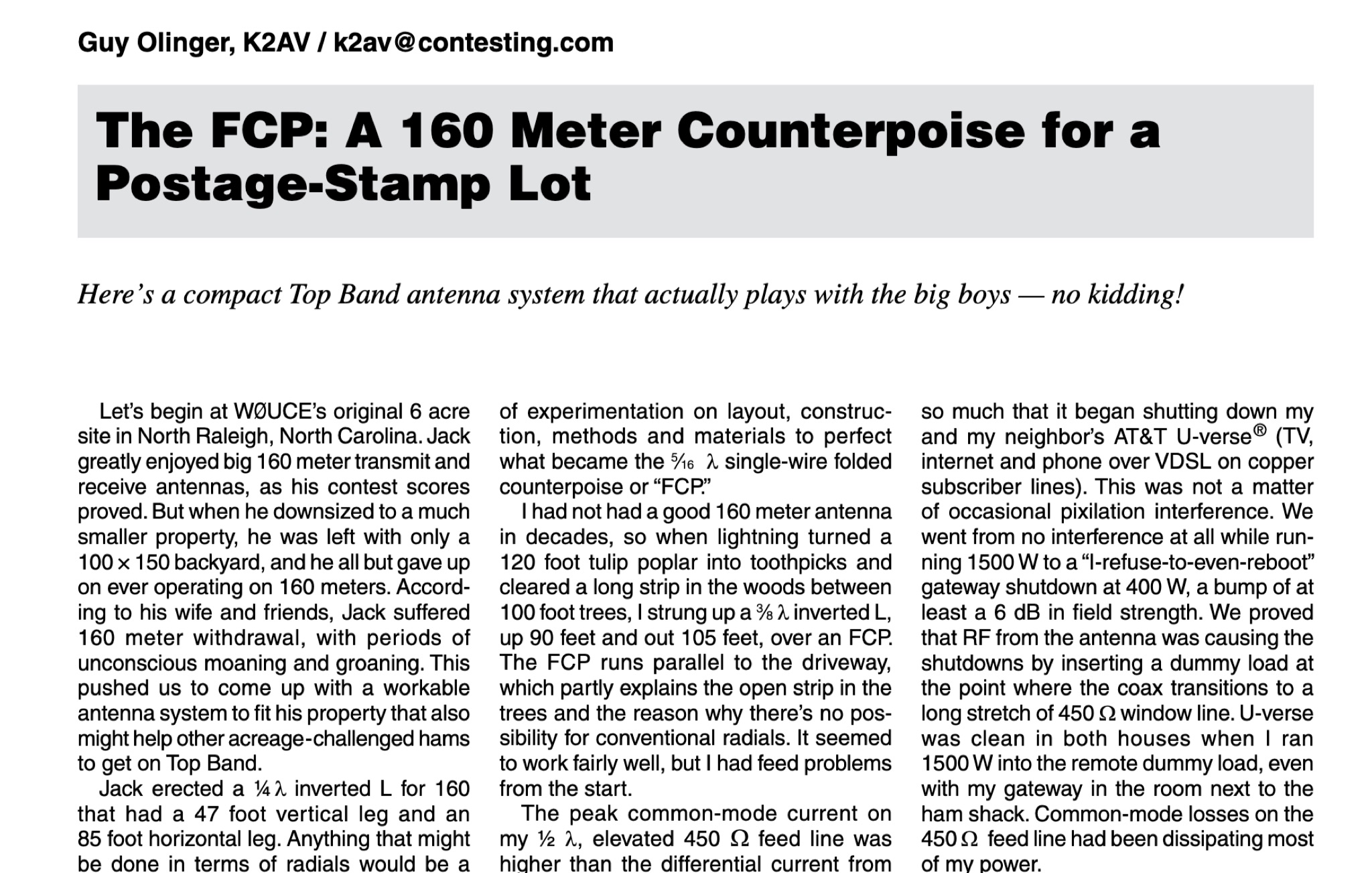 The article by Guy Olinger, K2AV, published in the May/June 2012 National Contest Journal, introduces the Folded Counterpoise (FCP), a compact 516-foot single-wire counterpoise elevated at 8 feet, designed for 160-meter operations on small lots like 100x150-foot backyards. Originating from efforts to revive Top Band for W0UCE on a postage-stamp property, the FCP uses strategic folds to cancel ground fields within 33 feet of center, minimizing losses to 0.13-0.53 dB—outperforming sparse or on-ground radials by up to 15 dB in poor soil—while mimicking opposed radials for efficient feedpoint impedance. Paired with a critical 1:1 or 4:1 isolation transformer (e.g., trifilar on T300-2 toroid) to block common-mode currents on coax feeds, it delivers proven results: K2AV's #8 North America low-power contest score, 7+ dB gains at W4KAZ and K5AF, and over 10,000 global web hits for DIY instructions using bare 12 AWG wire and weatherproof enclosures. Ideal for acreage-challenged hams, the FCP also excels on 80 meters with scaled dimensions, offering a low-loss alternative where full radials are impractical
 -
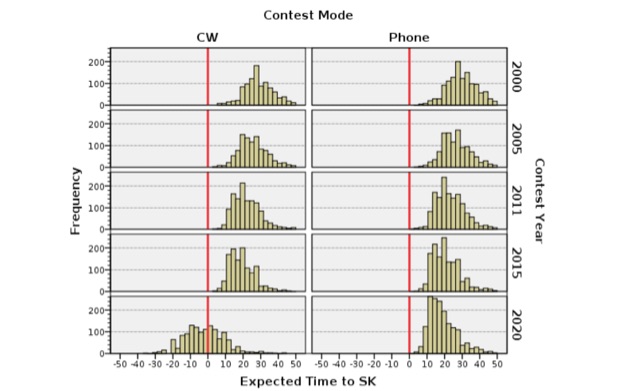 Examining the demographic shifts within amateur radio, particularly concerning **radiosport** participation, this resource analyzes survey data from the National Contest Journal (NCJ) and two regional ARRL surveys. It focuses on the relationship between age and engagement in contesting, presenting findings that suggest older amateur radio operators tend to participate in more contests annually. The author, a spatial demographer, details the methodology, including data consolidation, georeferencing, and statistical analysis performed in collaboration with Dr. Scott Wright K0MD, covering ARRL November Sweepstakes participants from 2000 to 2020. The analysis also addresses the limitations inherent in using voluntary response samples rather than random samples, which may influence the generalizability of the results. Furthermore, the resource investigates the preferred sources of contest information among different age groups, noting that older contesters frequently rely on traditional publications like the NCJ, while younger participants show a preference for online platforms. This demographic review provides insights into the evolving landscape of **amateur radio contesting** and the generational differences in information consumption.
 -
 This document serves as a thorough guide to amateur radio nets throughout Australia and includes some international (DX) nets. It outlines key information like frequencies, schedules, and the people responsible for managing these nets. Among the nets covered are Ron's 10 A.M. net, the Australian Travellers Net, and several others, each operating on different bands and regions. Additionally, it offers technical details about repeaters, such as frequency, offset, and CTCSS tones where applicable. Any updates are clearly marked, and further details are included for linked repeater systems and network connections.
 -
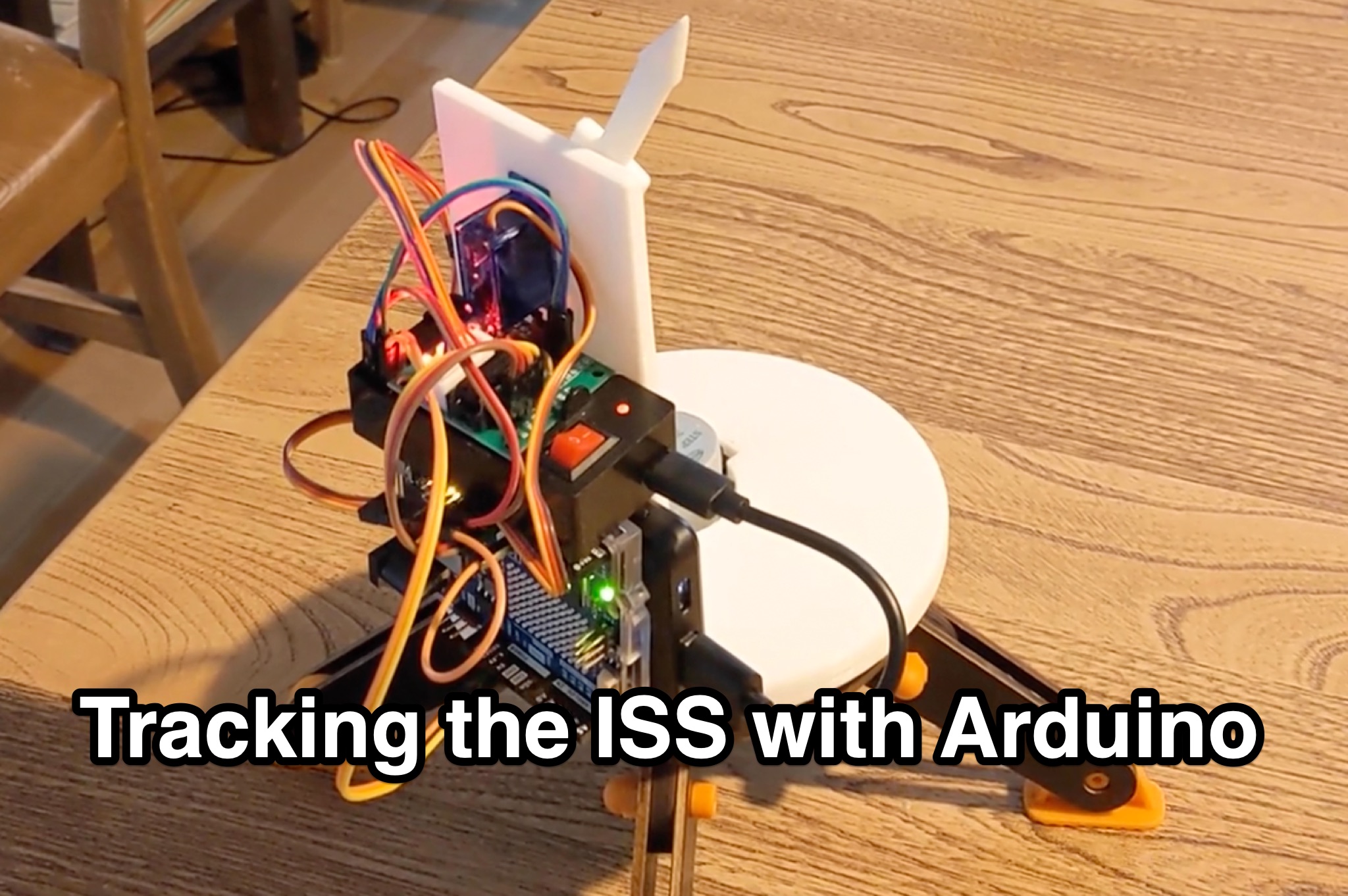 Learn how to hack an IR turret to track the International Space Station (ISS) as it passes overhead. Discover the basics of the ISS and how to use simple tools to point an arrow at the ISS without looking at a phone. Find out how to calculate the azimuth and elevation angles to locate the ISS in the sky and enjoy watching this habitable space craft orbit the earth at a speed of 28,000 km/h. Take your hobby to the next level by bouncing radio signals off the ISS or even talking to the astronauts on board. Turn stargazing into an interactive and educational experience with this fun and practical project.
 -
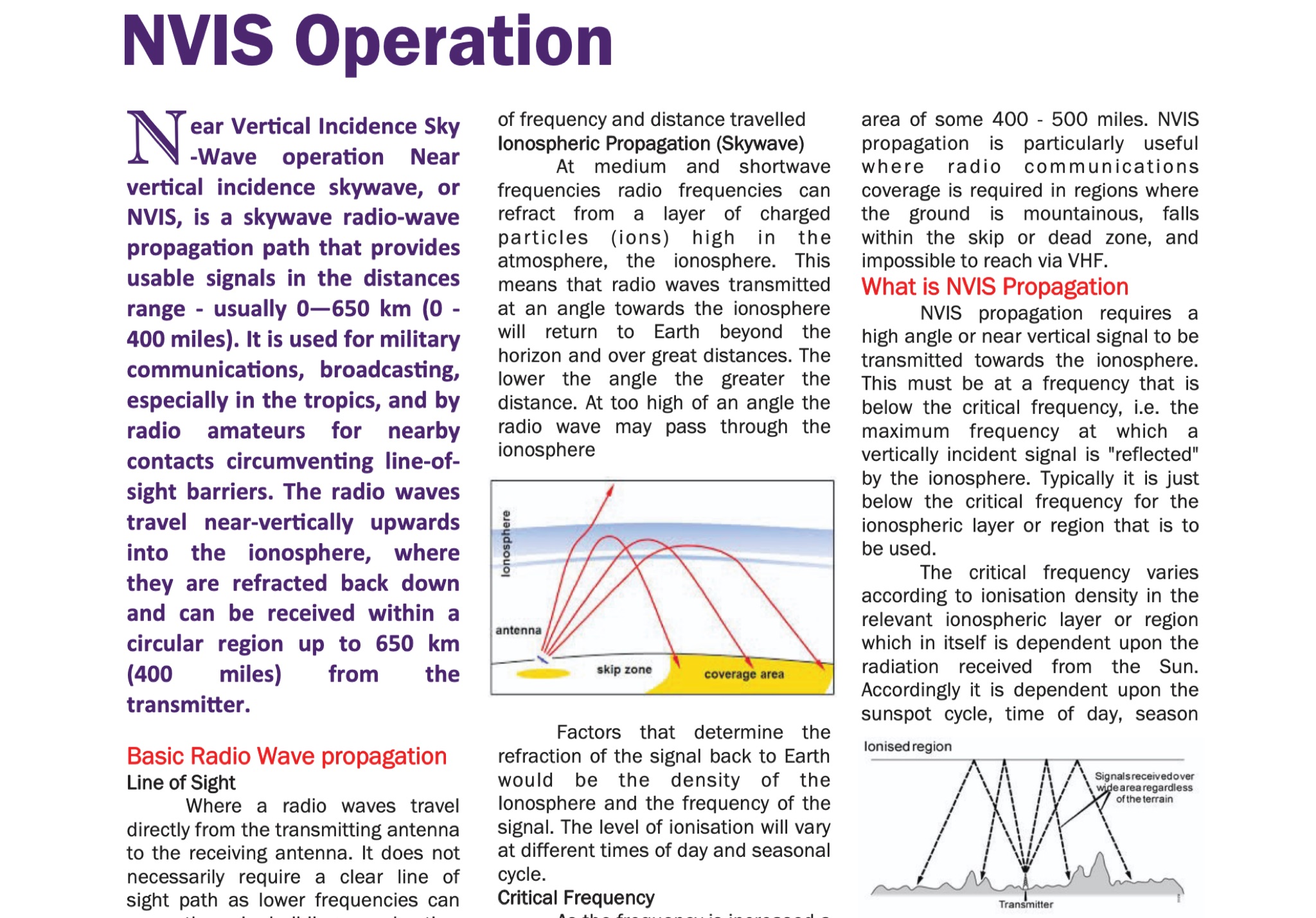 Understanding radio wave propagation is fundamental for effective HF communication, and this guide from the Galway Radio Club elucidates the principles behind _Near Vertical Incidence Skywave_ (NVIS) operation. It begins by contrasting NVIS with line-of-sight and surface wave propagation, highlighting its utility for reliable regional coverage, particularly in challenging terrains or within the skip zone. The document explains how NVIS leverages high-angle radiation, refracting signals from the ionosphere to return to Earth within a circular region, typically up to **650 km** (400 miles) from the transmitter. The guide delves into critical factors influencing NVIS, such as the _critical frequency_ (Fo) and the Maximum Usable Frequency (MUF), emphasizing their dependence on solar activity, time of day, and season. It provides practical advice on frequency selection, noting that 40 meters is often the highest daytime NVIS band, with 60 meters and 80 meters favored as darkness falls. The author, EI5DD, suggests using an ionogram for real-time propagation data, considering it more reliable than generic ham-clocks. Antenna considerations are also covered, recommending dipoles, inverted vees, or phased dipoles positioned 0.1 to 0.25 wavelengths above ground for optimal high-angle radiation. The document mentions mobile NVIS setups, including military configurations and commercial options like the Barrett Communications roof-rack antenna, which can cost around **£2000.00**. It concludes by reinforcing NVIS as an essential technique for national emergency communications, with 5 MHz (60m) and 80 meters being primary bands for daytime and nighttime operations, respectively.
 -
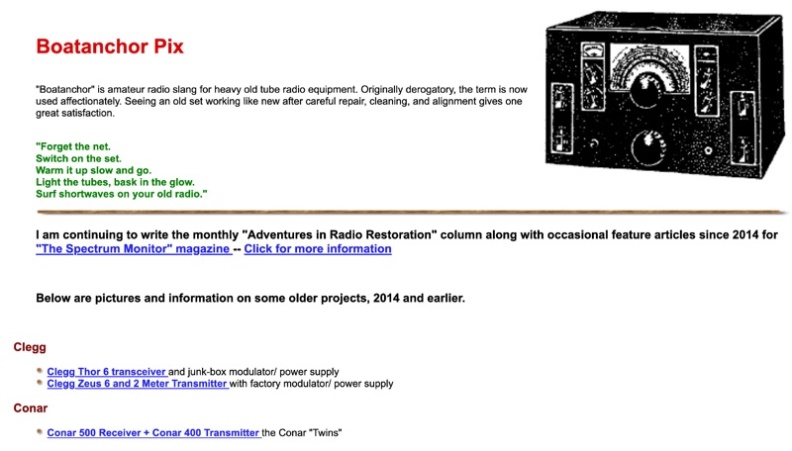 A website deticated to Boathancors, with lots of pictures of some of the most popular ol tube radios from Hallicrafters, Hammarlund, Heathkit, Lafayette, National, Zenith and some projects. Boatanchor is amateur radio slang for heavy old tube radio equipment. Originally derogatory, the term is now used affectionately. Seeing an old set working like new after careful repair, cleaning, and alignment gives one great satisfaction.
 -
 National Communications Magazine is a subscription-based weekly publication on Substack, focusing on scanner radios, CB radio, GMRS, FRS, and MURS. Transitioning from print to an online PDF format in 2012 and to Substack in April 2023, it delivers timely content for radio enthusiasts. Edited and published by Chuck Gysi, the magazine provides in-depth coverage and updates across diverse communication services.
 -
 Presents DJ5IL's personal amateur radio station, detailing his journey as a licensed operator since 1973. The resource covers his **shack setup**, including an Elecraft K4D, Icom IC-7610, and various vintage transceivers like the Drake 2-B, along with a SPE Expert 1K-FA amplifier. Antenna systems include a PRO.SIS.TEL RD1524T rotary dipole for 40/20/15/10m at 15m height, an 18m vertical dipole with an SGC SG-230 tuner for 3.5-30 MHz, and an inverted-V dipole for 80m. The site features a **QSL gallery** showcasing his custom card designs and outlines his QSL policy, emphasizing the exchange of unique, personalized cards over generic confirmations. It also includes a detailed operator's biography, tracing his early fascination with radio, obtaining his license at 16, and memorable QSOs, such as a contact with his blood-relative W3NZ. The resource also delves into the historical significance of amateur radio's role in pioneering shortwave communication following the 1912 International Radiotelegraph Convention, which initially relegated amateurs to wavelengths of 200 meters and shorter. DJ5IL's philosophy on "ham spirit" is discussed, stressing the unpolitical nature of amateur radio as a global fraternity.