Search results
Query: ham radio log
Links: 442 | Categories: 23
Categories
- Ham Radio > Ham Radio News
- Ham Radio > Blogs
- Software > Log Analysis
- Software > Log Converters
- Software > Android
- Software > Contesting
- Operating Modes > D-STAR
- Software > Decoders
- Ham Radio > Blogs > Europe > Germany
- Ham Radio > Blogs > Asia > India
- Software > iPhone
- Operating Modes > Internet Linking > IRLP
- Software > Linux
- Software > Legacy Systems > MS DOS
- Manufacturers > Test Equipment > Multimeters
- Ham Radio > Blogs > Oceania
- Internet and Radio > Pictures
- Operating Modes > Remote Operations
- Ham Radio > Blogs > Special Interest
- Operating Aids > Time
- Ham Radio > Blogs > Europe > UK
- Ham Radio > Blogs > USA
- Operating Modes > WiFi
-
 More than just a Ham Radio Blog – CQHQ is an informative, cynical and sometimes humorous look at what is happening in the world of amateur radio
 -
-
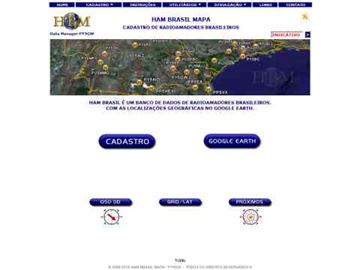 Approximately 524,475 Brazilian amateur radio operators are cataloged within this resource, offering a comprehensive database for the South American region. Each entry includes geographical coordinates, enabling users to visualize station locations directly within Google Earth. This functionality supports DXers in identifying potential contacts and understanding propagation paths relative to specific Brazilian QTHs. The platform serves as a digital callbook, primarily focused on the Brazilian amateur radio community. It facilitates the lookup of callsigns and associated location data, which is crucial for award tracking, contest planning, and general operational awareness. The integration with mapping services provides a visual dimension to traditional callsign databases, enhancing the utility for operators interested in geographical aspects of radio communication.
 -
 Producers of custom name tags, luggage tags, club badges, Employee Name Tags, Special Event Badges, but also Comtech Amateur Radio Television Transmitters and Receivers D480 filters, Video cameras and accessories.
 -
 Blog related to ham radio t-shirt and accessory designs
 -
 Personal blog dedicated to the world of ham radio. Ivan Palcic, Novalja, island Pag, Croatia
 -
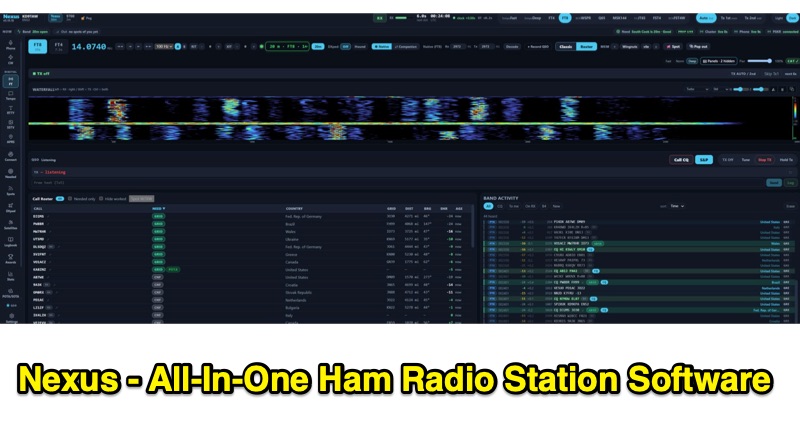 Nexus is a free and open-source ham radio software application, built in Rust by KD9TAW, designed to integrate multiple station functions into a single program. It supports fifteen operating modes, including FT8, FT4, CW, SSB, FM, RTTY, SSTV, and APRS, with both transmit and receive capabilities across Windows, Linux, and Raspberry Pi platforms. The software provides band activity displays with country, distance, and bearing information, a call roster, a 3-D propagation globe with live spots, and alerts for new DXCC, WAS, WAZ, VUCC, and IOTA entities. It also features a native RF panadapter for Icom CI-V and Flex radios, or a live audio scope for other transceivers. Nexus integrates a comprehensive logbook, computes awards offline without requiring an account, and includes repeater search functionality with curated memory packs. It offers CHIRP CSV round-trip compatibility for approximately 1,000 radio models and is compatible with WSJT-X, JTDX, and MSHV via UDP protocol for seamless integration with existing workflows. The application supports ADIF import/export for log data management and provides accessibility features for operators with hearing or visual impairments, including screen reader compatibility and keyboard-navigable interfaces.
 -
 My blog is general info regarding HAM radio hobby and collection of my QSL cards
 -
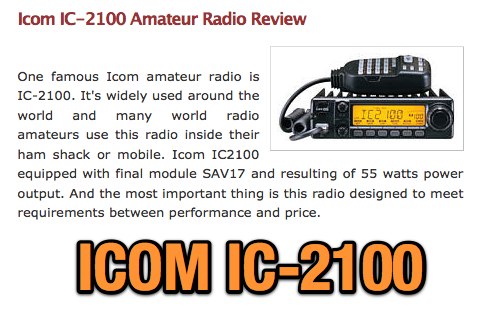 Review of the popular Icom IC-2100 VHF ham radio transceiver by YB3TD
 -
 Amateur Radio Operator since April of 2005. My time as a Technician was primarily spent working for the community and various organizations to provide Emergency Communications. I originally became a ham to work DX but found enjoyment volunteering for the local community.
 -

-
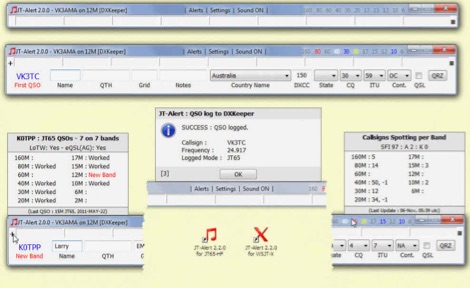 JTAlert provides several audio and Visual alerts for WSJT-X & JTDX software. JTAlert generate audio and visual alerts for several alert conditions, logs automatically to several ham radio log books software like hrd dxkeeper,log4om, interoperates with web services and it supports dxlab suite.
 -
-
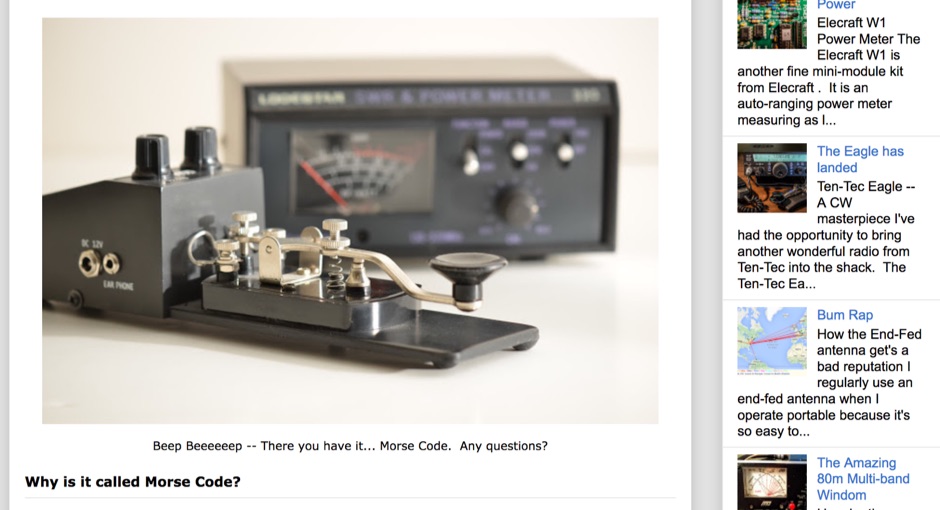 An interesting article dedicated to hams that want to start learning morse code, including notes on Methodology, online training tools, and a guide to Morse Keys
 -
 Presents RigOne, a radio controller application designed for Windows 10 (later releases) and Windows 11, with a macOS version under active development. The software provides core operational controls such as tuning, VFO following, signal metering, and audio management, emphasizing a clean interface for everyday use. It supports native Icom direct control, with the **IC-7300** serving as the primary tested profile, and integrates **Hamlib** for broader compatibility across various transceivers. The resource details specific features, including frequency and mode read/write, VFO A/B switching, quick mode/band selectors, and switchable analog-style or horizontal-bar signal meters. For the IC-7300, RigOne offers an integrated panadapter, waterfall display, native VOX control, and Twin PBT controls, leveraging live scope data for an enhanced visual operating experience. The application focuses on essential functions, avoiding unnecessary clutter. It outlines the latest version, v1.2.5.1, highlighting updates like a compact layout selector for Tall mode, direct frequency entry, and refined fixed 16:9 panel layouts. The page also clarifies hardware compatibility, noting extensive testing with the IC-7300 via USB/COM CI-V, and invites user feedback for expanding Hamlib support to other radio models, ensuring the software evolves based on real-world amateur radio station use.
 -
 This resource presents a placeholder page for the _Tobacco Valley Amateur Radio Club_ (TVARC), signaling the future establishment of an online presence for this amateur radio organization. The page currently displays a "Coming Soon" message, indicating that the club's official website is in development. It serves as a preliminary marker for the club's digital footprint, suggesting an upcoming platform for members and prospective hams. The current state of the page offers no technical details, operational information, or specific club activities. It functions solely as a temporary landing page, prompting site owners to log in for launch and visitors to check back later. The resource does not provide any data on club repeaters, meeting schedules, or special events, nor does it detail any past achievements like **DX contacts** or **contest scores**.
 -
 A nice blog about DXing, Shortwave Radio Listening (SWL) and Amateur (Ham) Radio by VK3BVW
 -
 Blog post announcing that Ham Radio, shortwave listeners and broadcast band listeners will be protected by Law in Europe
 -
-
 W0VLZ ham radio experience incuding vintage homebrew QRP operating and national radio company
 -
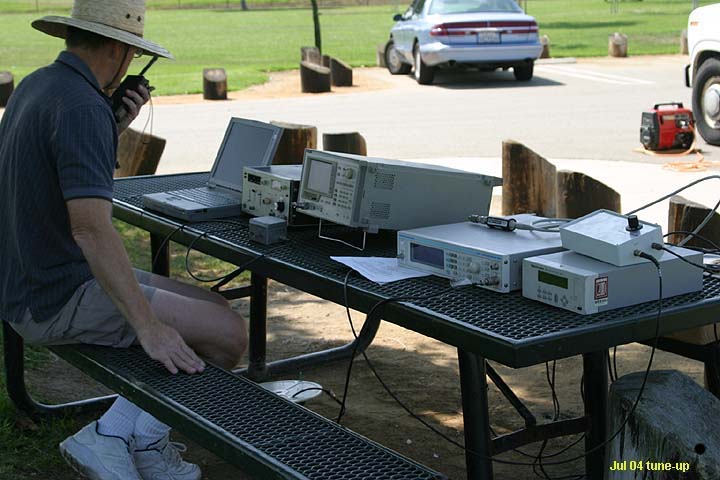 The San Bernardino Microwave Society, operating under the callsign _W6IFE_, serves as a significant technical hub for amateur radio operators specializing in frequencies above 1 GHz. This organization's influence extends across Southern California, providing a centralized resource for advanced RF experimentation and **regional frequency management** within the microwave spectrum. Its permanent value lies in its extensive archive of technical papers and project documentation, which are critical for operators engaged in high-frequency design and deployment. The society's infrastructure is primarily intellectual, focusing on the dissemination of specialized knowledge rather than a conventional repeater network. It offers a robust collection of technical papers from prominent members like K6PIP, K6BLG, and WA6EXV, covering topics such as Rubidium oscillator data, logging software, and filter design. This resource facilitates advanced amateur radio operations, including participation in microwave contests and the development of custom transverters for bands like 24 GHz. The site also details various member projects, such as the Owens Valley Radio Observatory Project, showcasing practical applications of **RF propagation analysis** and system integration. DXZone Focus: Microwave | Technical Papers | RF Propagation | Contest Results
 -
-
 Highlights the PRO CW CLUB's mission to foster the art of telegraphy, a fundamental skill in amateur radio. The club actively encourages members to engage in CW operation, emphasizing its historical significance and continued relevance in modern ham radio communications. Members participate in various activities designed to improve their Morse code proficiency and on-air operating techniques. The club's focus extends to supporting new operators in mastering CW, providing resources and mentorship to help them achieve comfortable speeds and accurate copy. This dedication ensures that the legacy of _telegraphy_ endures within the amateur community, connecting hams across continents with the simplicity and effectiveness of dots and dashes. The PRO CW CLUB serves as a hub for CW enthusiasts, promoting regular on-air activity and camaraderie among its members, who span the globe.
 -
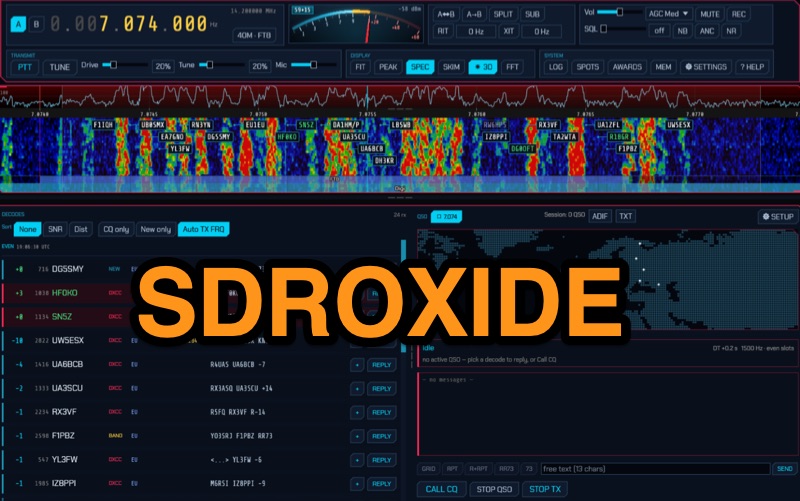 Operates as a universal client for Software Defined Radios, SDRoxide provides a robust platform for amateur radio operators to engage in diverse modes and activities. It integrates a **GPU panadapter** for real-time spectrum visualization, dual VFOs for flexible tuning, and advanced neural noise reduction to enhance weak-signal reception. The software supports a comprehensive suite of digital modes, including FT8, JS8, RTTY, and PSK, alongside built-in skimmers for automated signal detection. Its capabilities extend to Winlink radio email, 868 MHz ISM sensor decoding, and hands-free satellite operation with continuous Doppler correction and Hamlib rotator tracking. The client offers native drivers for popular SDR hardware like RTL-SDR, RX-888, and HackRF One, covering a wide frequency range from 1 MHz to 6 GHz. It also interfaces with CAT-controlled transceivers via Hamlib and Flrig, allowing a second SDR to function as a panadapter. Network dongles, SpyServer, KiwiSDR, and OpenHPSDR Ethernet SDRs are also supported, providing flexibility for remote and local operations. Beyond core radio functions, SDRoxide incorporates a live 3D space-weather globe with aurora and lightning displays, real-time satellite tracking with TLE updates, and a measured propagation heat map. It includes a full-featured logbook with DX cluster spots, award tracking for **DXCC** and WAS, and direct QSL upload integration with services like eQSL and Club Log, streamlining post-QSO management.
 -
 Amateur radio operators often document their station activities, equipment, and on-air experiences through personal blogs. These platforms serve as a digital logbook, sharing insights into antenna setups, radio modifications, and DX contacts. Such blogs frequently feature photographs of the shack, descriptions of operating conditions, and reflections on various aspects of the hobby, including contesting or portable operations. The PBG Station Brunei blog provides a glimpse into the amateur radio scene from Southeast Asia. It covers general station updates, local repeater information, and personal reflections on radio operations. The content offers a localized perspective on ham radio activities within Brunei, including details about specific frequencies and equipment used for local communication.
 -
 Station QRP presents various **circuit diagrams** for constructing low-power AM vacuum tube shortwave transmitters, catering to enthusiasts interested in vintage radio technology. The resource details schematics ranging from simple to more complex designs, enabling hams to build their own QRP AM transmitters for operation on frequencies like 6.925 kHz AM. It emphasizes the use of vacuum tubes, providing a technical foundation for understanding and replicating classic shortwave broadcasting methods. The content is geared towards those who enjoy the hands-on aspect of electronics and the unique characteristics of tube-based RF circuits. Building these transmitters allows operators to experience the nostalgia of early shortwave radio, with the site specifically mentioning a pioneer station on 6.925 kHz AM. The designs facilitate experimentation with low-power AM transmission, offering practical application for homebrew projects. The focus on QRP (low power) operation aligns with a segment of the amateur radio community that values efficiency and minimalist setups, providing a distinct alternative to modern solid-state transceivers.
 -
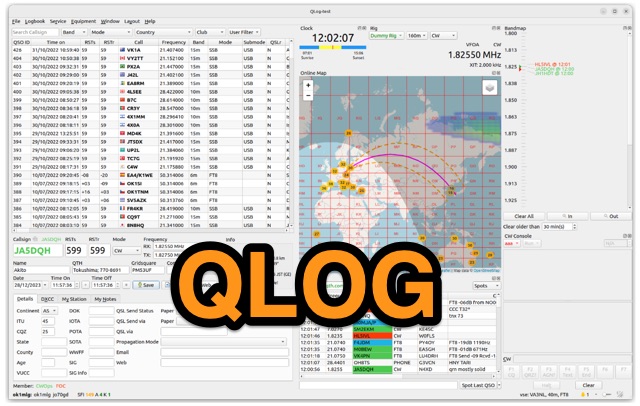 Provides a robust logging solution for amateur radio operators across multiple operating systems, QLog simplifies the process of recording contacts and managing station data. It leverages the _Qt framework_ for its graphical user interface and stores all QSO information efficiently in a local SQLite database, ensuring data integrity and accessibility. This design choice supports a streamlined user experience for daily logging activities. QLog supports essential logbook functionalities, enabling hams to accurately document their two-way radio contacts. While not specifically designed for high-speed contest operation, it serves as a reliable tool for general amateur radio logging, allowing operators to maintain detailed records of their on-air achievements and station activities. Its cross-platform compatibility, including Linux, Windows, and macOS, makes it a versatile option for a wide range of amateur radio enthusiasts seeking a free and functional logging application. The project is a fork from _7h0ma5/QLog_, indicating a continued development path.
 -
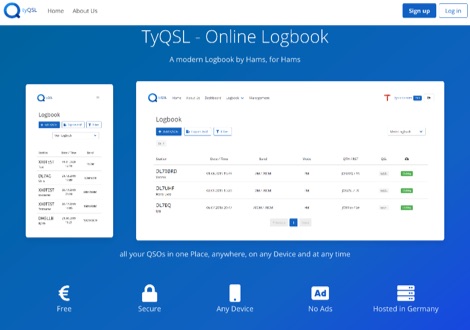 TyQSL provides a web-based online logbook platform, enabling users to manage all QSOs from any device with features like fast ADIF import, supporting up to **100,000 QSOs** per file. The platform facilitates real-time uploads to services such as _Clublog_ and _eQSL_, either automatically or with a single click, ensuring logs are current across multiple platforms. Operators can manage multiple callsigns and create various logbooks within a single account, allowing for flexible QSO organization. The integrated logger features a streamlined layout with live DXCC checking, duplicate QSO alerts, and autofill for satellite operations. It also supports one-click logging from _WSJT-X_. Users can share public profiles, displaying QSO statistics and searchable logbooks, enhancing community interaction. A PRO account offers additional features like an interactive QSO map, showing worked grids and future activities of other users.
 -
 Ham radio and electronics radio blog from India
 -
-
 Stuff about amateur (ham) radio, with emphasis on VHF/UHF, QRP, portable and mountaintop operating.
 -
 Stuff about amateur (ham) radio, especially VHF/UHF, QRP, portable and mountaintop operating
 -
-
-
-
-
-
-
-
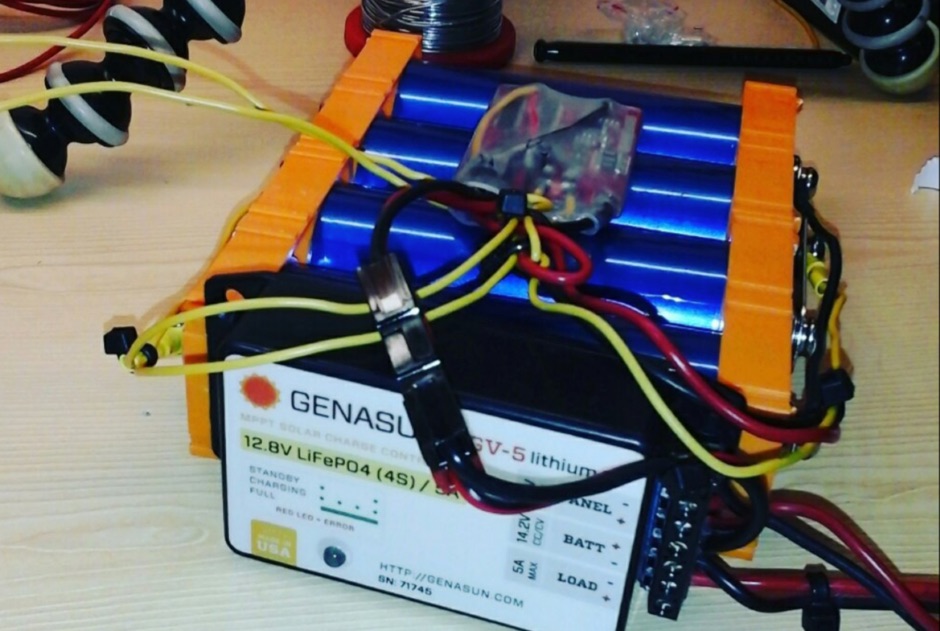 An interesting article about a homemade LiFePO4 battery pack for ham radio operations, a 10Ah LiFePO4 based on Headway 38120 Cells
 -
 A blog by W1REI dedicated to ham radio hobby
 -
 A ham radio blog primarily focused on newbies and those interested in the hobby. Covers a wide area of subjects that might be of interest to Amateur Radio operators, and material that can be used to study for the Amateur Radio tests.
 -
 A Primer On Mics For Ham Radio. Difference between dynamic and condenser microphones, microphone plugs and differences in kind of microphones available on the market
 -
 High Speed Multimedia (HSMM) radio, as introduced by John Champa, K8OCL, represents a significant advancement in amateur radio's digital capabilities, moving beyond traditional keyboard modes like packet radio. This initiative, driven by ARRL's Technology Task Force, focuses on developing high-speed digital radio networks capable of up to 20 megabits per second. HSMM primarily facilitates digital voice (DV) and digital video (ADV), enabling real-time video transmission from emergency scenes to an EOC without expensive ATV gear, often requiring only a laptop, a PCMCIA card, a digital camera, and a small antenna. The working group's initial efforts concentrate on cultivating microwave skills within the amateur community to build and support portable and fixed high-speed radio-based local networking, or **RLANs**. These networks prove invaluable for RACES and ARES organizations, as well as homeland security and other emergency communications. Field Day exercises and simulated emergency tests (SETs) are encouraged to hone skills in rapid site surveys and deploying broadband HSMM microwave radio networks, with examples like linking Field Day logging stations or antenna test results at the Midwest VHF-UHF Society Picnic 2003. Getting started with HSMM often involves adapting off-the-shelf **IEEE 802.11** (WiFi) equipment to comply with amateur radio regulations, typically operating in the 2.4 GHz ISM bands. While consumer WiFi gear has range limitations under Part 15 rules, proper setup under amateur regulations can extend coverage significantly, with test networks like the Hinternet achieving 5-15 mile ranges at 54 M bit/s using small mast-mounted dish antennas. Careful selection of equipment with external antenna ports, high transmit power, and low receive sensitivity is crucial, along with using low-loss coaxial cable like LMR-400 for optimal performance at these frequencies.
 -
-
 Personal blog devoted to ham radio topics, portable operation, homebrew, antenna and other projects
 -
 Weblog from Florence Italy, with personal infos and updates on his ham radio activity
 -
 This site is established by a group of ham members who wish to see the interests of amateur radio in Malaysia protected.
 -
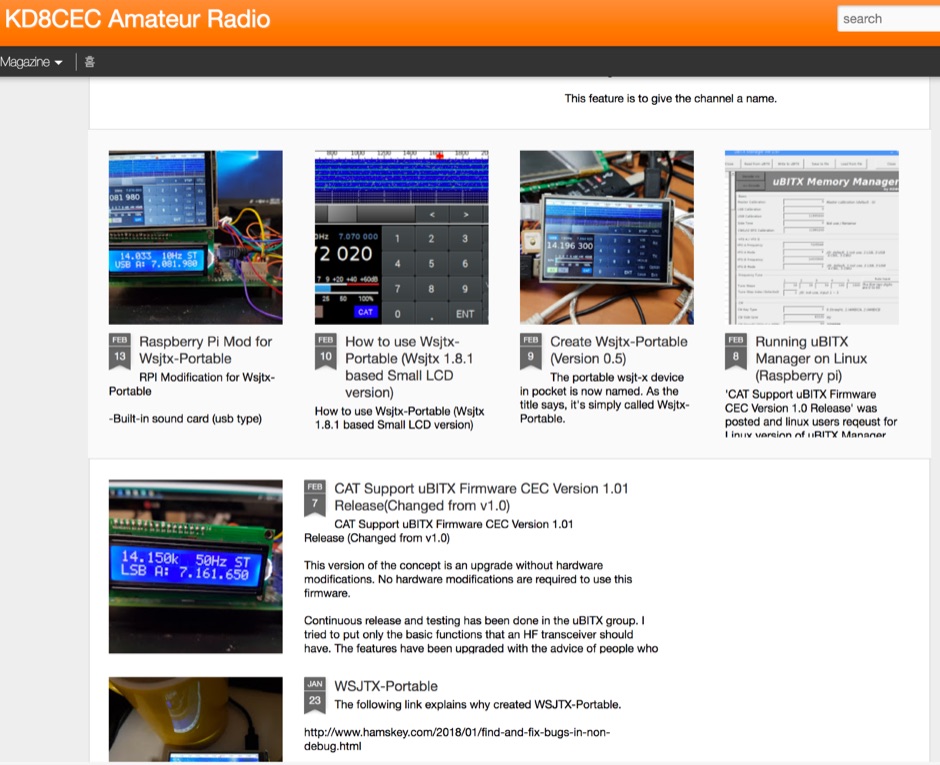 A personal blog about amateur radio activities, including homebrew, bitx, ubitx, mcHF, JT65, FT8 and more digital communications.
 -
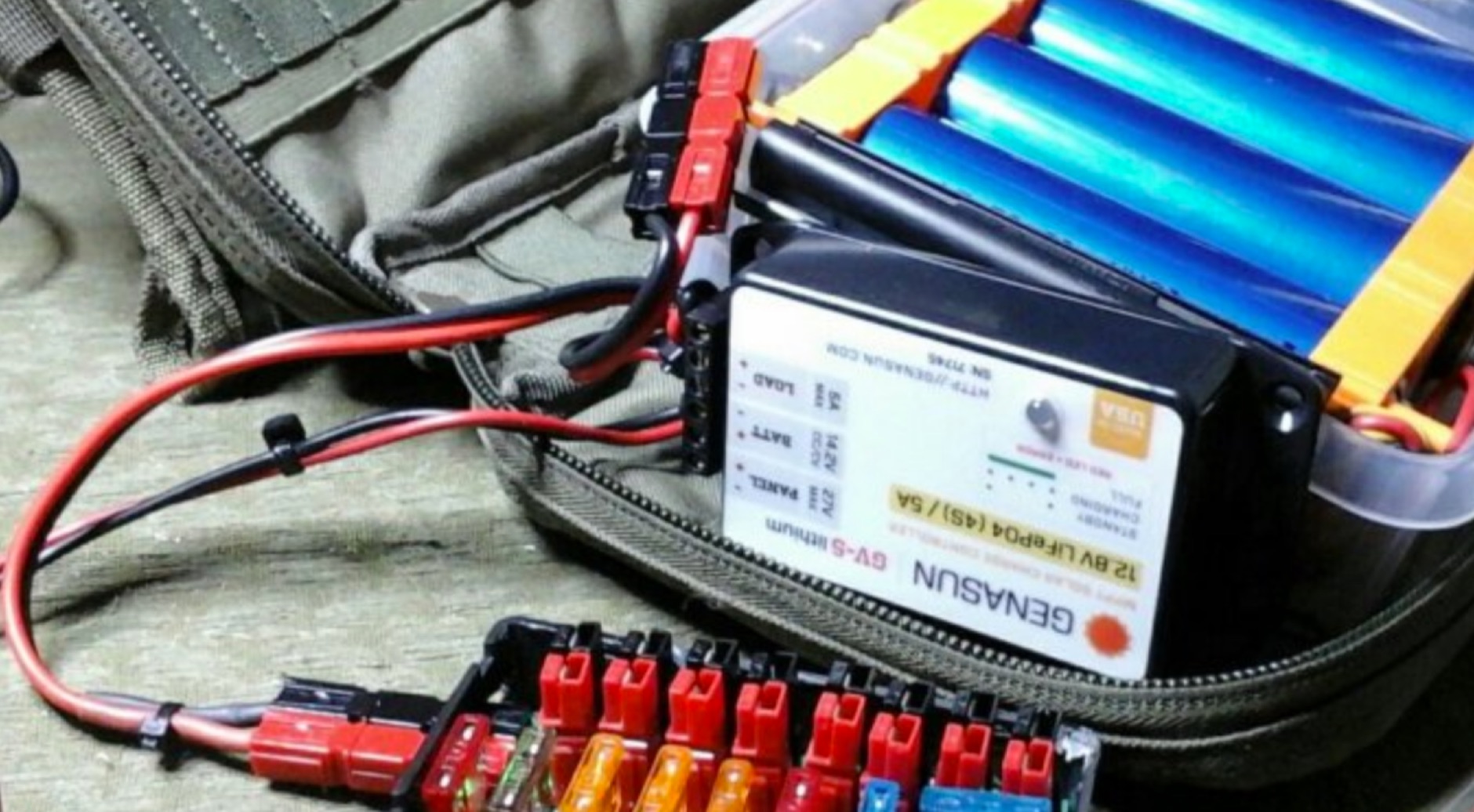 Using portable battery power is always a challange when operatin amateur radio in sota oprations. This article is about implementing lithium iron phosphate cells (LiFePO4) in ham radio portable operations.