Understanding NVIS for Local Ham Radio Communication
Learn about Near Vertical Incidence Skywave (NVIS) propagation, its operating frequencies, and suitable antenna types for effective short-range communication.

Near Vertical Incidence Skywave, or NVIS, is a propagation mode particularly useful for short to medium-range communications on HF bands, typically up to 400 km. It relies on signals being sent almost straight up and reflected back down from the ionosphere, covering a local area without a skip zone. This makes NVIS ideal for emergency communications, tactical operations, and regional nets where operators need reliable links over challenging terrain.
Understanding NVIS involves selecting the right frequency for current ionospheric conditions and using antennas designed for high-angle radiation. Operators often use horizontal wire antennas like dipoles or loops mounted low to the ground to achieve the necessary radiation pattern. Resources in this category provide detailed explanations of NVIS theory, including presentations by experienced hams like N4UFP, and practical guidance on antenna selection and operating frequencies for effective NVIS QSOs.
Related Categories
-
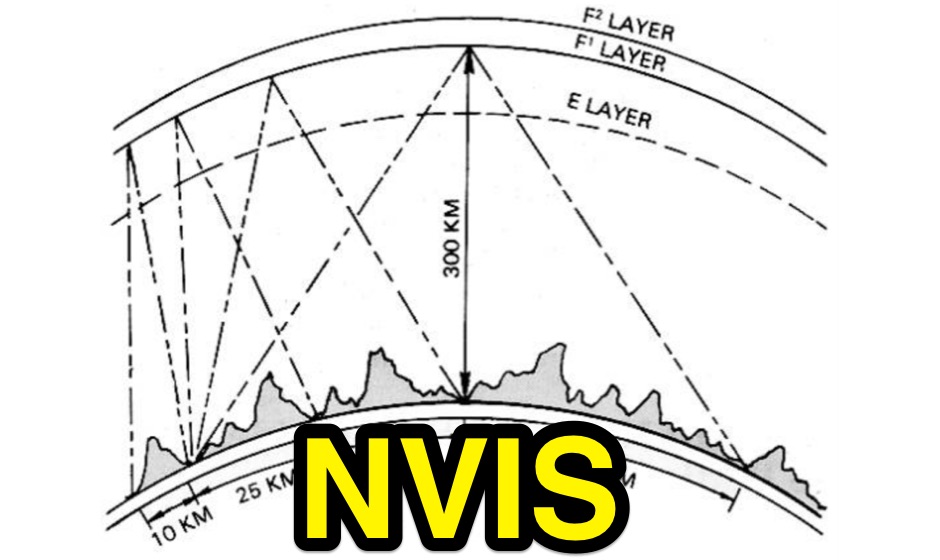 Operating NVIS mode, understanding operation frequencies, choosing the proper antenna to operate with the Near Vertical Incidence Skywave propagation
 -
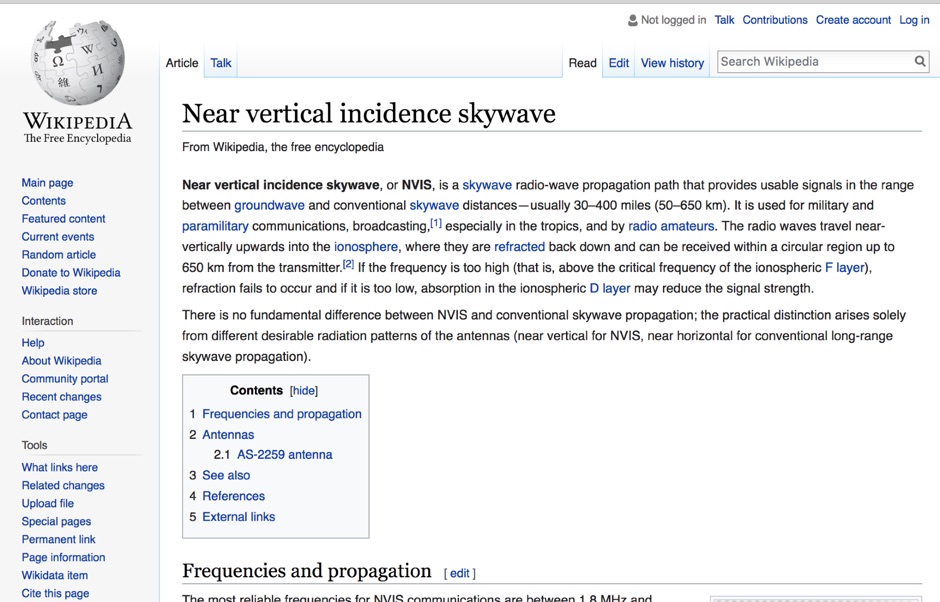 The wikipedia article about NVIS Near vertical incidence skywave with information about usable frequencies and some general information on main NVIS oeprations usages