Search results
Query: icom ic r 5
Links: 467 | Categories: 28
Categories
- Manufacturers > Transceivers > Icom
- Radio Equipment > Antenna Tuners > Icom AH-4
- Radio Equipment > VHF-UHF Mobile > ICOM IC-2100H
- Radio Equipment > VHF-UHF Mobile > Icom IC-2300H
- Radio Equipment > VHF-UHF Mobile > ICOM IC-2720H
- Radio Equipment > HF Transceivers > Icom IC-7000
- Radio Equipment > HF Transceivers > Icom IC-703
- Radio Equipment > HF Transceivers > Icom IC-705
- Radio Equipment > HF Transceivers > Icom IC-706
- Radio Equipment > HF Transceivers > Icom IC-7100
- Radio Equipment > HF Transceivers > Icom IC-718
- Radio Equipment > HF Transceivers > Icom IC-7300
- Radio Equipment > HF Transceivers > Icom IC-746
- Radio Equipment > HF Transceivers > ICOM IC-756
- Radio Equipment > HF Transceivers > Icom IC-7600
- Radio Equipment > HF Transceivers > Icom IC-7700
- Radio Equipment > HF Transceivers > Icom IC-7760
- Radio Equipment > HF Transceivers > Icom IC-7851
- Radio Equipment > HF Transceivers > Icom IC-9100
- Radio Equipment > Receivers > Icom IC-R20
- Radio Equipment > Receivers > Icom IC-R7100
- Radio Equipment > Receivers > Icom IC-R75
- Radio Equipment > VHF-UHF Mobile > Icom IC-V8000
- Radio Equipment > VHF-UHF Handhelds > Icom ID-51A
- Radio Equipment > VHF-UHF Mobile > ICOM ID-880H
- Radio Equipment > HF Amplifiers > Icom PW-1
- Radio Equipment > HF Transceivers > Icom IC-7610
- Technical Reference > HF Radios
-
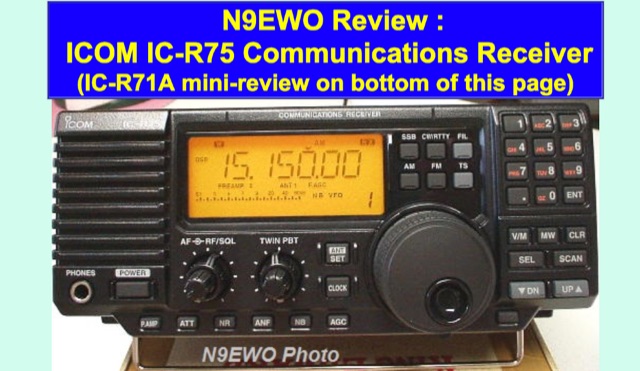 Icom IC-R75 tabletop HF communications receiver came onto the market back in 1999 and was taken out of production in late 2015. Frequency coverage is from 30 hz right to 60 MHz. This allows one to catch the 6 Meter amateur band as well.
 -
 Make an otherwise fine radio even better, change one resistor and one capacitor in the audio section
 -
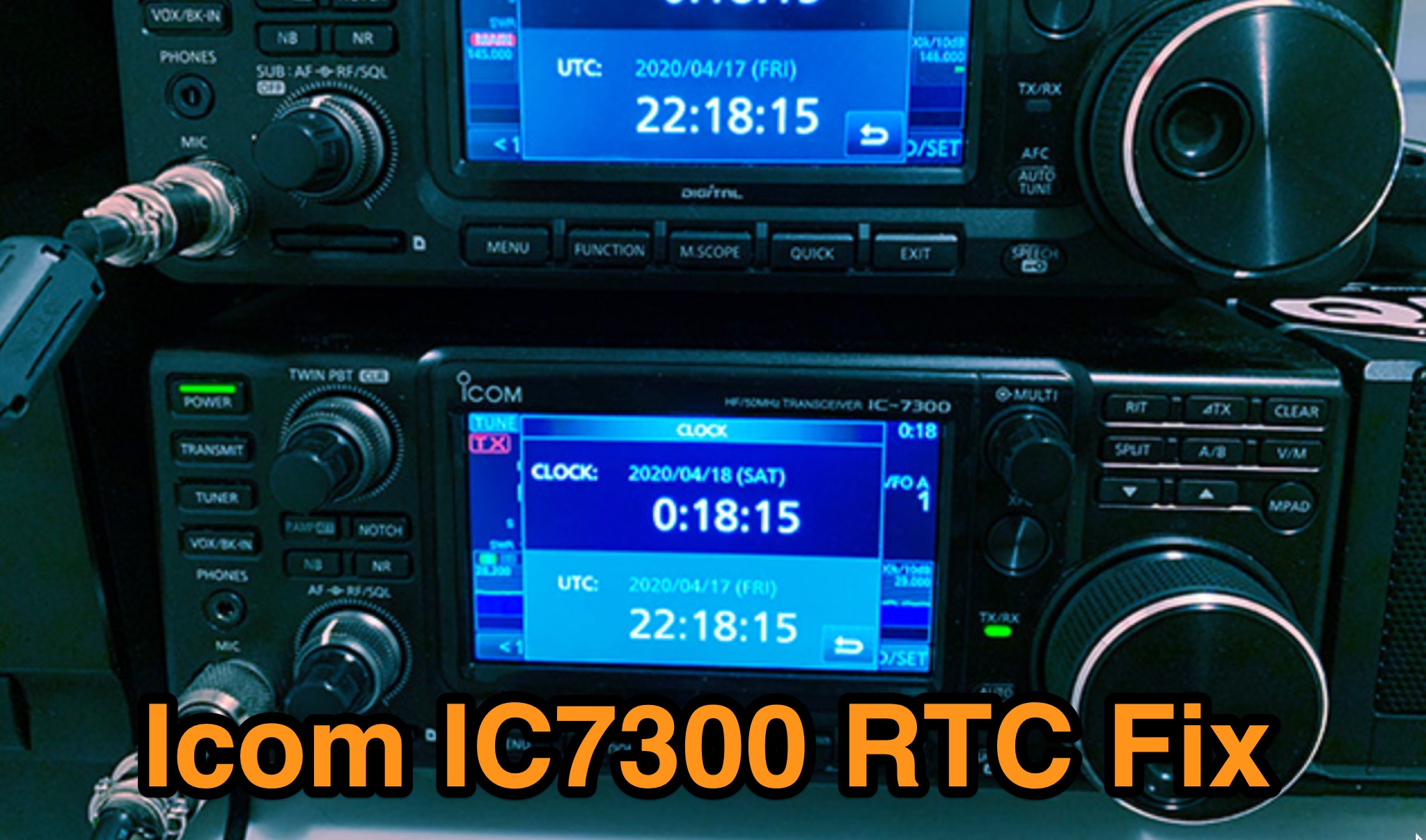 The article "Icom IC7300 RTC Fix" details the meticulous repair of an Icom IC-7300's faulty real-time clock (RTC). The author and a friend, Nacho, discovered the RTC was gaining an unacceptable 11 seconds per day. Investigations revealed the Seiko Epson RX8803LC RTC was far outside its specified stability. Despite replacing the RTC and a burned pullup resistor, the transceiver still malfunctioned, leading to the replacement of the processor. Post-repair, the clock's accuracy improved significantly, now gaining only 1.4 seconds per month. This narrative underscores the complexities of electronic repairs and the satisfaction of resolving intricate issues.
 -
 Official English Brochure by ICOM of the IC-7760 HF and 50 MHz 200W Power output, transceiver. PDF File
 -
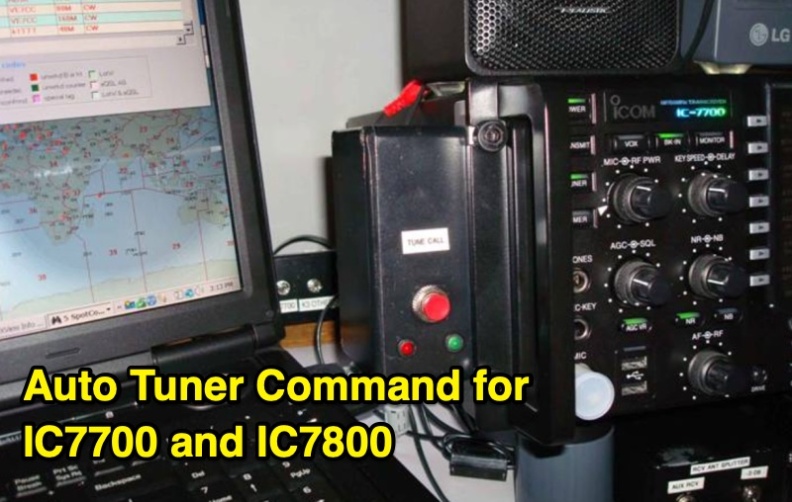 An Arduino-based interface provides a remote tuner call command for Icom **IC7700** and **IC7800** transceivers, addressing the lack of a built-in function for external tuners such as the MFJ 998RT. This setup initiates a low-power transmit signal, typically 15 watts, allowing the remote autotuner to perform its matching sequence. The article details the required CI-V line communication and modifications to existing Arduino code, specifically referencing contributions from Jean-Jacques ON7EQ for improved Icom interrogation routines. The system involves a sequence of steps: storing the transceiver's current mode and power, disabling the internal autotuner, activating a control relay to interrupt the amplifier line, switching to RTTY mode at low power, and initiating transmit. The transmit duration is manually controlled by the operator, observing the SWR meter until a low SWR is achieved, then a second button press stops the transmission. A built-in 4-second transmit limit provides a safety measure. After tuning, the routine restores the original mode and power settings, re-enables the internal autotuner, and performs a brief 2-second RTTY transmission for internal tuner adjustment. The circuit diagram includes a Panasonic form 2 relay for amp control and emphasizes critical delays in the Arduino code for stable operation at 9600 baud CI-V communication. Compatibility with logging software like DXLab, N1MM, and N3FJP is noted, with specific interrogation time settings required to avoid conflicts.
 -
 The ICOM IC-R75, introduced in 1999, operates on 13.6 Volts DC and measures 241 by 94 by 229 mm. Its coverage spans from 30 kHz to 60 MHz, making it a versatile receiver for various bands. The review details available accessories, including optional filters and the **UT-106 DSP module**, which significantly enhances signal processing capabilities. Performance comparisons are drawn against other notable receivers such as the Drake R8B and earlier ICOM models, providing context for its audio quality and overall functionality. User feedback is integrated, offering practical insights into its daily operation and reception characteristics across the spectrum. This analysis offers an in-depth look at the IC-R75's technical capabilities and features, serving as a valuable reference for operators interested in this **legacy receiver**.
 -
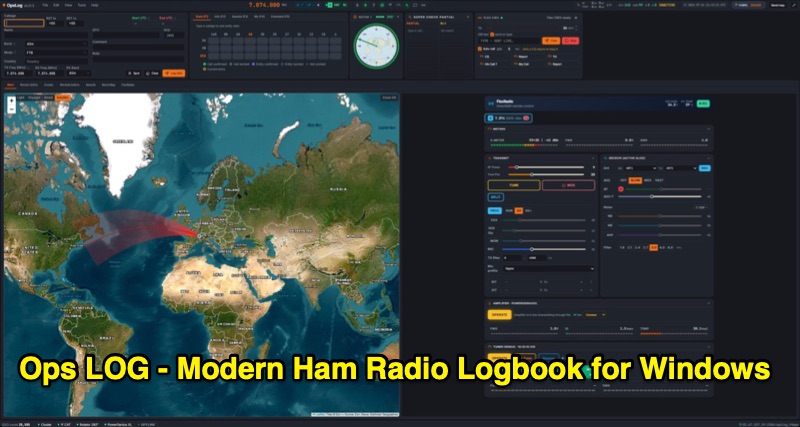 OpsLog is a modern amateur radio logbook application for Windows, designed to consolidate station operations into a single, integrated interface. It provides fast, single-strip QSO entry with automatic lookup from QRZ.com or HamQTH, populating callsign, name, QTH, and grid square. The software offers real-time CAT control supporting OmniRig, native FlexRadio/SmartSDR, Icom CI-V (via USB or internet), and TCI protocols. Key logging features include ADIF 3.1.7 compliance, offline DXCC resolution, a worked-before matrix, and dupe detection. It also incorporates a great-circle map for short/long path calculations and a clickable rotor compass, displaying antenna direction accurately. The application integrates DX cluster functionality with multiple server connections, band map spot display, and customizable alert rules for callsign, country, band, mode, or spotter, delivering notifications via sound, on-screen alerts, and email. OpsLog tracks numerous awards such as DXCC, WAS, WAZ, WAC, WPX, IOTA, POTA, SOTA, WWFF, and DDFM, with synchronization capabilities for ClubLog, LoTW, QRZ.com, and eQSL. For contesting and multi-operator environments, it offers serial number auto-fill, enforced contact windows, live dupe flagging, and shared MySQL logbook support for real-time status updates among operators. Additionally, it includes a QSL card designer with automated layout suggestions.
 -
 Presents an online retail platform for amateur radio operators, showcasing a diverse inventory of equipment and accessories. The site lists popular transceivers such as the _Icom IC-7300_ and _Icom IC-7610_, alongside various antenna solutions including base, HT, mobile, and end-fed designs. Operators can find coaxial cable, including bulk options and products from "The Wire Man," essential for shack setup. The platform also stocks crimping and stripping tools, adapters, and power supplies, crucial for station maintenance and construction. Test equipment like _RigExpert Analyzers_ and accessories such as Daiwa meters and _West Mountain Radio_ Power Poles are available. Additionally, the site offers software from _Ham Radio Deluxe_ and _RT Systems_, catering to logging and radio programming needs. Shipping policies include free shipping on C.Crane Radios and most orders over $100.00 within the lower 48 states, providing clear purchasing incentives.
 -
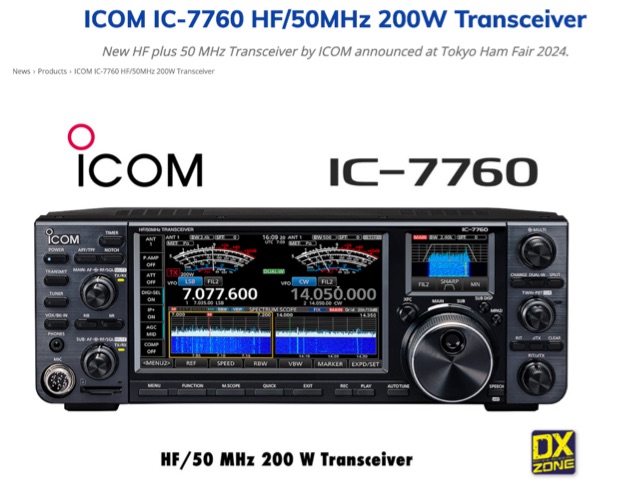 Our Article about the ICOM IC-7760 announce done by ICOM at the annual Ham Fair in Tokyo
 -
 Unicom Radio, since 2005, has excelled in the communications and telecommunications market, offering advanced services across diverse industries globally. Specializing in corporate communication systems, base station construction, and professional antenna systems, Unicom Radio leverages expertise to deliver high-tech equipment internationally. Unified by a strategic vision, the company continues to innovate and build trust with partners and clients.
 -
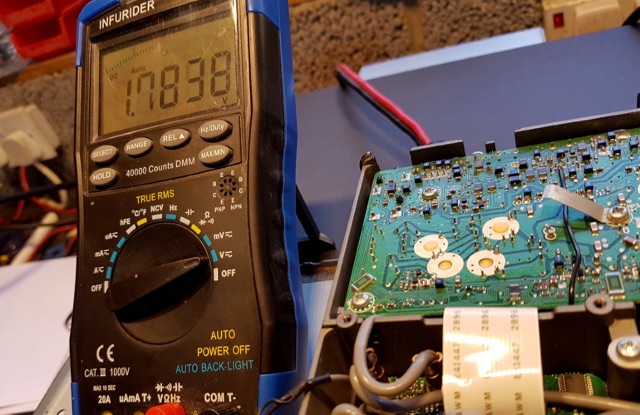 After years of reliable performance, a 26-year-old Icom 706MK2G exhibited an unusual deviation during FM transmission, with the actual frequency being 10kHz off from the displayed frequency. Additionally, the power meter showed a sharp dip during transmission. Upon investigation, it was discovered that the FM VCO voltage adjust variable had become dirty and sluggish over time. By adjusting the variable capacitor and cleaning it with switch cleaner, the issue was resolved, restoring stable power output and accurate frequency transmission.
 -
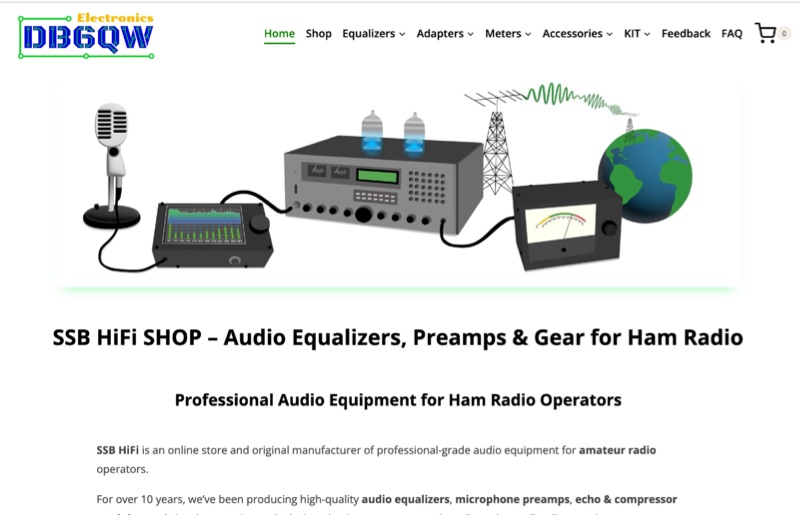 Optimizing on-air audio for SSB, DXing, and contesting operations is addressed through a range of specialized audio processing equipment. The offerings include multi-band equalizers, specifically 5-band, 8-band, 10-band, and 12-band units, some integrated with features such as compressors, echo effects, noise gates, and phase rotation capabilities. These devices are engineered to interface with common amateur radio transceivers, with explicit compatibility noted for models like the Yaesu FT-DX10, FT-DX101D, FT-1000MP, FT-DX5000, Collins HF-380, and Flex 6300, alongside analog S/P meters for Icom rigs. The product line focuses on enhancing microphone audio characteristics, supporting XLR dynamic microphones for improved signal clarity and presence. The manufacturer, DB6QW Electronics, emphasizes direct support and a 100% manufacturer's warranty, reflecting confidence in product quality and operational reliability. This resource details specific audio processing tools designed to refine the transmitted audio signal, providing operators with granular control over their voice characteristics for competitive and casual amateur radio communications.
 -
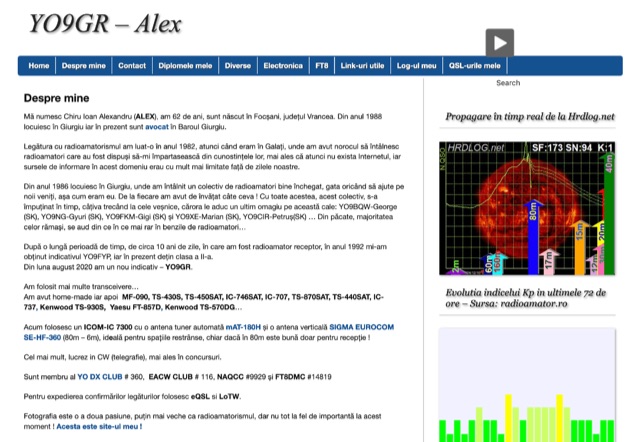 Personal website of YO9GR Alex from Romania. Alex provides in his web site a blog with personal ham radio related informationm but also some interesting projects like an external keyer for Icom Transceivers, and other electronics projects.
 -
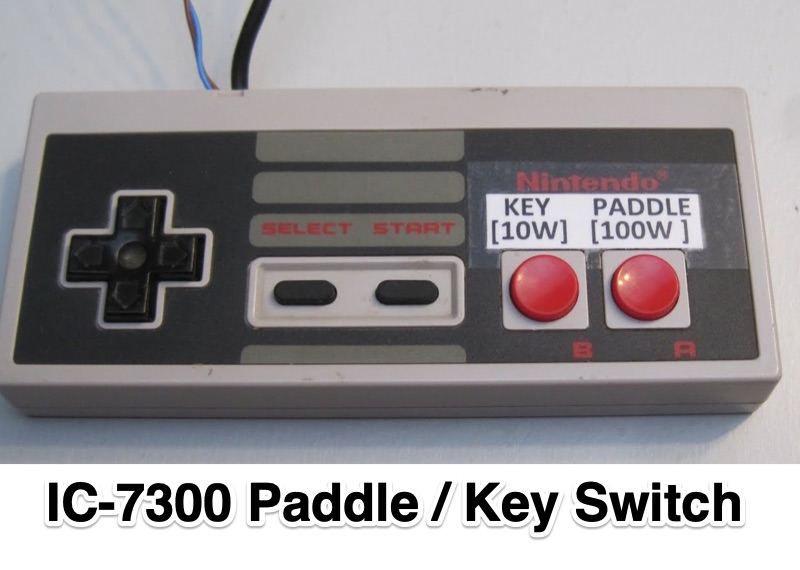 Demonstrates an **Arduino-based** solution for the Icom IC-7300 transceiver, specifically addressing the operational inconvenience of switching between a CW paddle and a straight key. The project leverages the IC-7300's **CI-V bus** (Computer Interface 5) to provide instant keyer type selection and two preset power levels, bypassing the rig's menu system which otherwise requires eight button presses. This implementation utilizes the 3.5mm CI-V connector, leaving the USB port free for CAT control and the internal soundcard, a critical design choice for integrated station setups. The system's utility is particularly evident for CW operators who frequently alternate between keying methods during contesting or general operating. The article details the hardware setup, including an Arduino Nano, a 3.5mm jack for CI-V, and pushbuttons for control. An update in 2023 expanded the project to incorporate an 8-button Nintendo controller, enhancing user interface flexibility and demonstrating the adaptability of the initial design for further customization and feature integration.
 -
 We are excited to share the news about the inaugural URC DX RTTY Contest, organized by the Unicom Radio Club! We would greatly appreciate your support in spreading the word within the RTTY community.
 -
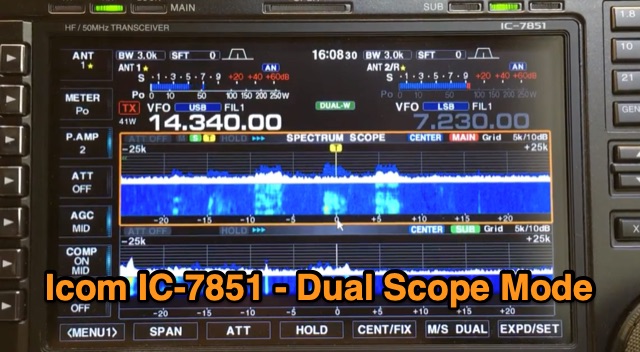 The Icom IC-7851 features the capability to display two scopes simultaneously, providing frequency, mode, and antenna information for each receiver. Users can choose between vertical or horizontal display orientations, and the dual scopes are also viewable on a high-resolution monitor connected to the radio. Additionally, the IC-7851 allows for mouse connectivity, enabling users to click on signals displayed on either scope for quick tuning. A demonstration video is available showcasing this dual scope functionality.
 -
 The State QSO Party Challenge is an annual program recognizing amateur radio operators' participation in U.S. State and Canadian Province QSO parties. To qualify for the SQP Challenge, participants must make at least two QSOs in a minimum of two SQP Approved QP contests and submit their scores to 3830Scores.com. The site details the SQP Mobile/Portable Challenge, an overlay competition encouraging mobile/portable operations, with scoring identical to the main SQP Challenge: (Number of QPs entered) x (Number of QSOs) = Score. Eligibility for the Mobile/Portable Challenge requires prior qualification for the SQP Challenge. The website also mentions a State QSO Party Club Challenge and provides contact information for questions. The 2026 SQP Challenge will be dedicated to Stan Zawrotny, K4SBZ, a key team member instrumental in the program's development. Participants are recognized for reaching five levels of achievement: Bronze, Silver, Gold, Platinum, and Diamond. Scores are calculated by totaling reported contacts and multiplying by the number of SQPs entered year-to-date, encouraging more entries and longer operating times. The Worked All QSO Parties (WAQP) program, sponsored by Icom America, offers certificates for participating in at least 50% of approved contests, with a goal of participating in all. WAQP requires submitting a log with at least two valid contacts to the contest manager, in addition to the 3830scores.com submission.