Weak Signal Modes for Amateur Radio Communication
Find resources for weak signal operating modes like JT65, EME, WSPR, and meteor scatter, including software, guides, and technical information.

Weak signal operation focuses on making QSOs under extreme propagation conditions, often pushing the limits of amateur radio equipment and techniques. Hams use specialized digital modes and precise timing to extract signals far below the noise floor, enabling contacts over vast distances, including Earth-Moon-Earth (EME) and meteor scatter paths. This activity demands careful station optimization, low-noise preamplifiers, and high-gain antennas to achieve successful communication.
Operators can find extensive guides for digital modes like JT65 and WSJT-X, which are essential for weak signal work. Resources also cover specific applications such as WSPR for propagation reporting and detailed procedures for EME contacts. Many hams build or modify transceivers, like the DSP-10, to enhance their station's weak signal performance on VHF and UHF bands.
Related Categories
-
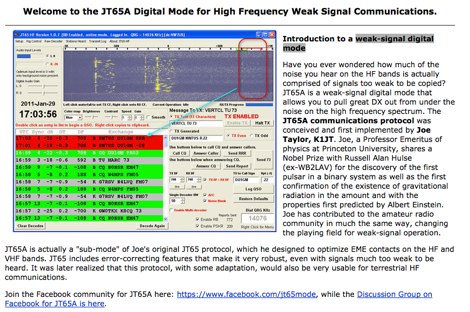 A very exaustive and complete article on JT65A and JT65-HF operating mode, including software download links, installation notes, how to make JT65A QSO and videos to correctly work with weak signals by NW7US
 -
 JT44: New Digital Mode for Weak Signals
 -
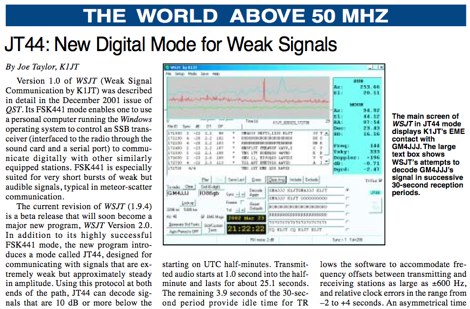 Moon bounce EME, meteor scatter and weak signal operations, introduction by ARRL.
 -
 The DSP-10 is an amateur-radio, software-defined 2-meter transceiver that can be built at home. It operates not only on SSB, FM and CW, but also on four Weak-Signal modes. Features are tailored to operation on VHF, UHF and Microwave frequencies. By W7PUA
 -
 Amateur Radio operation and weak signal detection pages by AF9Y
 -
 WSJT manuals and user guides in many languages. Most of these manuals are outdated and refers to legacy versions.
 -
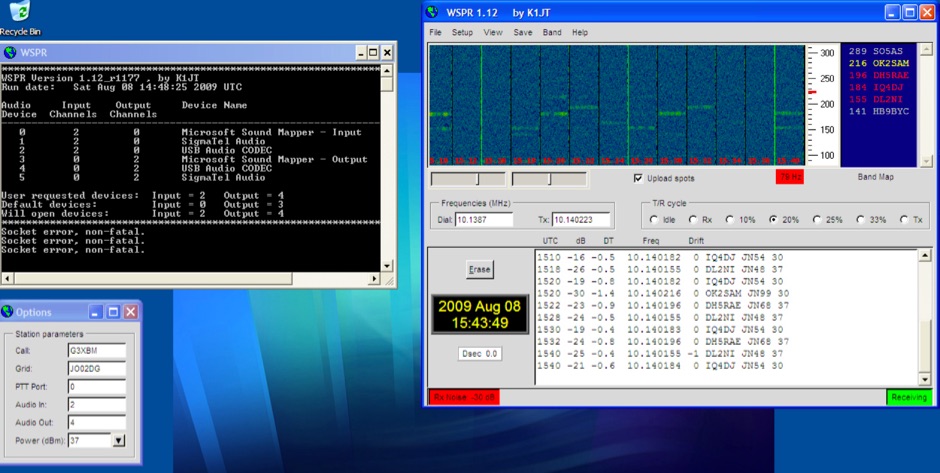 Introduction to WSPR beacons. Article describe WSPR2 and WSPR15 beaconing mode and include a frequency reference table for both WSPR modes
 -
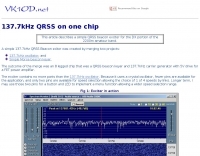 A simple QRSS beacon exciter for the 2200m amateur band, designed for weak signal operation using a single chip solution.
 -
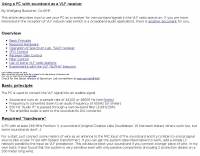 Using a PC with soundcard as a VLF receiver, how to use your PC as a receiver for narrow-band signals in the VLF radio spectrum by DL4YHF
 -
 This project delves into the development of a compact WSPR beacon, building on earlier experiences with weak-signal modes. Inspired by QRP Labs kits and modified open source designs, it integrates a Si5351 frequency generator, GPS module, and class E PA for efficient operation. Extensive optimizations—addressing drift, heat management, and power stability culminated in a portable, serviceable device. The beacon offers insights into propagation while minimizing reliance on main station equipment. Lessons learned highlight the importance of careful component selection and iterative design improvements for robust amateur radio experimentation.
 -
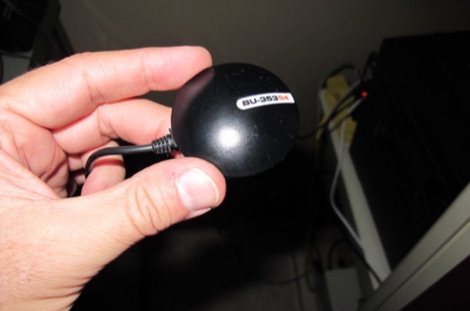 As FT8, JT65 and JT9 are a time synchronized protocol, one soon discovers that an accurate PC clock is very important. If your workstation time is off it can cause you to send when no one is listening, or to listen when no one is sending.
 -
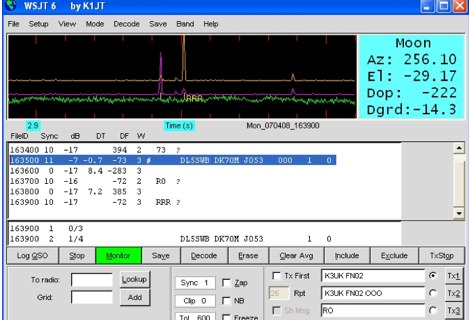 The complete Bozo's guide to JT65A by K3UK, learn how to install and operate WSJT software and start making QSO in weak signals operating modes
 -
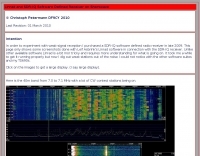 Linrad and SDR-IQ Software Defined Receiver on Shortwave
 -
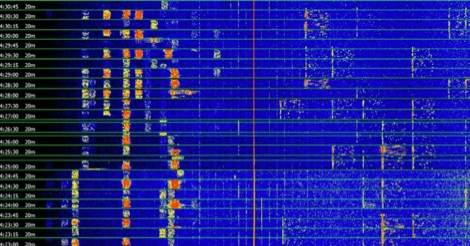 This article discusses how volume reduction can help in the reception of weak signals by reducing the noise level. It is commonly known that reducing the volume also reduces the background noise, and especially in the reception of weak digital signals it can be beneficial
 -
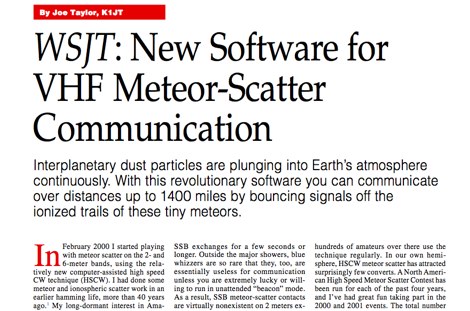 WSJT New Software for VHF Meteor-Scatter Communication QST Article December 2001 by K1JT
 -
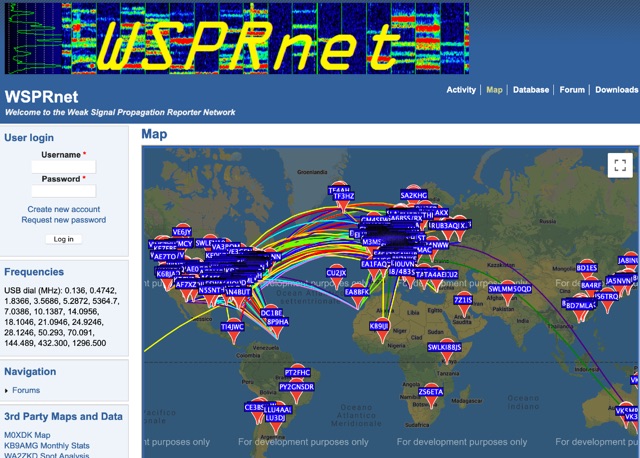 Weak Signal Propagation Reporter Network Map and Database of WSPR data