Operating on the 160-Meter Top Band
Find resources and guides for effective operation on the 160-meter band, including antenna solutions and propagation insights.

The 160-meter band, often called Top Band, presents unique challenges and rewards for amateur radio operators. Its propagation characteristics are heavily influenced by the ionosphere, making it a favorite for hams who enjoy exploring the limits of low-frequency DX. Operating on 160 meters often requires significant antenna projects and careful attention to noise reduction, especially in urban environments.
Operators interested in Top Band can find resources covering antenna solutions for small lots, including vertical designs like the "WindoVert." There are also detailed articles on operating techniques for working DX, along with insights into the unpredictable aspects of 160-meter propagation and how geomagnetic activity can influence signal paths. Hams can also review band allocations and common operating frequencies for different world areas.
-
 Detailed overview of the 160-meter amateur radio band, covering its history, frequency allocations, propagation characteristics, and antenna challenges.
 -
 Antennas and operating note on 160 meters
 -
 Lights on why 160 meters is so unpredictable and what is being done to reveal its secrets
 -
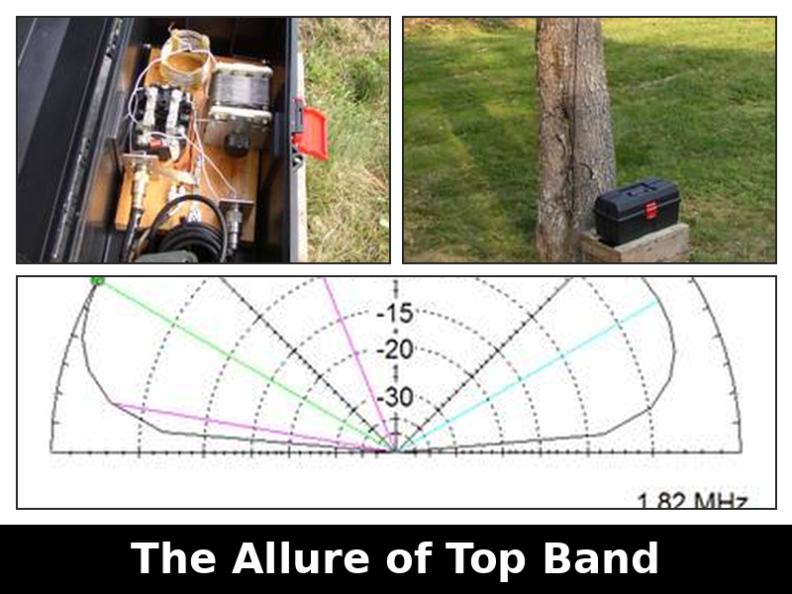 Details the construction and EZNEC modeling of a 160m "WindoVert" vertical antenna for urban environments, integrating existing Windom components and analyzing
 -
 This article examines how geomagnetic activity influences 160-meter radio propagation. K9LA analyzes observations of enhanced signals preceding K-index increases. Modeling shows that as ionospheric electric fields rise from 0 to 75 mV/meter during early geomagnetic storms, they create an electron density valley above the E region, enabling signal "ducting" between the E and F regions. This effect vanishes at higher field strengths (100 mV/meter). The phenomenon may explain both exceptional 160m openings preceding 6m propagation and possibly Marconi's contested 1901 transatlantic reception, which occurred during a small geomagnetic disturbance.
 -
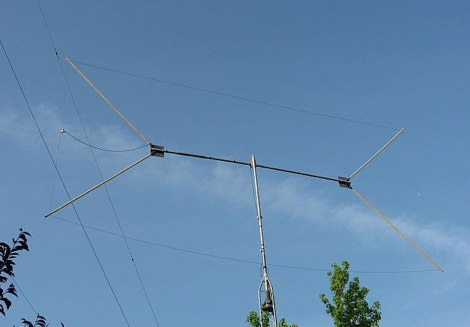 Encouragement for Little Pistols, article originally written for and published in SKIP the monthly newsletter of the Fresno Amateur Radio Club
 -
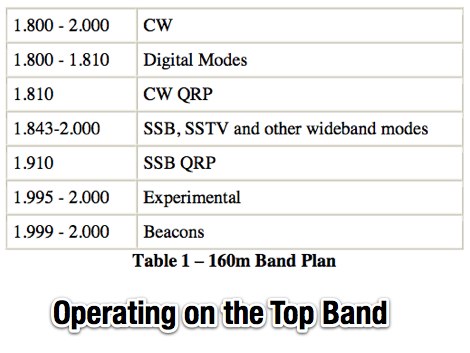 An introduction top operating on 160 meters band, article appeared on November 2006 issue of CQ, PDF file by K9LA
 -
 The Big Gun's Guide" is a comprehensive exploration of low-band propagation, aimed at serious Amateur Radio operators. It delves into the complex physics of the ionosphere at lower frequencies, contrasting it with HF propagation. The book covers essential topics like ionospheric fundamentals, propagation mechanisms, magneto-ionic effects, and disturbances. It also addresses the challenges of low-band DXing and provides insights for overcoming them. Brown's work is detailed and technical, offering valuable knowledge for those seeking to master the intricacies of low-band communication
 -
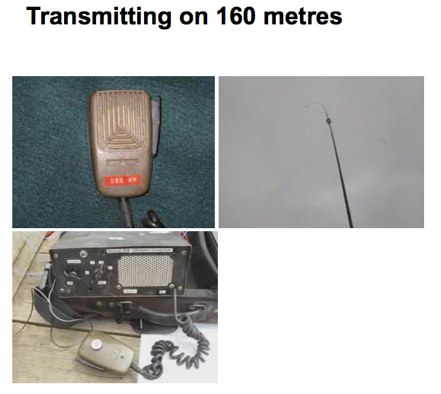 A page dedicated to top band transmitting equipment and operations by VK3YE
 -
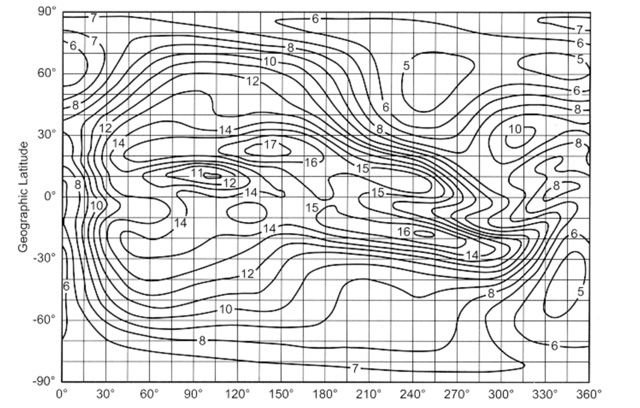 Come learn why it is very difficult to predict propagation on the top band. Ionospheric Variability, Time Variations of Ionospheric Parameters, Atmospheric Gravity Waves, Ionospheric Absorption and The Role of Negative Ions.
 -
 A 109 pages presentation in PDF File by Jim Brown K9YC on techniques in operatint the top band from a small lot.