Search results
Query: Ham
Links: 1861 | Categories: 356
This query is too generic. Please try adding an additional term to focus your research.
Categories
- Technical Reference > AI Ham Radio
- Software > Ham Exam
- Ham Radio
- DX Resources > Ham Radio Awards
- Shopping and Services > Ham Radio Insurance
- Shopping and Services > Ham Radio Stores
- Ham Radio > Hamfests
- Operating Modes > Satellites > Hamsat VO-52
- Operating Modes > Morse code > High Speed CW > HST Championships
- Ham Radio > Clubs > North America > USA > New Hampshire
- Ham Radio > Famous Hams
- Operating Modes > Ham Radio Balloons
- Technical Reference > Ham Radio Go Kits
- Ham Radio > Ham Radio News
- Ham Radio > Ham Shack
- Manufacturers > Ham Shack Accessories
- Antennas > 12M
- DX Resources > DX Peditions > 2013 DXpeditions
- DX Resources > DX Peditions > 2024 DXpeditions
- Antennas > 23cm
- Technical Reference > 3D Printed Projects
- Antennas > 40M > 40 meter Magnetic Loop Antennas
- Antennas > 70cm
- Manufacturers > Accessories
- Shopping and Services > Accessories
- Operating Modes > Aircraft scatter
- Ham Radio > Clubs > North America > USA > Alabama
- Ham Radio > Clubs > North America > USA > Alaska
- Ham Radio > Clubs > North America > Canada > Alberta
- Operating Modes > Internet Linking > AllStarLink
-
 The IK-STIC 2 is a vertical, all band, antenna that is over 25 feet tall yet weighs under 5 pounds. Based on a telescopic pipe or a fiberglass fishing pole, using a tuner it can easily cover the amateur radio HF bands from 40 - 10 Meters
 -
 The Dayton Hamvention is the world's largest amateur radio gathering.
 -
 This antenna article is geared towards new Hams and antenna builders looking for a very inexpensive 6 band antenna that can be efficiently fed with 50 ohm coax without a tuner by N4JTE
 -
 This end fed type of antenna was marketted in the UK and is a useful system for the portable set-up. Being a half wave, no radials or counterpose wires are needed.
 -
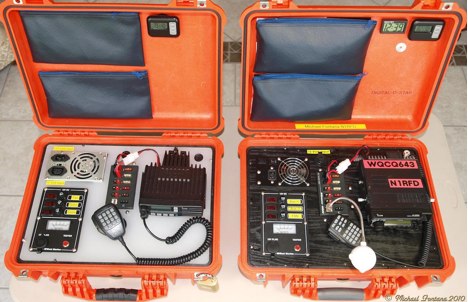 Radio Incident Command Kit project is described in this article loaded with many pictures and go-kit composition.
 -
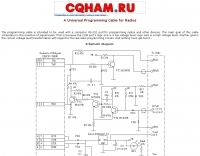 The programming cable is intended to be used with a computer RS-232 port for programming radios and other devices.
 -
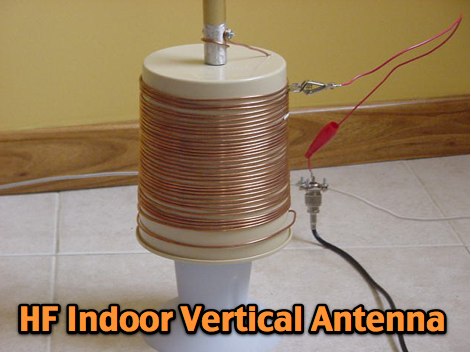 W5ALT Indoor Vertical Antenna is a base loaded vertical antenna that can be tuned on almost all HF bands by adjusting a big coil. Operating a ham radio station from an apartment in Maracaibo, Venezuela, the author demonstrates effective communication with over 100 countries using a custom-built indoor vertical antenna. Addressing common misconceptions, the design uses a balanced approach with radials and a base-loaded vertical element made from affordable materials. The antenna fits discreetly indoors, covers 6 to 40 meter bands, and achieves acceptable SWR with an MFJ tuner. Despite limited space and typical apartment challenges, the setup enables reliable DX contacts, confirmed by numerous QSL cards, proving indoor antennas can perform well in constrained environments.
 -
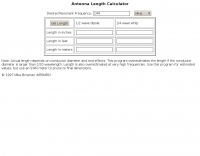 Input the desired resonant frequency and it will calculate lenght in inches feet and meters
 -
 Ubuntu software packages in "karmic", subsection hamradio
 -
 Get KB1OIQ - Andy's Ham Radio Linux CD at SourceForge.net. Fast, secure and free downloads from the largest Open Source applications and software directory
 -
 The webs premier site for custom ham maps (azimuthal equidistant projection maps) and great circle bearing/distant charts for the radio amateur. Customized azimuthal equidistant projection maps and tables.
 -
 gMFSK, a Gnome Multimode HF Terminal, provides a comprehensive software solution for digital conversational modes on HF bands within Linux and Unix-like operating systems. The application facilitates sending and receiving various digital modes, including MFSK (MFSK16 and MFSK8), RTTY, THROB (1, 2, and 4 throbs/sec), PSK31 (BPSK and QPSK), PSK63, and MT63. It leverages the computer's soundcard for transceiver interfacing, performing all digital signal processing on the main CPU. The software features a multimode waterfall display incorporating waterfall, spectrum, and scope views, enabling _point-and-click tuning_ of decoded signals. Remote logging capabilities are supported via SysV IPC, with integration for logging applications like Xlog. PTT control is managed through serial or parallel port lines, and rig control is implemented using the _Hamlib_ library, allowing for real-time frequency display and transceiver manipulation. Fixtext macros can incorporate variables and command-line output. Distributed under the GNU General Public Licence, version 2, gMFSK requires Gnome libraries and FFTW 2.x libraries for operation, even without a full Gnome desktop environment. The software's design ensures compatibility with any soundcard supported by the operating system.
 -
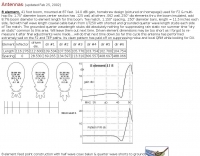 8 and 4 elemets yagi beam antenna by N6CA
 -
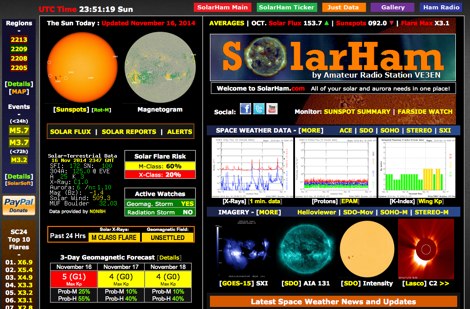 SolarHam is a website all about the Sun and how it affects Earth. This site is routinely updated with breaking news, sometimes hours before other Space News websites. You can trust SolarHam.com for the most up to date and accurate solar information on the net. SolarHam is a trusted and easy-to-use website for anyone interested in solar activity and space weather. It gives daily updates on <b>solar flares</b>, sunspots, geomagnetic storms, and radio blackouts. The site uses data from NOAA and NASA to show what is happening on the Sun and how it may affect radio signals on Earth. Charts and images are clear, and reports are updated often. Many amateur radio operators use SolarHam.net to check band conditions and aurora forecasts before operating. The site is fast, well organized, and focused on the needs of the radio community. Whether you are a beginner or an experienced ham, SolarHam.net is a helpful tool for understanding space weather and its impact on radio communications.
 -
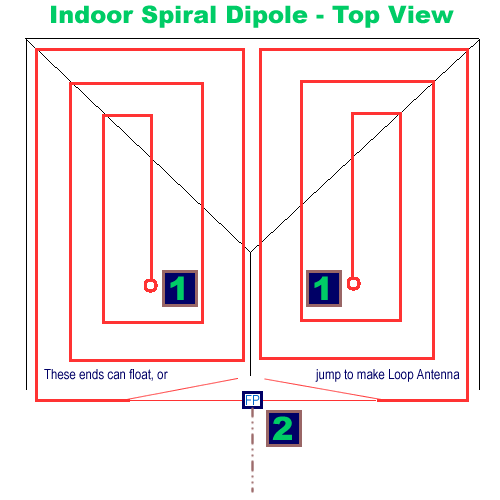 An attic indoor antenna successfully implemented by N9RET by using two runs of 2-conductor wire
 -
 CW transceiver kits, QRP, frequency counters, QRP wattmeters, Dummy loads and QRP Parts
 -
 The Elecraft K3, a popular HF transceiver, is often benchmarked against new market entrants. This article critically compares the Kenwood TS-590S to the K3, focusing on key technical specifications and operational aspects relevant to serious amateur radio operators. The author proposes three distinct evaluation methods: a circuit diagram comparison, an independent review analysis (referencing Peter Hart, G3SJX, in RadCom), and a real-world "ear test" by experienced contest operators on 40 and 80 meters. The analysis delves into specific receiver components, including the first mixer design, RF and IF amplifier performance, and the presence of an image noise filter. It highlights the K3's switched mixer and the potential for the TS-590S to utilize similar or improved designs, such as a classic filter with enhanced selectivity. The article also scrutinizes the second mixer stage, noting the K3's SA612 chip and its associated IP3 limitations, suggesting Kenwood might achieve benefits with a different mixer architecture. Further points of comparison include DSP capabilities, where the K3's high-performing DSP with KK7P's involvement is noted against the TS-590S's potential reliance on newer IC technology but possibly less refined software. The discussion extends to DDS and PLL implementations for phase noise and spurious emissions, and the utility of a second receiver for DX chasing and contesting, acknowledging its importance for some operators while being less critical for others. The article concludes by emphasizing personal preference in equipment selection.
 -
 A freeware dos antenna design program, dedicated to yagi antenna design by K4VX
 -
 The webs premier Ham Radio discussion forums
 -
 A site devoted to Amateur Radio Homebrewing, CW-decoder, CW QRP Transceiver for the 40 & 20 meters band, CMOS reader
 -
 Comparison chart of most popular VHF UHF amateur radio transceivers
 -
 Frequency Filer is database program designed for people who use a great many different radio frequencies. It is primarily intended for amateur radio operators, short-wave listening enthusiasts and scanner users. The program makes it easy to keep all of your important frequency information in one place, displayed in a logical format to facilitate easy retrieval. Frequency information can be displayed as a list and can be viewed on a world globe. Other features include easy data backup and custom field names. Included is database import utility that can be used as a general file conversion utility. The globe display can also be used as general geographic aid for countries, cities, states, rivers, and lakes. You may even find your home town. Windows Shareware
 -
 These are 200 Morse Code QSO`s which might typically be heard on the HF bands.
 -
 Over 20 years of development have gone into _Shacklog_, a logging software designed for radio amateurs and Shortwave Listeners (SWLs), primarily from the UK. This resource provides a detailed overview of its capabilities, which include real-time and post-event QSO logging, comprehensive log analysis and reporting, and the ability to print QSL labels. It also features a country status display, rig control integration, and supports importing existing logs, along with interfacing with CallBook CD-ROMs for callsign lookups. The software facilitates efficient management of radio contacts, allowing users to track their DXCC status and other awards. Its analytical tools help operators review their operating patterns and contest performance, while the QSL label printing function streamlines the process of confirming contacts. The integration with rig control systems enhances the logging experience by automating data entry, making it a practical tool for both casual logging and competitive contesting.
 -
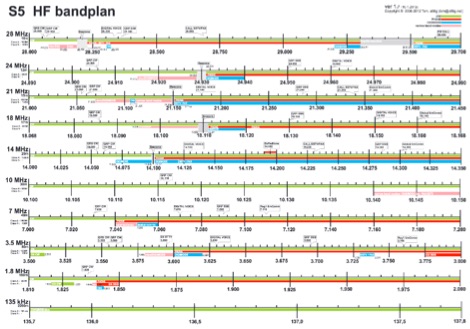 Amateur Radio bandplan in a large PDF A3 format valid for Serbia and Region 2. This band plan can be donwloaded and printed on a color laser printer for optimal quality.
 -
 Wound on a 3 foot length of PVC pipe, the long loopstick antenna was an experiment to try to improve AM radio reception without using a long wire or ground.
 -

-
 Mirko Pelcl's extensive radio collection features numerous historical transceivers and receivers, with a significant focus on military communications gear. The collection includes notable examples such as the Wireless Set No. 19, various Cold War-era military radios, and even a rare WWII spy radio utilizing a Loewe 3NF tube. Visitors can explore detailed sections dedicated to sets manufactured before 1945, including those used for military exchange, and a separate category for post-1945 radios, particularly those from the former Yugoslavia. The site also delves into specific modifications, like a digital head conversion for the RU-20, and showcases a frequency counter built with a microcontroller. This personal archive provides a unique glimpse into the evolution of radio technology, from early vacuum tube designs to more modern solid-state military transceivers like the PRC-515. The content reflects Mirko's dedication to preserving and documenting these pieces of radio history.
 -
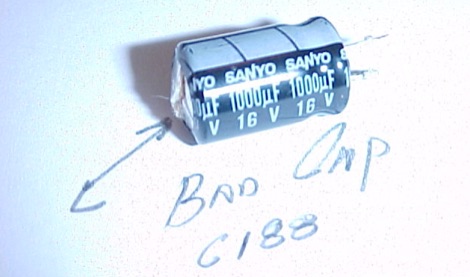 WA6CDE write about a major problem, a design flaw on two Icom 706 caps that have corrosive liquid that can seriously damage this icom transceiver.
 -
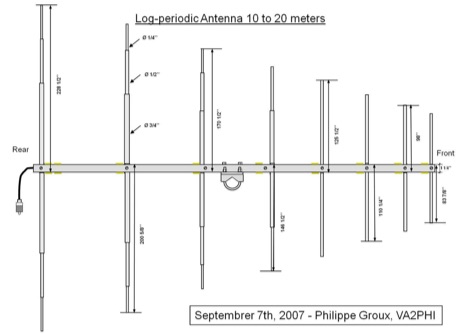 10 to 20 meters band log-periodic antenna project with SWR Plots, boom lenght and element spacing.
 -
 The safe RS232 CAT interface and PA buffer for Yaesu FT-817, FT-857, FT897 and FT-100 rigs
 -
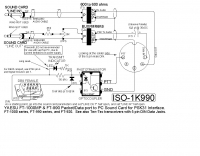 Yaesu FT-1000MP, FT-990 and FT-920 packet data port to pc sound card for psk 31 interface.
 -
 The basic antenna is a vertical monopole, using elevated radials to complete the ground plane by k5oe
 -
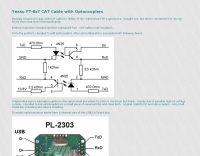 Yaesu CAT Cable for FT-817 857 897
 -
 Forum thread about IC-718 compared vs Yaesu FT 990 and Icom IC-781
 -
 Forum thread about possibility to extend VX-6R to freeband and 6 meters
 -
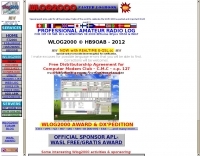 WLOG2000 demonstrates a comprehensive logging software solution tailored for amateur radio operators, shortwave listeners (SWLs), broadcast listeners (BCLs), and CB enthusiasts. It integrates essential utilities such as DX Cluster and DXtelnet for real-time DX spotting, along with PSK and PSK-Pbbs capabilities supporting both TNC and PC sound card interfaces. The software also features radio and rotor control, CDbook interface functionality, and a wide array of other logging and operational tools, making it a versatile station management platform for various radio activities. Franco, HB9OAB, developed WLOG2000 to provide a robust, free logging solution, with continuous updates available from the homepage. The software supports popular digital modes like RTTY, SSTV, KGSTV, EASYPAL, FT8, and FT4, alongside traditional CW operation. It offers rig control for major manufacturers including Kenwood, Yaesu, and Icom, facilitating seamless integration with existing shack setups. Users can track awards like DXCC, WAS, WAZ, and WAC, and manage QSLs, enhancing the practical application for contesters and DXers.
 -
 3 MHz to 30 MHz, the shortwave bands offer a vast array of international broadcast stations, maritime communications, and amateur radio signals, often heard far beyond the typical range of AM/FM. This resource introduces shortwave listening (SWLing) by explaining what shortwave radio is, how signals propagate via the **ionosphere**, and the general characteristics of different shortwave bands. It details how international broadcasters like Radio Australia and Deutsche Welle transmit in multiple languages, including English, and discusses the real-time nature of these over-the-air transmissions compared to internet streams. The guide provides practical tips for better reception, such as tuning between 9 MHz and 12 MHz during daylight hours and below 9 MHz at night, and notes the presence of amateur radio operators on the 75/80 meter band (3.5 MHz to 4.0 MHz) using **LSB** mode. It reviews popular portable shortwave receivers, specifically highlighting the Sangean ATS-505 and the Sony ICF SW 7600GR, comparing their features like synchronous detection and filter choices. The article also suggests audio enhancement methods, such as external amplified speakers or quality headphones, and briefly mentions high-end receivers like the AOR AR8600MKIIB for advanced monitoring.
 -
 Web site updated several times per month. It covers all aspects of ham radio.
 -

-
 The mirror-image J-Pole is very easy to construct and requires only two T-Fittings plus a length of copper pipe.
 -
 A really simple receiving antenna for 80 and 160 meter dxing by WA2WVL
 -
 Eighteen-part tutorial on packet radio in HTML and ASCII format from Larry Kenney, WB9LOZ
 -
 PC power supply conversion for ham radio use. Slide show overview showing how convert PC Power supplies to ham radio use presented at the August 2007 FSARC meeting.
 -
 Elmers Forum at eHam.net about the Yaesu handhelds radios VX3 VX6 VX7
 -
 All about amateur radio, police scanner frequencies. Frequency Listings for Kentucky, West Virginia, Virginia and others. Add your URL to the Scanner Link Page.
 -
 PA3FWM's software defined radio (SDR) page documents his extensive hardware and software development efforts between 2004 and 2009. Initial experiments utilized a direct conversion receiver with 90-degree phase difference, feeding a PC soundcard at 48 kHz sample rate, covering 24 kHz of spectrum around a 7080.5 kHz local oscillator. This setup, similar to AC50G's QEX 2002 article, allowed for basic I/Q signal processing to distinguish signals above and below the LO frequency. Limitations included fixed crystal frequencies, 16-bit dynamic range, and narrow bandwidth. Subsequent hardware iterations aimed for enhanced performance, incorporating external 24-bit ADCs with 192 kHz sample rates, connected via 10 Mbit/s Ethernet. A **MC145170-based PLL** and programmable octave divider provided a 58 kHz to 30 MHz tuning range. The **Tayloe mixer** was employed, with differential outputs feeding a PCM1804 ADC. An ATmega32 microcontroller handled serial data conversion to Ethernet frames, though without CRC calculation due to processing constraints. Later designs integrated AD7760 2.5 Msamples/second ADCs and a Xilinx Spartan-3 FPGA, enabling direct reception of 0-1 MHz spectrum and eventually 2.5 MHz bandwidth across the shortwave spectrum. Software was refactored to use an initial 8192 non-windowed FFT for efficient high-bandwidth processing. The project culminated in a two-way QSO on 21 MHz using the developed hardware and software, demonstrating transmit capabilities with a D/A converter. The system exhibited a 2.5 MHz wide spectrum display and a zoomed 19 kHz display, capturing signals like ionospheric chirp sounders and RTTY contest activity. Challenges included noise leakage from digital circuitry and cooling for high-power dissipation components.
 -
 RSCW demonstrates a Linux/Unix command-line utility engineered for **Morse code** decoding via a computer's sound card. It specifically targets the extraction of weak CW signals from noise, operating on 8-bit, 8000 samples/second audio input, typically from `/dev/dsp`. The program outputs decoded characters to `stdout`, supporting user-specified speeds in words per minute (WPM) and carrier frequencies. While effective for machine-sent signals, it exhibits a 2-second decoding lag and requires manual speed input, making it less suitable for general-purpose, real-time contest operation. The resource details the program's components, including `rscw` (the main decoder), `rscwx` (an X11 graphical auxiliary for spectrum and internal signal visualization), `rs12tlmdec` (a specialized decoder for RS-12 amateur radio satellite telemetry), and `noisycw` (a utility for generating noisy Morse signals for testing). Installation instructions involve downloading a `.tgz` file, compiling with `Make`, and requiring the FFTW library (and GTK 2.0 for `rscwx`). Performance is illustrated with a .wav file example of a 12 WPM, 800 Hz CW signal at 12 dB Eb/N0, showcasing RSCW's near-error-free decoding of a test message. The site provides command-line examples utilizing `sox` for audio conversion and `noisycw` for signal generation, inviting comparisons with other decoding software and human operators, particularly for weak signal conditions.
 -
 Using the TS-2000 for packet and digital modes. How to connect the Kenwodd TS2000 to TNC
 -
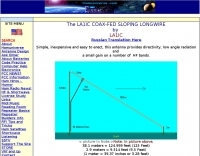 Simple, inexpensive and easy to erect, this antenna provides directivity, low angle radiation and a small gain on a number of HF bands.