Search results
Query: software for amateur radio
Links: 302 | Categories: 26
Categories
- Technical Reference > Programming Radio
- Software
- Software > Aircraft scatter
- Software > Antenna analysis
- Software > Circuit Design
- DX Resources > Contest
- Software > Digital Voice
- Operating Modes > EME
- Internet and Radio > Ftp Sites
- Software > Hellschreiber
- Radio Equipment > HF Transceivers > Icom IC-7000
- Software > Internet Linking
- Operating Modes > JT65
- Radio Equipment > HF Transceivers > Kenwood TS-590S
- Software > Linux > Linux Distributions
- Software > Logging
- Operating Modes > Meteors
- Software > Morse Code Decoders
- Software > Morse Code Training
- Operating Modes > NBEMS
- Operating Modes > Satellites > Real Time Tracking
- Software > Repeater Control
- DX Resources > Contest > SO2R
- Operating Modes > SSTV
- Software > Weather and FAX
- Internet and Radio > WebSDR
-
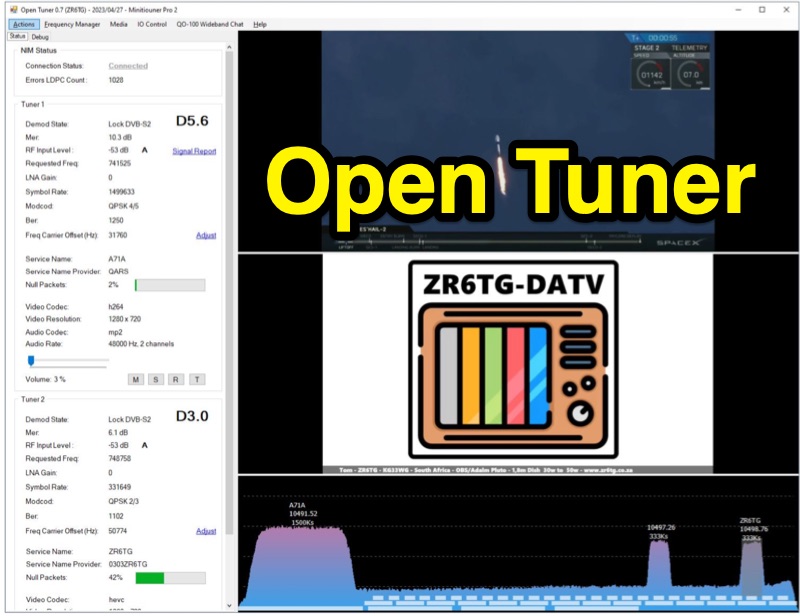 Version 0.7 of Open Tuner, released on April 27, 2023, marked a significant milestone by introducing proof-of-concept dual tuner functionality for the BATC Minitiouner. This C# client, inspired by Heather Lomond's _Longmynd_ project, aims to leverage both tuners and demodulators within the NIM module, a capability crucial for advanced Digital Amateur Television (DATV) operations on QO-100 and terrestrial links. My own experience with DATV often involves juggling multiple receive paths, so a unified client like this simplifies the workflow considerably. Further enhancing its utility, version 0.9 (February 11, 2024) integrated support for the Raspberry Pico, utilizing Colin (G4EML)'s _PicoTuner_ firmware. This offers a more accessible and cost-effective alternative to the traditional FTDI module, streamlining dual tuner setups with a single USB cable. The project's evolution reflects a practical approach to overcoming hardware availability challenges. The software is developed using Visual Studio 2019/2022 and .NET Framework 4.7.2, requiring specific Nuget packages like VLC/Websocket and an ffmpeg folder for full operation. It's an active, community-driven effort, with the source code openly available on GitHub for contributions and bug reporting, embodying the collaborative spirit of amateur radio development.
 -
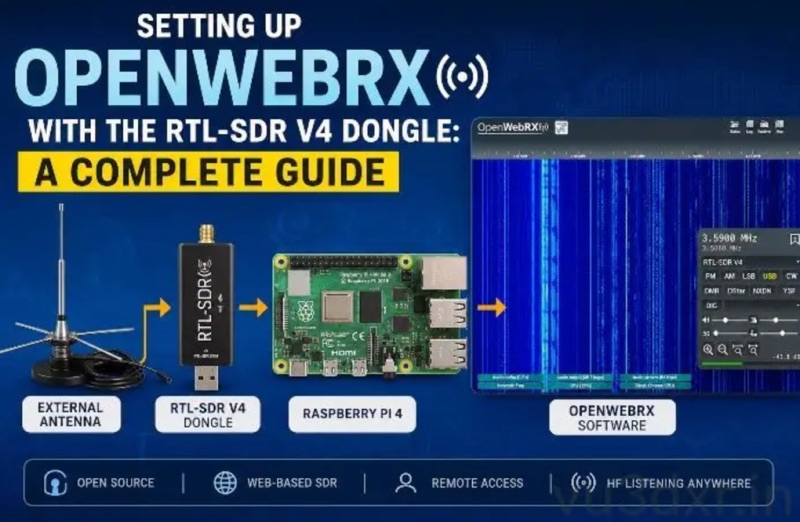 This guide details how to set up an OpenWebRX software defined radio (SDR) receiver using an RTL-SDR V4 dongle on a Raspberry Pi or similar small computer. The resulting SDR receiver is accessible via a web interface, featuring a live waterfall display and demodulation for AM, FM, SSB, and CW. It can be configured for public sharing or private network use. The RTL-SDR V4 dongle offers direct sampling improvements for HF, a tuning range of approximately 500 kHz to 1.7 GHz (covering HF, VHF, UHF, and microwave amateur allocations), improved front-end filtering, and a built-in software-switchable bias tee. The guide covers two installation methods for OpenWebRX: using an official Raspberry Pi image or a Docker installation. It also provides recommendations for Raspberry Pi models (3/3B+, 4, Zero 2 W), antenna and placement tips, and troubleshooting common issues. OpenWebRX is an open-source, browser-based SDR software package.