MFSK: Digital Mode for Amateur Radio
Understanding MFSK Communication

MFSK (Minimum Shift Keying) is a digital communication mode widely used in amateur radio. It employs frequency shift keying to transmit data, making it effective for weak signal propagation. MFSK is particularly valued for its ability to maintain readability in noisy environments, enhancing communication reliability among operators.
Key concepts related to MFSK include M-ary FSK, phase continuous tones, and convolutional coding for forward error correction (FEC). Understanding these principles is essential for optimizing MFSK operations and achieving successful digital communications in amateur radio.
Sort:
Related Categories
-
 A new weak signal DX mode for Radio Amateurs, employing M-ary FSK, phase continous tones and convolutional coded FEC.
 -
 An introduction to PSK31, MT63, and Hellschreiber, John DeGood NU3E Trenton Computer Festival in PDF
 -
 MFSK is an easy-to-use chat mode for real-time amateur contacts, nets and bulletin transmissions, but not intended for contesting or Bulletin Board System (BBS) use. It is a half-duplex non-Automatic Repeat ReQuest (ARQ) forward-error-correcting (FEC) mode. It performs well on long-path fading conditions and in the presence of interference
 -
 Using MFSK mode, 98 Kb PDF doc, taken from QST January 2001
 -
 Olivia MFSK digital communications are becoming popular in amateur radio because Olivia is one of the most robust methods of text keyboarding, that can perform superbly for long distance communications. Olivia frequencies, format and software
 -
 A super-fast PSK mode for RTTY Contesting, 100 wpm character transmission speed for contest exchanges and macro transmission versus RTTY at 60 wpm
 -
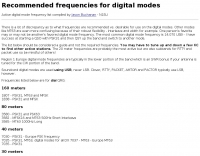 Active digital mode frequency list compiled by Jason Buchanan - N1SU
 -
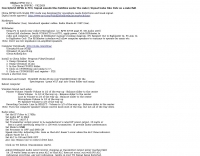 Short description of the olivia mfsk mode and explanation of how to use olivia mode and proper radio setup including recommended olivia frequencies
 -
 A mail list for those interested in the new Amateur Radio MFSK modes.