QRSS: Very Slow Morse Code for Weak Signal Operation
Learn about QRSS, a specialized amateur radio operating mode that uses extremely slow Morse code for detecting weak signals and propagation.

QRSS is a fascinating weak-signal operating mode where hams transmit extremely slow Morse code, often over several minutes per character. This technique allows for reception of signals far below the typical noise floor, making it ideal for propagation experiments and long-distance contacts with very low power, often QRPp levels. Operators use specialized software and receivers to decode these faint transmissions, which appear as visual traces on a waterfall display rather than audible tones.
Many operators build simple QRSS beacons, like the G0UPL 30m Junkbox Beacon, to test propagation paths and experiment with antenna designs. The category features numerous examples of these low-power transmitters and receivers, along with grabber compilations from I2NDT that show live QRSS signals from around the world. These resources help hams understand how to set up their own QRSS stations and participate in this unique aspect of amateur radio activity.
Related Categories
-
 This simple 30m QRSS beacon is built entirely out of junkbox parts, the only component purchased specifically for this project was the 10,140kHz crystal. Hans Summers' 30m QRSS beacon project emphasizes simplicity and low cost, built almost entirely from reused parts. Key components include a 10,140kHz crystal, a 2N3904 transistor from a broken DVD player, and an ordinary LED used for frequency shift. The oscillator is stabilized in a polystyrene box, with power amplification driven by recycled copper PCB. Output power peaks at 360mW, and a custom 50-ohm dummy load manages heat. Though aesthetically unconventional, the beacon works effectively, fulfilling the project's low cost aim.
 -
 G0UPL QRSS receiver inspired by I1DFS receiver
 -
 Article on a QRSS receiver for 30 meters band
 -
 ON7YD narrowbands modes on 136 Khz
 -
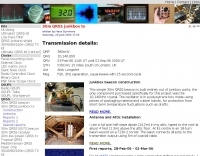 This simple 30m QRSS beacon is built entirely out of junkbox parts, the only component purchased specifically for this project was the 10,140kHz crystal.
 -
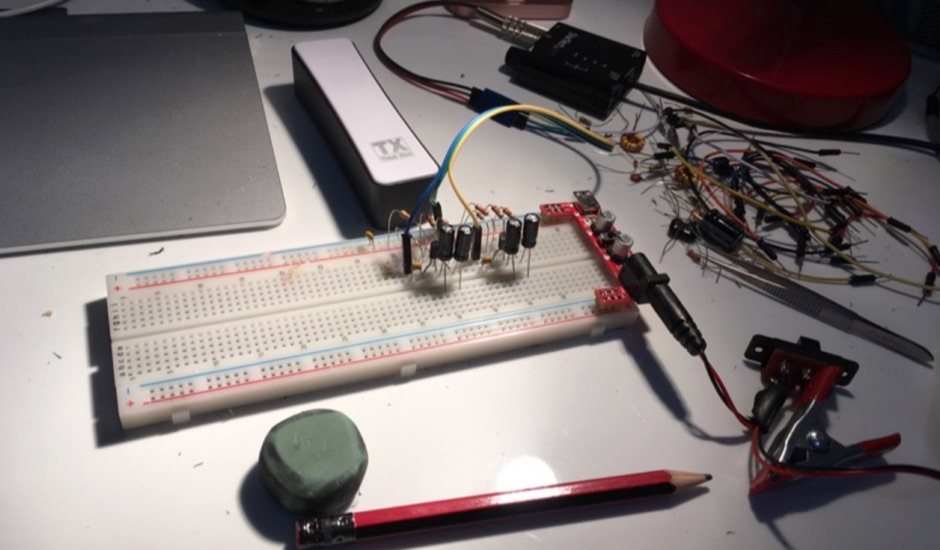 Designs for QRSS TX and other Arduino based systems
 -
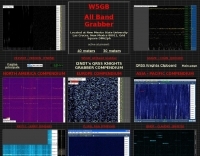 A compendium of QRSS grabber screenshots, showcasing live slow CW signals from various stations worldwide, including W5GB, VE1VDM, and I2NDT.
 -
 pictures and description of QRSS activity
 -
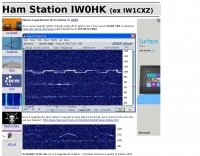 QRSS pictures and examples from IW0HK ex IW1CXZ
 -
 transmite equipment, collections of qrss signals received
 -
 Using absurdly low-speed CW for "communications"
 -
 30 meters beacon from UK. QRSS is a method of sending very slow morse code.
 -
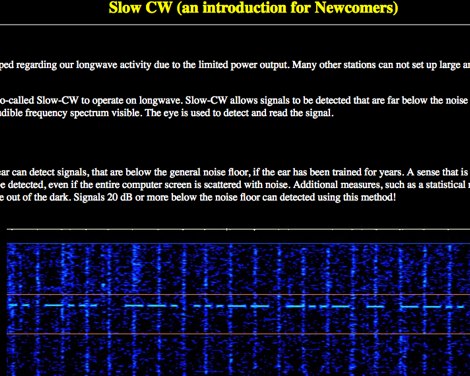 DK8KW Longwave Information
 -
 Operational mode QRPp QRSS Running as an MEPT Manned Experimental Propagation Transmitter
 -
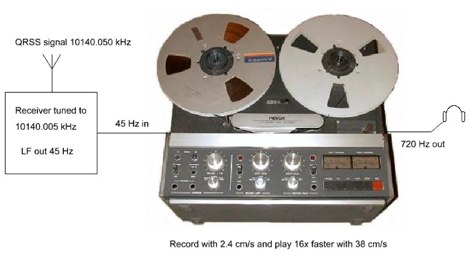 An unique method to listen to QRSS signals is... using an old tape recorder with variable speed
 -
 A blog dedicated to QRSS
 -
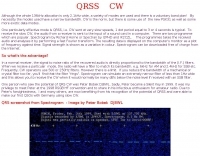 Receiving QRSS CW on your PC by G0MRF
 -
 QRSS operations on 30M with an home made dipole
 -
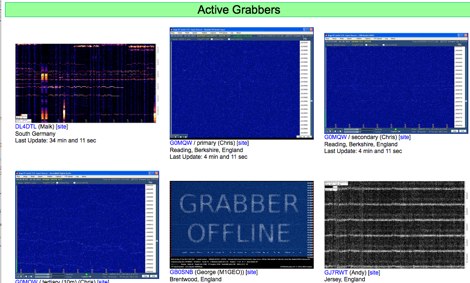 A portal of QRSS images, automatically Updated with Active QRSS Grabberers
 -
 This page discusses the use of the new Version 4 RTL-SDR dongle for simple QRSS reception. The author shares their experience with connecting the dongle to a PA0RDT miniwhip antenna and using RTLSDRlop QRSS software. They encountered issues with Linux but found a solution with a new driver. The page also provides information on coupling multiple dongles to one antenna and adding selectivity with a divider-filter box. Hams interested in experimenting with RTL-SDR technology, antenna setups, and software for QRSS reception will find this content useful.