Search results
Query: base ge
Links: 553 | Categories: 5
-
 The page automatically generate a Great Circle Map (GCM) for ham radio operators based on the IP address or by a given QTH locator. The GCM generated, unlike traditional maps of this type, has been rendered in an elliptical shape instead of a circle. This provides an expanded view horizontally thus making it easier to interpret. The map base is colored with each continent colored differently for easier recognition. The color code of the continents is given below the map for easy reference
 -
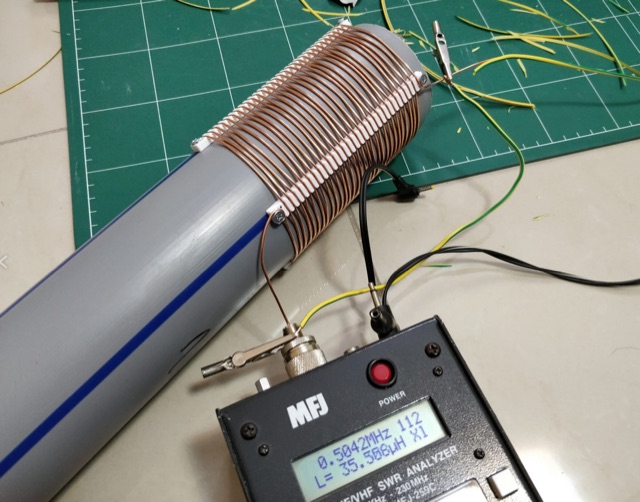 This article shares the author's experience with building antennas. After putting a large magnetic loop project on hold, they decided to try a base-loaded vertical antenna. The author explains how they chose to design a new antenna from scratch, aiming for a frequency of 7 MHz. They describe the calculations needed to find the right coil inductance and how they used 3D-printed parts for the construction. The article wraps up with results from their initial tests, showing good communication on different bands and highlighting the success of their design.
 -
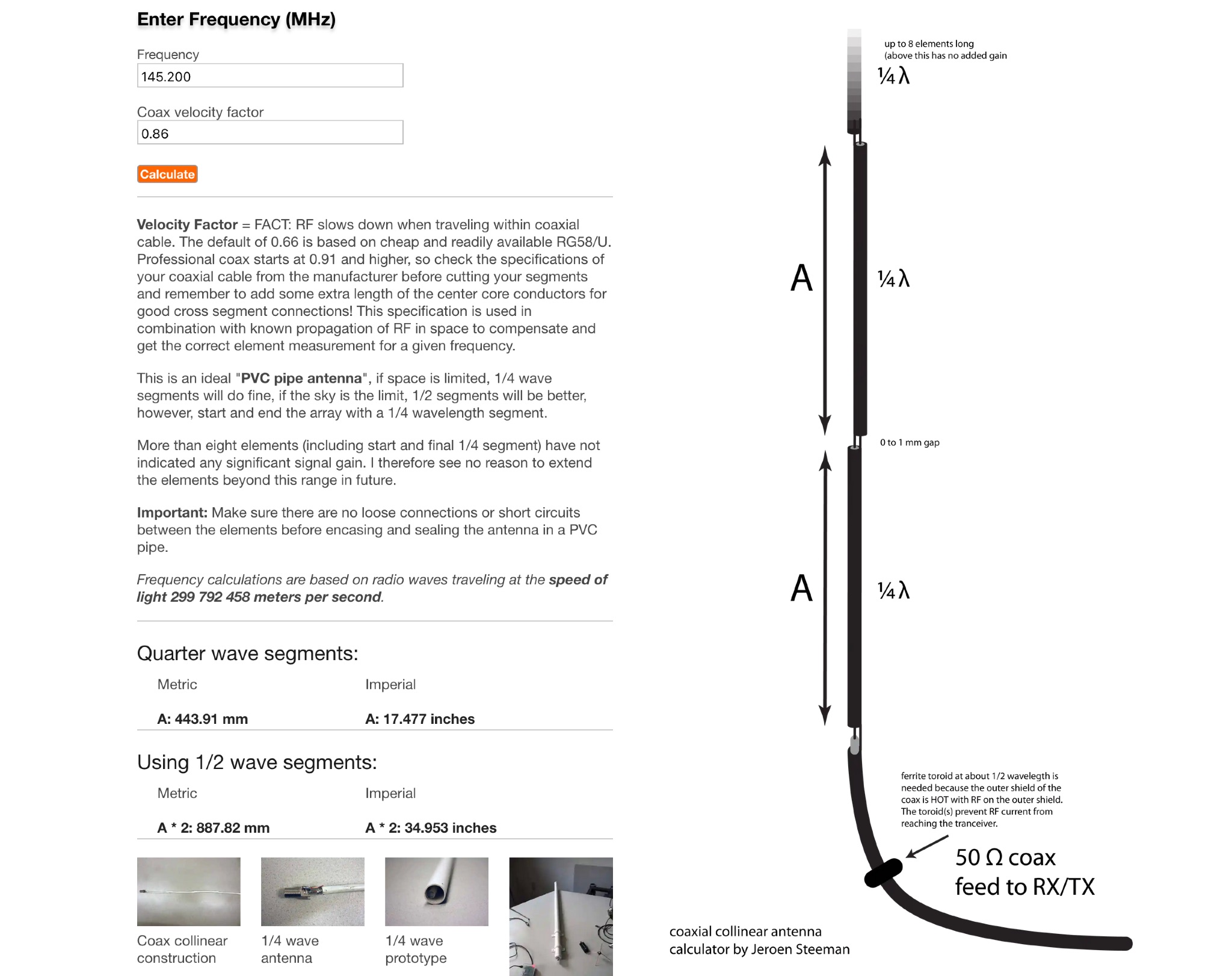 This page offers an online antenna designer tool for Hams to calculate the dimensions needed to construct a coaxial collinear antenna for a specific frequency. It provides guidance on the required frequency input, coax velocity factor, and element measurements for optimal performance. The tool is recommended for experienced antenna builders due to its complexity and technical requirements. Users can input the frequency in MHz and the tool will generate the necessary dimensions based on the chosen parameters. The page emphasizes the importance of accurate measurements and connections for successful antenna construction.
 -
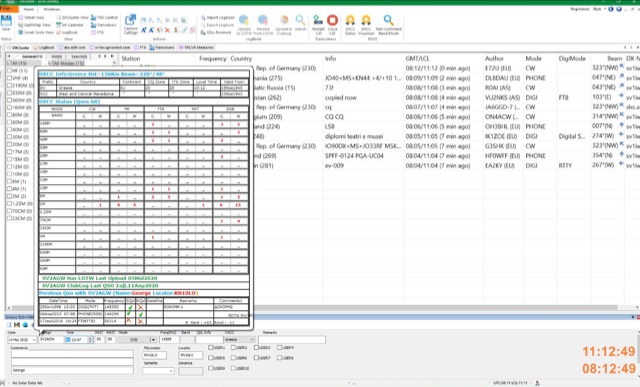 DxDozer is a Windows-based amateur radio logbook designed for both new and experienced DXers, featuring a robust logging system with extensive search capabilities. It offers seamless integration with FT8, displaying received stations from WSJT-X in a DX Cluster-like view, indicating LoTW status and prior contacts, and initiating QSOs directly. The software supports an unlimited number of callsign logbooks and allows multiple operators to log simultaneously to a single database, enhancing its utility for multi-operator stations or contest operations. The application includes a sophisticated DX Cluster with highly configurable filters based on band, mode, continent, worked/confirmed status, and LoTW participation, enabling users to monitor specific calls or countries. DxDozer simplifies QSL management by facilitating one-button uploads to LoTW and ClubLog, and downloads of new confirmed QSOs, with a dedicated field for QSL medium. The software provides both 'Easy' and 'Expert' modes to cater to different user proficiency levels, and is available via a yearly subscription after an initial free trial period.
 -
 The Narrabeen JOTA and JOTI camp facilitates global communication for Sydney North Region Scouts and Northern Sydney Girl Guides, utilizing amateur radio and internet technologies. Participants engage in two-way radio contacts, often on **HF** bands, to connect with other scouting and guiding groups worldwide, fostering international goodwill and technical skill development. The event integrates both traditional **ham radio** operations and modern internet-based communication methods, providing a diverse experience for youth members. The resource outlines the specific activities undertaken at the Narrabeen site, including station setup, operating procedures, and the use of digital modes for JOTI. It highlights the educational aspects of the event, such as learning about radio propagation, antenna theory, and basic electronics, all within a structured camp environment. The page also provides logistical information relevant to the Australian context of the event.
 -
 Small company based in Santa Maria, California, designing and manufacturing electronic products for amateur radio, education, and commercial users. Product line includes APRS devices for real-time vehicle tracking, weather monitoring, and remote telemetry, as well as the ADS-SR1 Simplex Repeater, the ADS-WS1 Weather Station, the SSTVCAM slow-scan TV camera, and GTRANS protocol translator for Garmin FMI.
 -
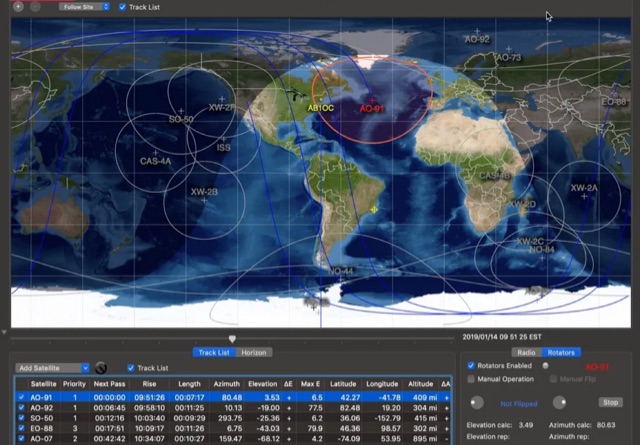 This article provides a step-by-step guide for assembling a Raspberry Pi-based Satellite Tracker Interface, designed to work with Green Heron Engineering's RT-21 controllers and MacDoppler software. The guide covers hardware assembly, SD card image installation, and system configuration for satellite tracking.
 -
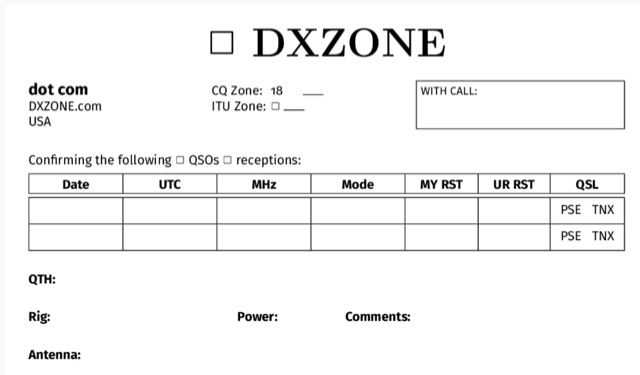 This app will generate a QSL card design based on the input paramters as a PDF. Fields marked by a * are required, but the rest are optional. The options at the bottom allow you to customise the look and feel of the QSL card. If you would like, you can also download the LaTeX source file and customise it.
 -
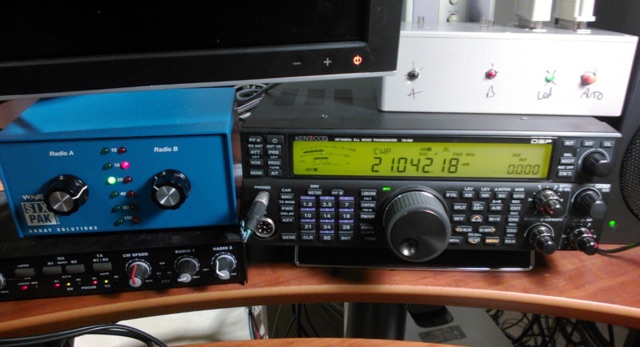 In pursuit of enhanced station efficiency, the author describes crafting an Arduino-based smart antenna switcher for an SO2R setup. Faced with manual antenna switching challenges during contests, the project utilizes a Logos Electromechanical 4x4 Driver Shield and a Power Screw shield for seamless functionality. Despite its raw appearance, the automatic switcher proves indispensable in contest scenarios, prompting considerations for future improvements and standardization of station control protocols.
 -
 The VKFAQ page on Visitors' licences in VK outlines the process for foreign amateur radio operators to obtain reciprocal operating privileges in Australia. It details the varying requirements based on the visitor's home country, ranging from direct use of a home callsign with a VK suffix (e.g., G3PHO/VK1) to needing a full Australian amateur radio license. The resource emphasizes consulting the Australian Communications and Media Authority (ACMA) website for the most current conditions and application procedures, noting that agreements are subject to change. Specific conditions are mentioned for countries with recognized license qualifications, allowing for corresponding Australian licenses. For other countries, a restricted license might be issued, typically permitting 146-148 MHz FM operation with a maximum of 10 watts output. Japanese operators with specific 'telephone or telegraph' licenses may receive privileges for bands above 30 MHz, phone only, also with a 10-watt power limit. Visitor licenses are not automatically renewable but can be extended upon request, provided all conditions are met.
 -
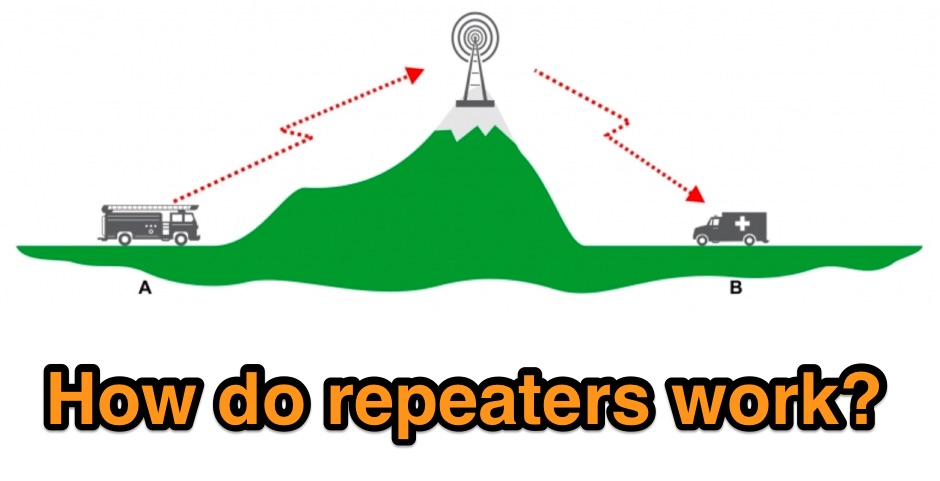 Illustrates the fundamental principles of radio repeaters, detailing their role in extending communication range beyond line-of-sight limitations. It begins by defining _simplex communication_ as a direct radio-to-radio link, effective only when no obstructions impede the signal path. The resource then introduces the concept of a repeater (or base station) strategically positioned on elevated terrain, such as a mountain, to overcome geographical barriers. The article clarifies the repeater's operational mechanism: it receives a signal on one frequency and simultaneously re-transmits it on a different frequency, enabling users on opposite sides of an obstruction to communicate. This _duplex operation_ is likened to satellite communication for VHF propagation, but with a fixed terrestrial station. Specific examples of signal paths are provided, showing how a handheld radio transmits up to the repeater, which then relays the message down to another user, effectively bypassing obstacles like hills or large buildings.
 -
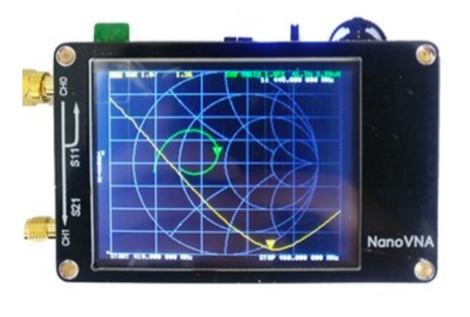 NanoVNA based on edy555, use the odd harmonic extension of si5351 to support the measurement frequency up to 900MHz. GitHub repository.
 -
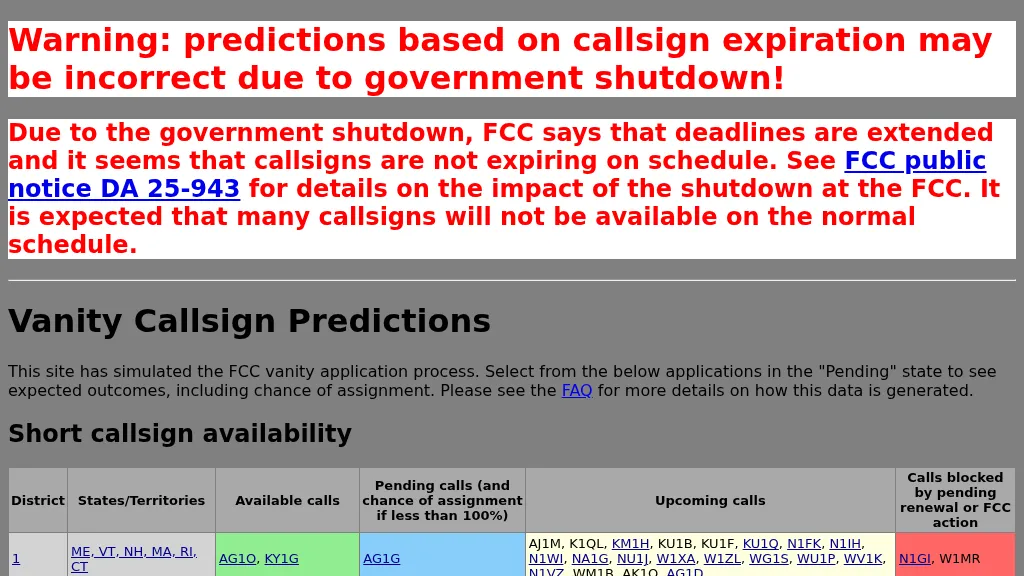 Over 100 FCC districts are analyzed by this resource, providing a predictive database for amateur radio vanity callsign assignments. The system simulates the FCC's application process, calculating the probability of assignment for specific callsigns, such as KD3Q at 94% or N9QC at 97.8%. Data is meticulously organized by FCC district, detailing available, pending, and upcoming callsigns, alongside those currently blocked by renewal or other FCC administrative actions. This allows hams to gauge their chances of securing a desired callsign. The database presents specific application entries, including the date entered, receipt date, process date, the applicant's current callsign, and the vanity callsigns they have applied for. Each entry facilitates examination of predicted outcomes, which categorize potential assignments as assigned, competitive, non-assigned, unneeded, curable, or unknown status. For instance, an application for K7DM clearly shows multiple applicants, indicating a highly competitive assignment scenario. This tool is particularly useful for those seeking a **short callsign** or a **1x2, 2x1, 2x2, 1x3, 2x3, 3x1, 3x2, or 3x3 callsign** that aligns with personal preferences or contest aspirations. It provides a clear, data-driven perspective on the likelihood of obtaining a specific vanity callsign.
 -
 First released in 1988, _SWLog_ is a comprehensive suite of applications providing logging and remote control for both amateur radio and shortwave, utility, and broadcast listening. It integrates program schedules from sources like _HFCC_, _ILGRadio_, and _EiBi_ for broadcast reception, while also linking with amateur radio logbooks such as _ClubLog_, _eQSL_, _QRZ_, and _LoTW_. The software supports radio control for various transceivers, including _Flex_, Icom, Yaesu, and Kenwood, alongside interfaces like _FLRig_, _OmniRig_, and _HamLib_. Mobile applications for Android and iOS facilitate on-the-go logging and remote control, seamlessly transferring logs without manual ADIF export. _SWLog_ leverages an enterprise-grade relational database (SQL Server) for robust data management and analytics, enabling features like mapping QSOs by band or state. It offers specific integrations for _POTA_ monitoring, displaying active spots with real-time propagation and automatic radio tuning. The application's scalability allows multiple users to log to a centralized database, suitable for Field Day or DXpeditions. The user interface features modern aesthetics with light, dark, and gray themes, the latter optimized for outdoor visibility during activities like _POTA_ or _SOTA_. The Plus Edition, available for an annual fee, expands capabilities with advanced QSL integration, additional map providers, and enhanced propagation calculations using _VOACAP_.
 -
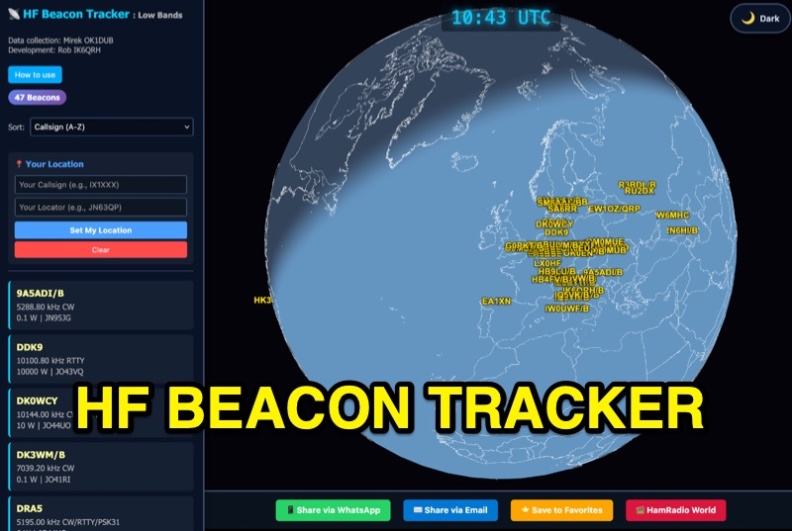 The HF Beacon Tracker is an advanced interactive tool designed for DXers and ham radio opoerators in general to monitor active beacons operating below 14 MHz. Built upon a high-fidelity 3D Earth globe, the application provides a spatial perspective on signal paths by integrating real-time environmental data with a comprehensive beacon database curated by Mirek OK1DUB. Beacons are plotted using precise Maidenhead locators and feature a real-time day/night terminator overlay to help operators identify Gray Line propagation opportunities. With a single click, users can calculate the exact distance from their own QTH to any beacon, visualized via an animated Great-Circle Path arc on the globe surface. To enhance its diagnostic capabilities, the tool seamlessly integrates with PSK Reporter, allowing users to right-click CW beacons to instantly fetch current reception reports and signal strength data. The interface is fully optimized with a mobile-responsive design, smooth globe rotation, and togglable Dark/Light themes suitable for any shack environment. Whether you are performing antenna gain tests, conducting ionospheric research, or simply hunting for band openings, the HF Beacon Tracker transforms raw database information into an intuitive, visual diagnostic suite. It serves as an essential asset for any operator looking to master HF band conditions.
 -
 Strictly Ham has a large retail presence in Australia and welcomes inquiries from New Zealand, the Pacific and Asia. Strictly Ham offers a comprehensive range of high quality Amateur, CB and Marine products, based in Victoria Australia
 -
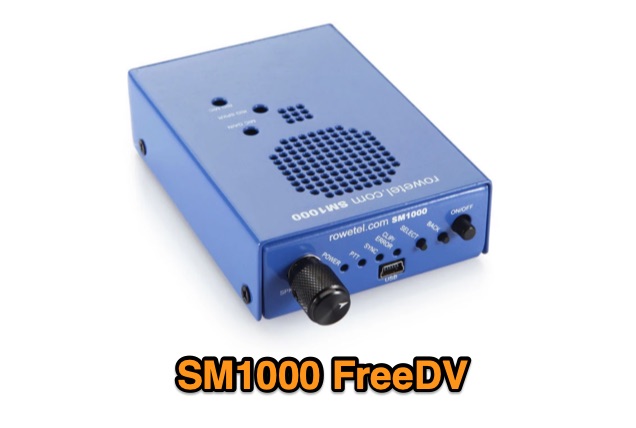 The SM1000 allows you to run FreeDV without a PC. Connect the SM1000 to your SSB radio, and you now have Digital Voice (DV). You don’t have to buy a new radio to run Digital Voice! It’s based on a STM32F4 micro-controller, has a built in microphone, speaker amplifier, speaker, and transformer isolated interfaces to your radio.
 -
 WSJTX-Controller-v2, or Otto, functions as an assistant for the WSJT-X amateur radio program, specifically designed to enhance operational efficiency for weak signal digital modes. The software automates several key tasks, including call management, prioritizing DX stations based on user-defined criteria, and optimizing frequency selection within the WSJT-X interface. It requires a modified version of WSJT-X to function correctly, integrating directly with its core processes to provide augmented control. Otto supports various digital modes, facilitating auto-logging of contacts and generating specific alerts for desired stations or conditions. It is engineered to streamline the workflow for operators engaged in DXing and general weak signal communication, offering features like automatic CQ responses and intelligent band monitoring. The utility is not compatible with certain other amateur radio software and is explicitly noted as unsuitable for contest operations or the WSJT-X Hound mode, indicating its specialized focus on non-contest DX and casual operating. The project's GitHub repository provides the source code and documentation, allowing users to review its implementation and contribute to its development. The software's design emphasizes automation to reduce operator intervention during routine digital mode operations.
 -
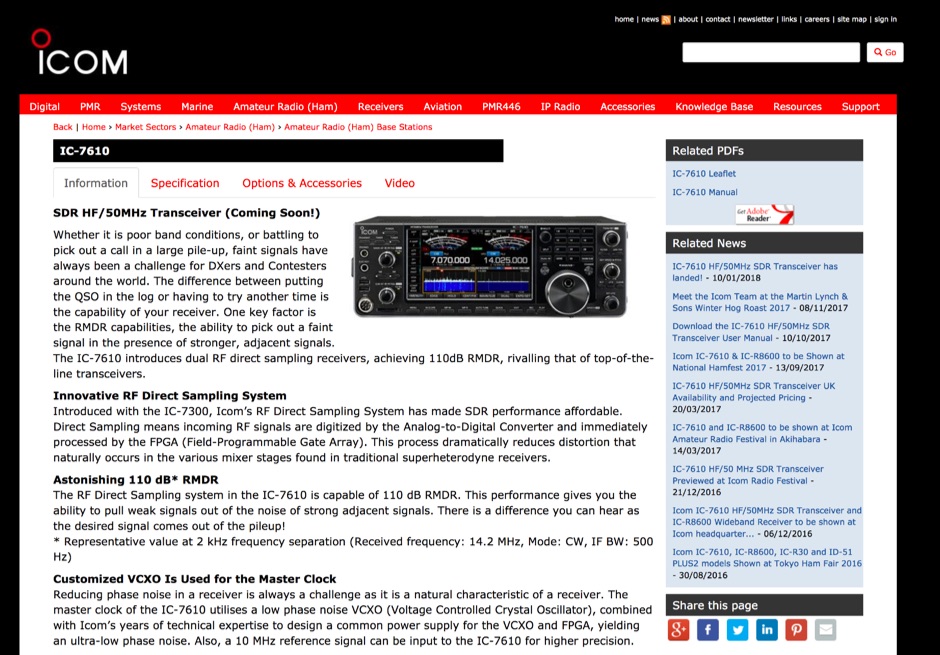 The ICOM IC-7610 SDR HF/50MHz Transceiver official product page with product specifications, option accessories and video at ICOM UK
 -
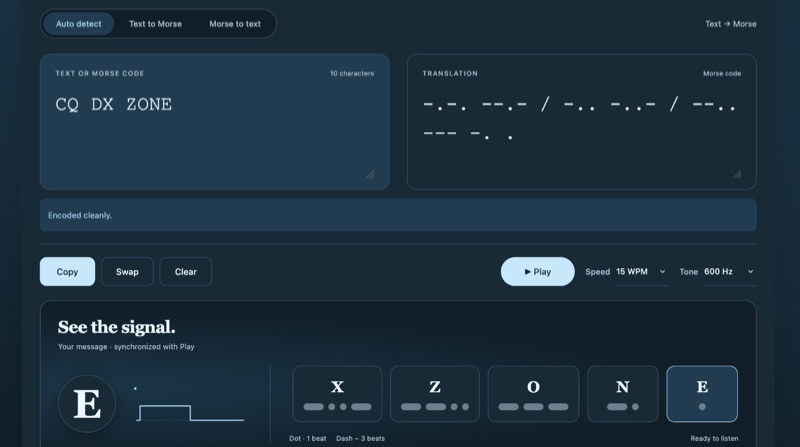 Txtopia provides a browser-based Morse code translator that converts plain text to International Morse Code and decodes Morse back into text, supporting various Unicode dot and dash representations. The tool automatically detects translation direction, normalizes common input variations like middle dots (·), bullets (•), em dashes, and underscores, and explicitly flags unsupported characters or ambiguous sequences with visible placeholders rather than silently dropping them. It accepts spaces, tabs, newlines, and pipes as letter separators, and slashes or blank lines for word boundaries, recording collapsed separators for user review. Users can adjust playback speed from 5 to 40 WPM and tone frequency from 300 to 1000 Hz for CW practice, with playback adhering to international Morse timing. The application operates entirely client-side, ensuring user input remains in the browser without server transmission. It includes a comprehensive reference for the supported Morse alphabet, numbers, and punctuation, aiding in learning and verification. The tool is suitable for checking game clues, verifying tattoo designs, and transcribing messages for ham radio CW practice.
 -
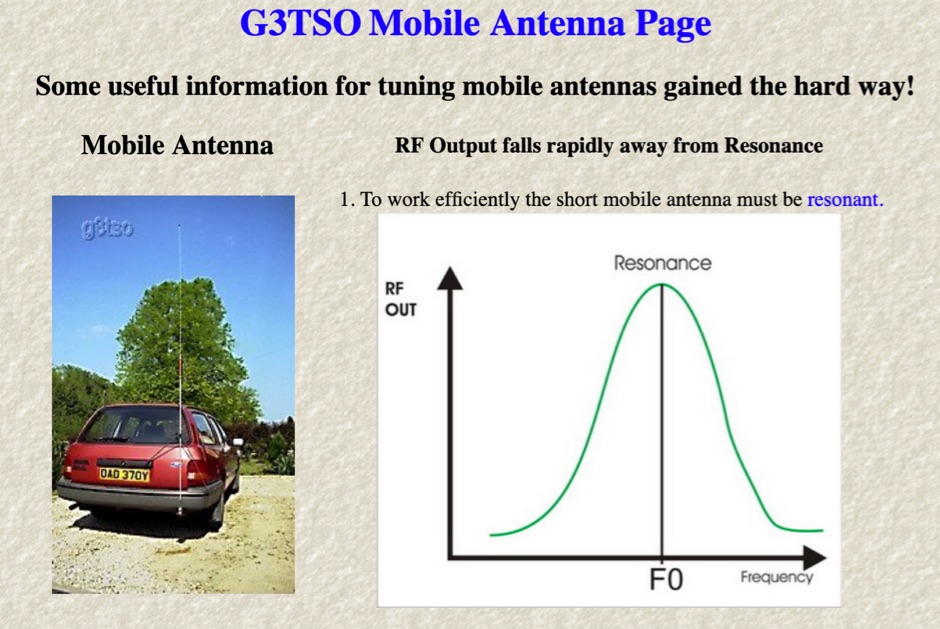 The _G3TSO_ Mobile Antenna Page details construction and tuning methods for mobile antennas operating across **10 to 160 metres**. The content describes a Hustler-based design, optimized for RF performance and vehicle speeds, featuring centre loading. For optimal operation on various bands, the loading coil placement requires clearance from the vehicle body. Antenna resonance is critical for efficient mobile operation. A mobile antenna's base impedance may be as low as 27 ohms, requiring specific matching to achieve maximum radiation, as a minimum SWR at the transmitter does not always indicate resonance or maximum output. Tuning involves physical adjustment of antenna length to achieve resonance at the operating frequency. The _G3TSO_ page outlines a tuning procedure utilizing a low-power signal source and a field strength meter to identify maximum radiation before impedance matching. Loading coil placement, either at the base, center, or top of the antenna, influences radiation efficiency and mechanical stability for mobile installations. Centre-loaded whips, such as the Hustler design, offer a compromise between efficiency and stability, often for single-band operation. Helically wound antennas, including those for **28 MHz**, may present base impedances around 17 ohms, resulting in a 3:1 SWR at resonance. Low resistance grounding at the antenna base is also specified for optimizing performance and minimizing RFI during mobile operation. DXZone Focus: Mobile | Any | Antenna Tuning | HF
 -
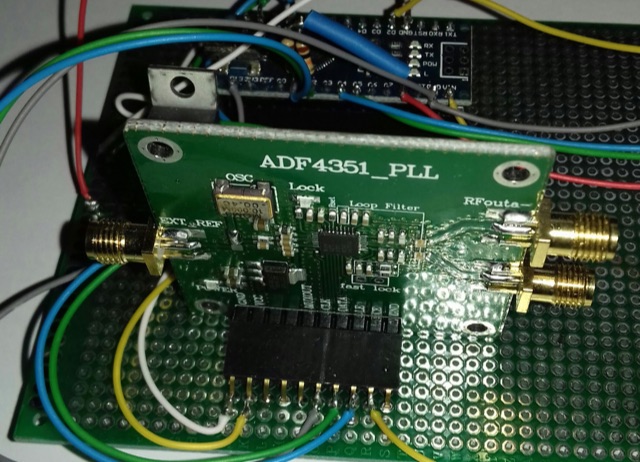 Just a simple signal generator based on ADF4351 module from fleebay allows you to generate one single frequency that can go up or down in 100Khz steps via two push buttons.
 -
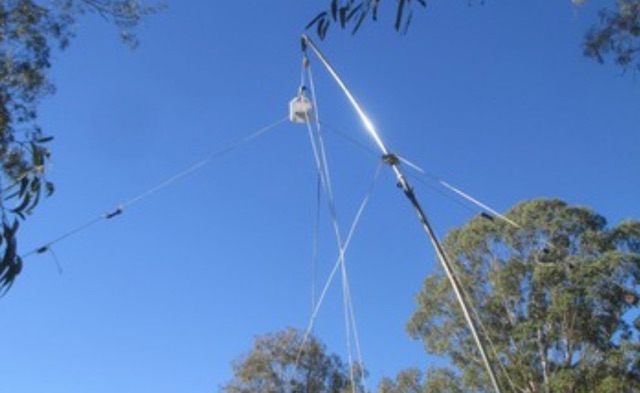 Article on portable HF antenna where author diverge about antenna efficiency versus size based on his personal experience on using HF antennas during portable operations
 -
 The 80-meter Skyloop antenna, a top-performing HF antenna, excels in weak signal work, low-noise operation, and omnidirectional coverage. Ideal for fixed stations, it delivers strong performance at low power, outperforming many alternatives, including 80m half-wave end-fed antennas. Requiring significant space for deployment, it’s well-suited for NVIS and groundwave use. Though not portable, it’s cost-effective and durable, with minor maintenance needs. Tuning may require adjustments for optimal resonance. It’s a standout for base stations, though a lighter portable version could enhance its versatility.
 -
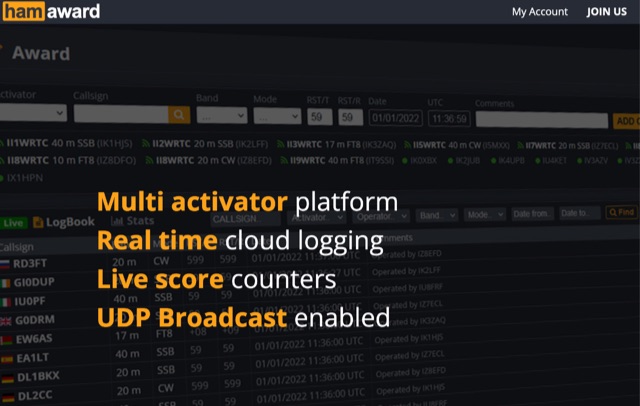 HamAward is a cloud based amateur radio logbook allowing multi operators multi station activities, featuring real time cloud logging with live score counters. This online tool is addressed to support multi station award operations and management.
 -
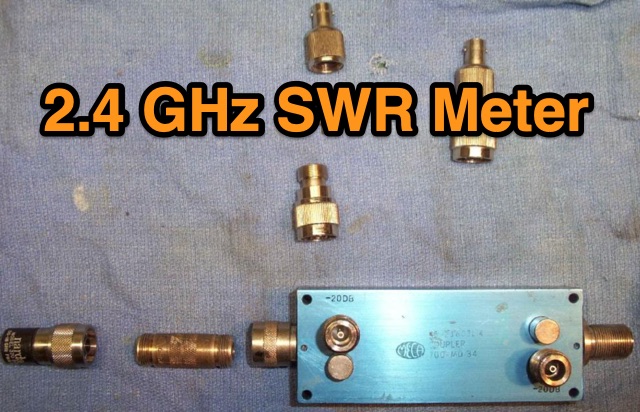 This is a simple 2.4 GHz SWR meter which is based around surplus microwave hardware which can be easily found. The main component is a MECA -20/-20 dB Directional Coupler which has a frequency range of approximately 700 MHz to 2.5 GHz.
 -
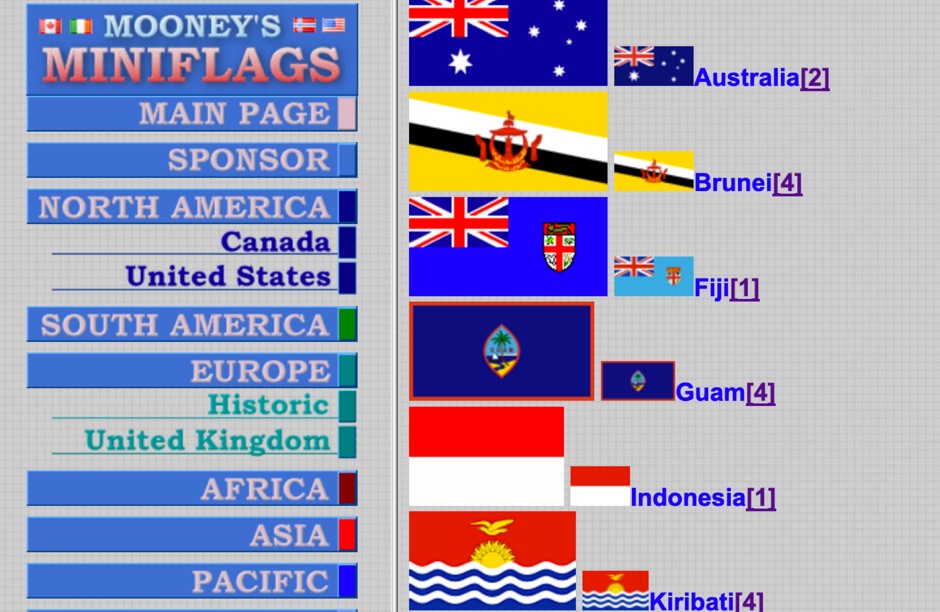 A website with a large collection of world flags pictures in GIF format divided per continent. Includes flags of US and Canada states
 -
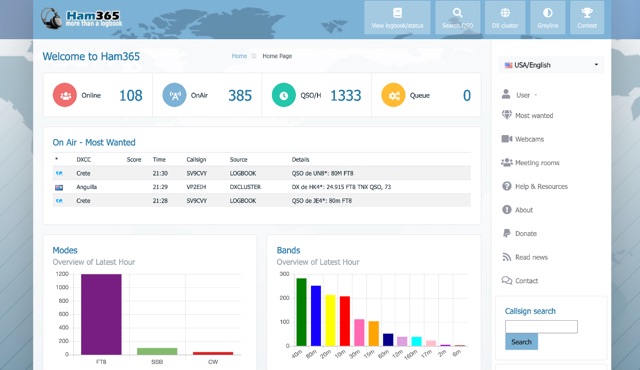 Over 15 years of continuous operation, Ham365 provides a web-based logging solution for Amateur Radio Operators, allowing them to maintain and share their QSO records online. Originally launched as the online logbook component of Ham Radio Deluxe, it has since evolved into an independent platform, now integrating with numerous other logging applications. The platform shares its database with HRDLOG.net, ensuring that operations performed on one site are reflected on the other, maintaining data consistency for users. Key features include an overview of the latest hour's activity, a display of the most recent QSOs, and a map visualizing recent contacts. It also highlights "Most Wanted" entities and ongoing DXpeditions, providing a dynamic view of current amateur radio activity. The logbook supports various operating modes, including SSB, RTTY, PSK31, and FT8, and handles ADIF data for interoperability. Users can manage their logbooks, track DX activity, and utilize features like OQRS (Online QSL Request System) through its integrated functionalities. The system is designed to be accessible to a wide range of operators, from casual ragchewers to avid DXers and contesters.
 -
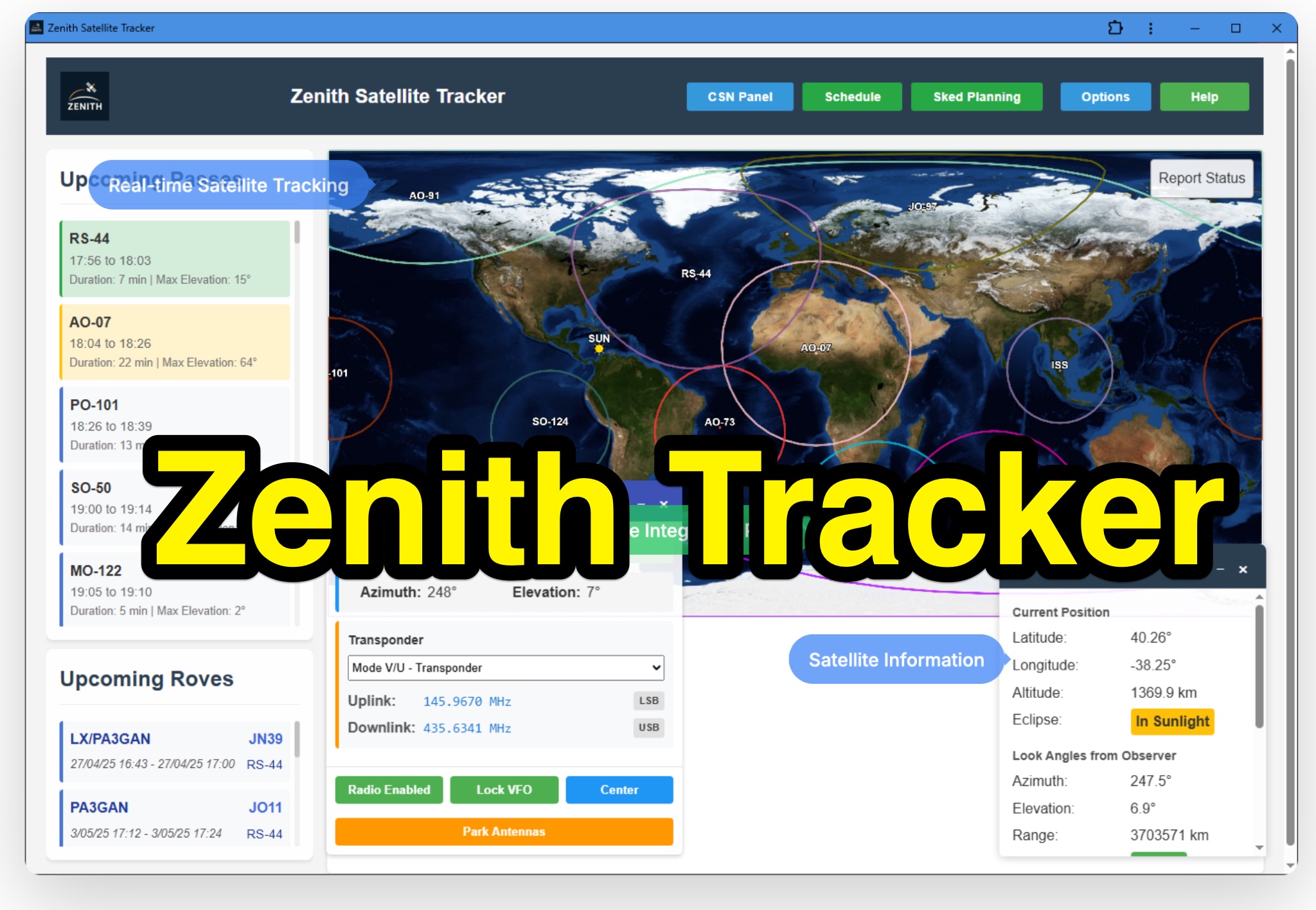 Zenith Tracker offers real-time satellite tracking, pass predictions, and radio hardware integration for ham radio operators. The platform includes an interactive world map showing satellite positions, footprints, and ground tracks, as well as a polar radar visualization for detailed pass analysis. Users can view upcoming passes, set filters, and receive notifications. Integration with CSN Technologies S.A.T Hardware and QTRigDoppler allows for automatic radio control, antenna tracking, and transponder management. The platform also offers APRS message interface, grid square-based location input, and API integration for rover activations. Zenith Tracker is recommended for both general users and those needing advanced hardware integration.
 -
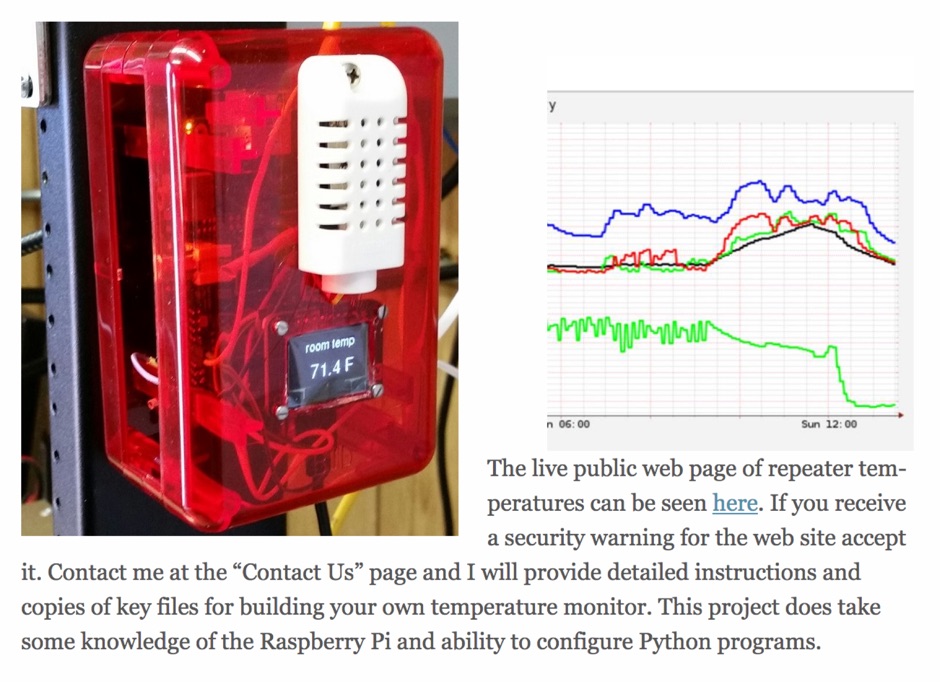 A simple and cheap solution to monitor temperature of your repeater implementing a Raspberry Pi device with a set of popular tools made in python a database and RRD tool
 -
 The document discusses the classifications of sunspots and their potential for solar flare activity, categorizing them into Alpha, Beta, and Delta groups based on their magnetic field characteristics. It explains how these classifications relate to the likelihood of solar flares, ranging from minor to extreme events. The report also outlines the geomagnetic indices and conditions that affect high-frequency (HF) radio propagation, emphasizing the effects of solar flares on radio communication and geomagnetic storms. The information is geared towards amateur radio operators, providing insights into how solar activity influences HF radio operations.
 -
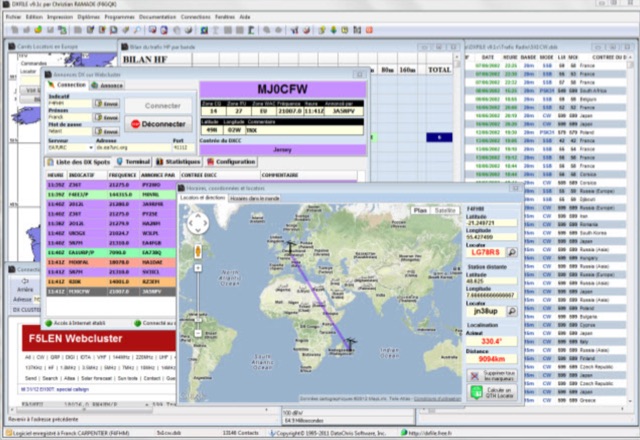 DXFile is a Windows shareware application designed for amateur radio operators, providing comprehensive log management capabilities. The software, developed in Pascal, facilitates real-time and deferred QSO entry, automatically populating fields like frequency, mode, and DXCC country based on user input and system time. It includes features for searching, modifying, and deleting QSO records, with options to sort logs by date, callsign, or entry order. The program offers various printing functions, including QSL card labels in multiple formats, and can generate standard logbook printouts. Beyond basic logging, DXFile integrates modules for tracking progress towards major operating awards such as DXCC, _IOTA_, WAZ, WAS, DDFM, and DIFM. It provides detailed summaries of contacts by band and mode, including graphical representations of HF traffic. A dedicated QSL Manager module assists in processing received QSLs, allowing users to mark confirmations and print multi-line QSL labels. The application also incorporates a DXCC list viewer, which can be updated to ensure accurate country and zone data for logging and award tracking. A distinctive feature is its HF propagation prediction module, which calculates optimal frequencies and signal levels for paths between **250 km** and **6000 km**, considering both E and F layer ionospheric conditions. This module helps operators determine the best times for long-distance contacts. Additionally, DXFile includes a _Web-Cluster_ interface, enabling connection to various DX cluster servers like DXLITE, DXSCAPE, and NC7J for real-time spot information.
 -
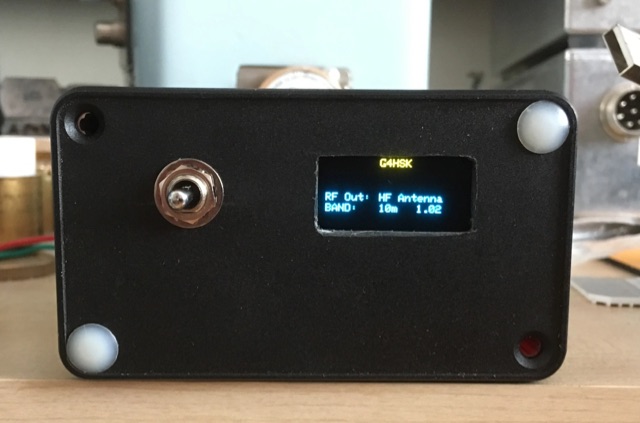 An Arduino Based Antenna Switch For The IC-7300 that monitors the band voltage from the rear accessory socket on the IC-7300. Two RF antenna relays are used to switch to the appropriate output.
 -
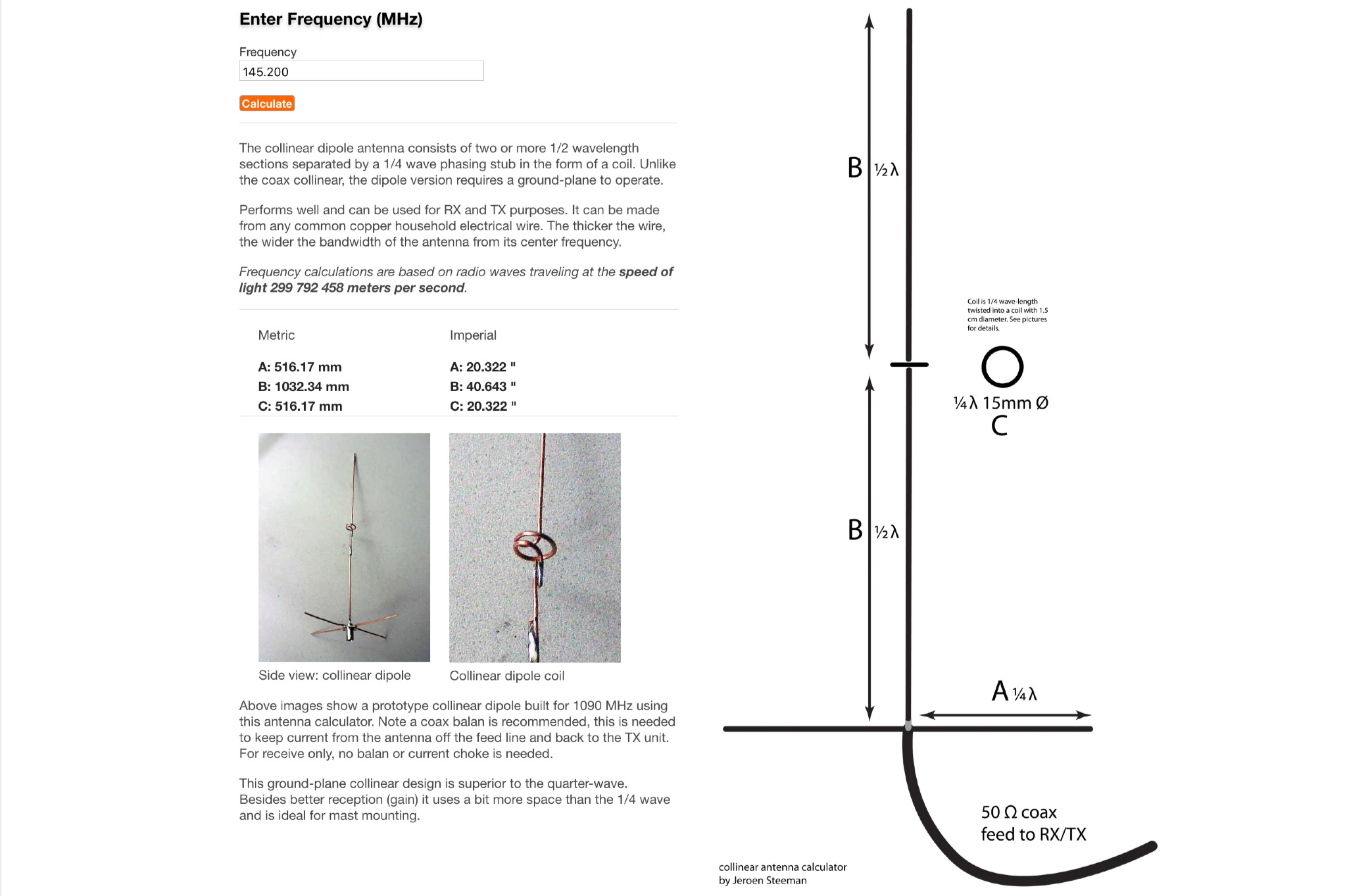 This page offers an online antenna designer to calculate the dimensions for a collinear dipole antenna at a specified frequency. The collinear dipole antenna is constructed with multiple 1/2 wavelength sections separated by a 1/4 wave phasing stub in the form of a coil. It requires a ground-plane to operate and can be used for both receiving and transmitting purposes. The antenna can be made from common copper wire, with thicker wire providing a wider bandwidth. The calculations are based on radio waves traveling at the speed of light. Ideal for ham radio operators looking to build their own antenna for improved reception and transmission.
 -
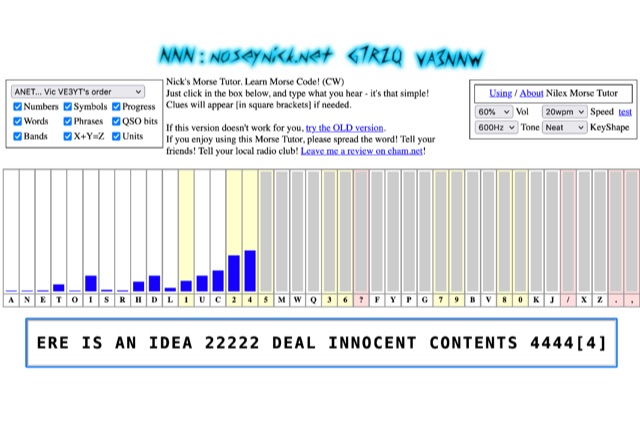 The **Nilex Morse Tutor** is an HTML5 web application designed to teach Morse code reception, adapting to user proficiency by adding new characters as readiness is detected. It prioritizes practice on less familiar letters, numbers, symbols, words, and phrases, while minimizing repetition of already mastered elements. The program offers multiple learning orders, including "Q7ZG..." (Ward/Jim's), "KMRS..." (PU5EPX/Koch), "KMUR..." (lcwo.net), "AENT..." (CWops CW Academy), "TEAN..." (Stephen C Phillips), "ANET..." (Vic VE3YT), and "ETI5..." (Ham Whisperer), alongside an alphabetical option. Users can customize the learning experience by enabling or disabling automatic progression, and selecting specific content categories such as numbers, symbols, words, phrases, QSO bits, Ham Radio Bands, X+Y=Z math, and units. Audio settings are adjustable for volume, speed (WPM), tone frequency, and keyshape/keying envelope, allowing for a personalized auditory environment. The interface provides visual feedback with blue bars indicating practice emphasis and gray bars for reserved characters, with clickable bars for manual character selection. Developed by "Nosey" Nick Waterman, VA3NNW, this tutor is based on earlier versions by Jim Wilson and a 1977 QST article. A significant October 2019 rewrite incorporated a new WebAudio sound library by AwesomeAidenW, improving offline functionality and mobile support. The content library was expanded to include 3000 top Google words, 2284+ General Service List words, ISO country codes, capital cities, US states, Canadian provinces, UK counties, common names, periodic table elements, quotes, Q-codes, electronic components, ham abbreviations, and example call signs. The software is distributed under the GNU GPL V2 license.
 -
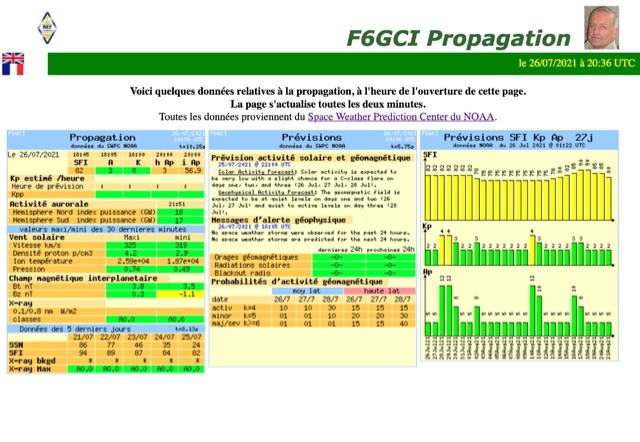 A collection of dynamically produced images based on the daily data of the NOAA Space Weather Prediction Center
 -
 Collection of flags of all DXCC entities. They are based on image sizes of precisely 47 x 28 pixels.
 -
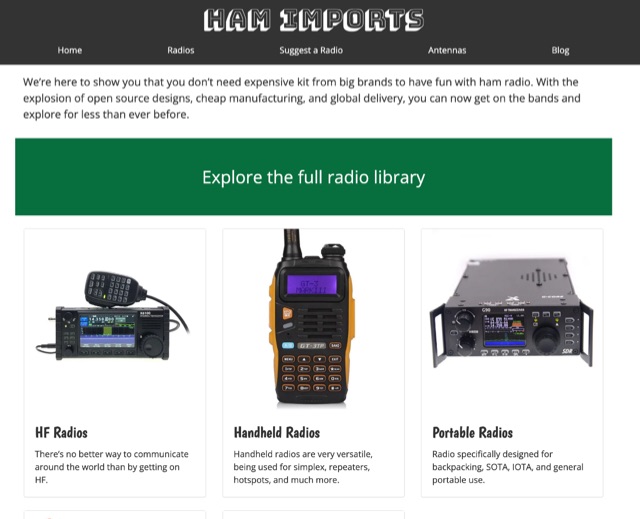 The database of Chinese ham radios. We are here to show you that you do not need expensive kit from big brands to have fun with ham radio. With the explosion of open source designs, cheap manufacturing, and global delivery, you can now get on the bands and explore for less than ever before.
 -
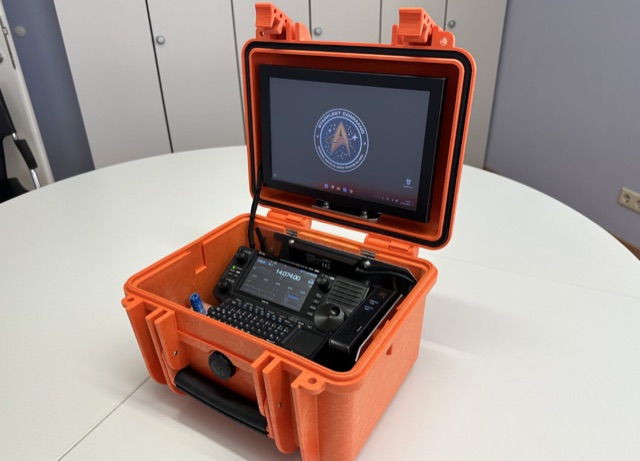 This project details the creation of a portable GoBox housing an IC705, Windows 11 PC, and Bluetooth microphone. The robust setup, enclosed in a weatherproof Hofbauer Explorer Case, ensures stability and functionality for QRP and emergency radio activities. The aluminum-mounted devices minimize RF interference, and a built-in LifePO4 battery powers the 10.1 TFT touch LED monitor, providing approximately 12 hours of use in receive mode. With a focus on grab-and-go versatility, this GoBox stands as an efficient solution for outdoor ham radio operations.
 -
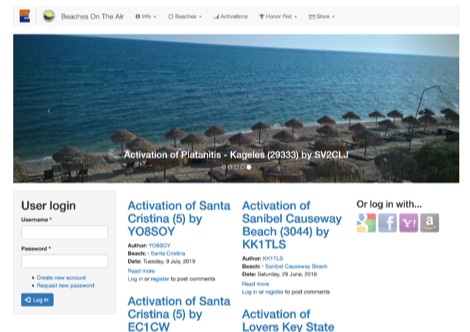 Beaches On The Air is an award scheme for radio amateurs that encourages portable operation from beaches. You can participate from any country or region around the world. Our beach lists currently contain more than 30,000 beaches and aim to be as exhaustive and objective as possible, and are often based on official sources, such as environmental protection agencies.
 -
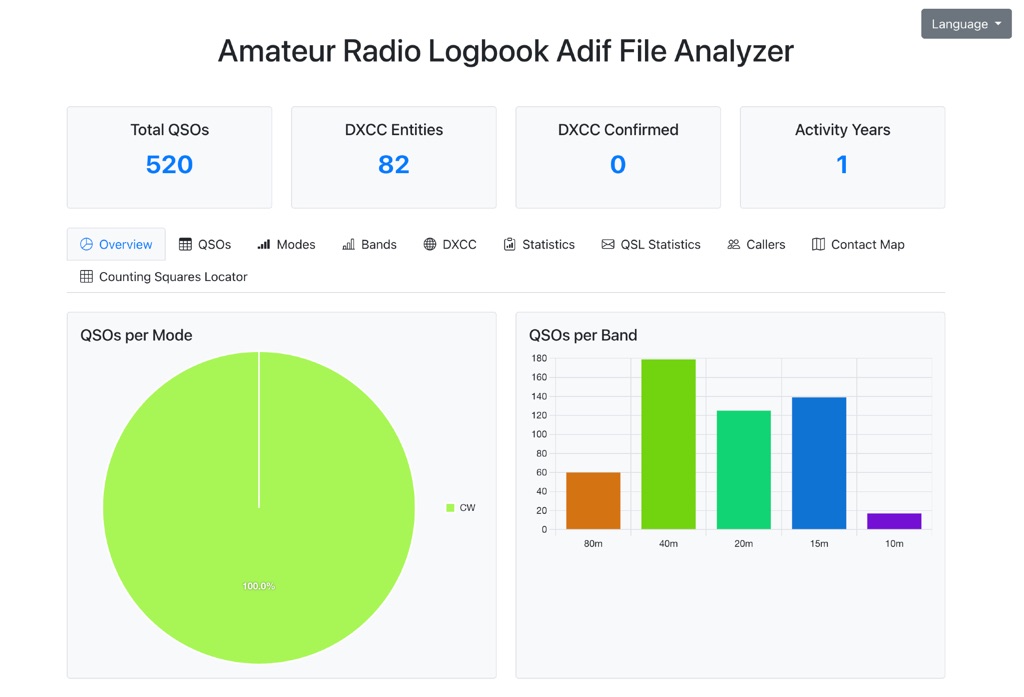 The Amateur Radio Logbook ADIF File Analyzer available at loganalyzer.sv5fri.eu is a convenient web-based tool that allows you to upload your ADIF log and instantly generate a visual map of your QSO contacts along with detailed statistics—by band, mode, time, grid squares, DXCC, and more. It provides an intuitive overview of your operating patterns and performance without requiring any software installation.
 -
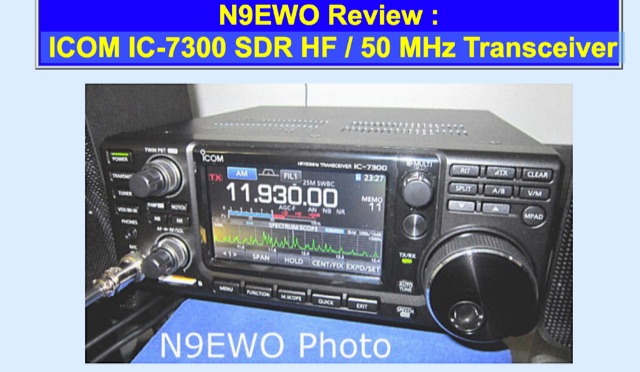 This page includes an interesting and comprehensive review of the ICOM IC-7300 SDR HF / 50 MHz transceiver. The author focuses on many aspects of this transceiver with impressions based on his experience
 -
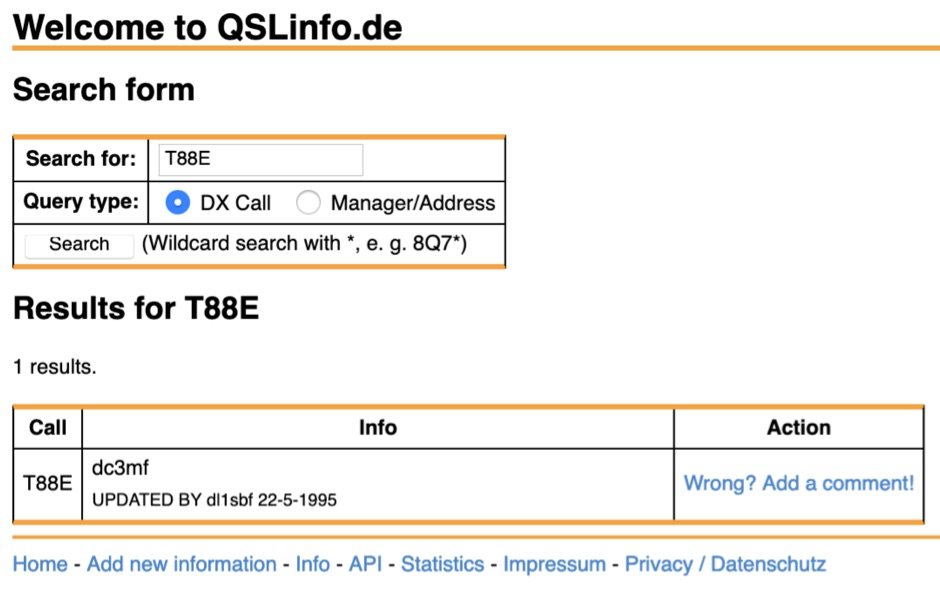 QSLinfo.de is a QSL manager and address database for radio amateurs, maintained by Lothar, DL1SBF for more than 25 years already.
 -
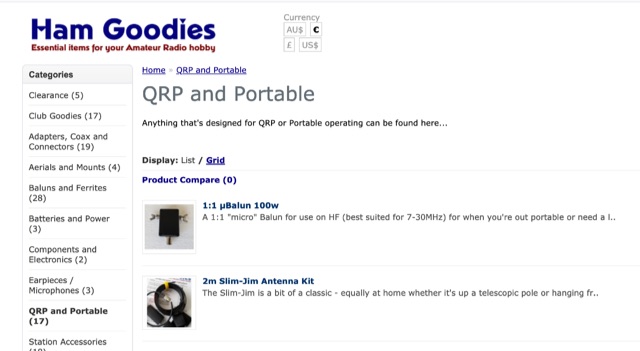 Amateur Radio goodies for not only the Shack, but also a range of outdoor/portable kit. Ferrite toroids, RTL SDR, Un-uns and Baluns for antennas and RF Filters. Based in the UK.
 -
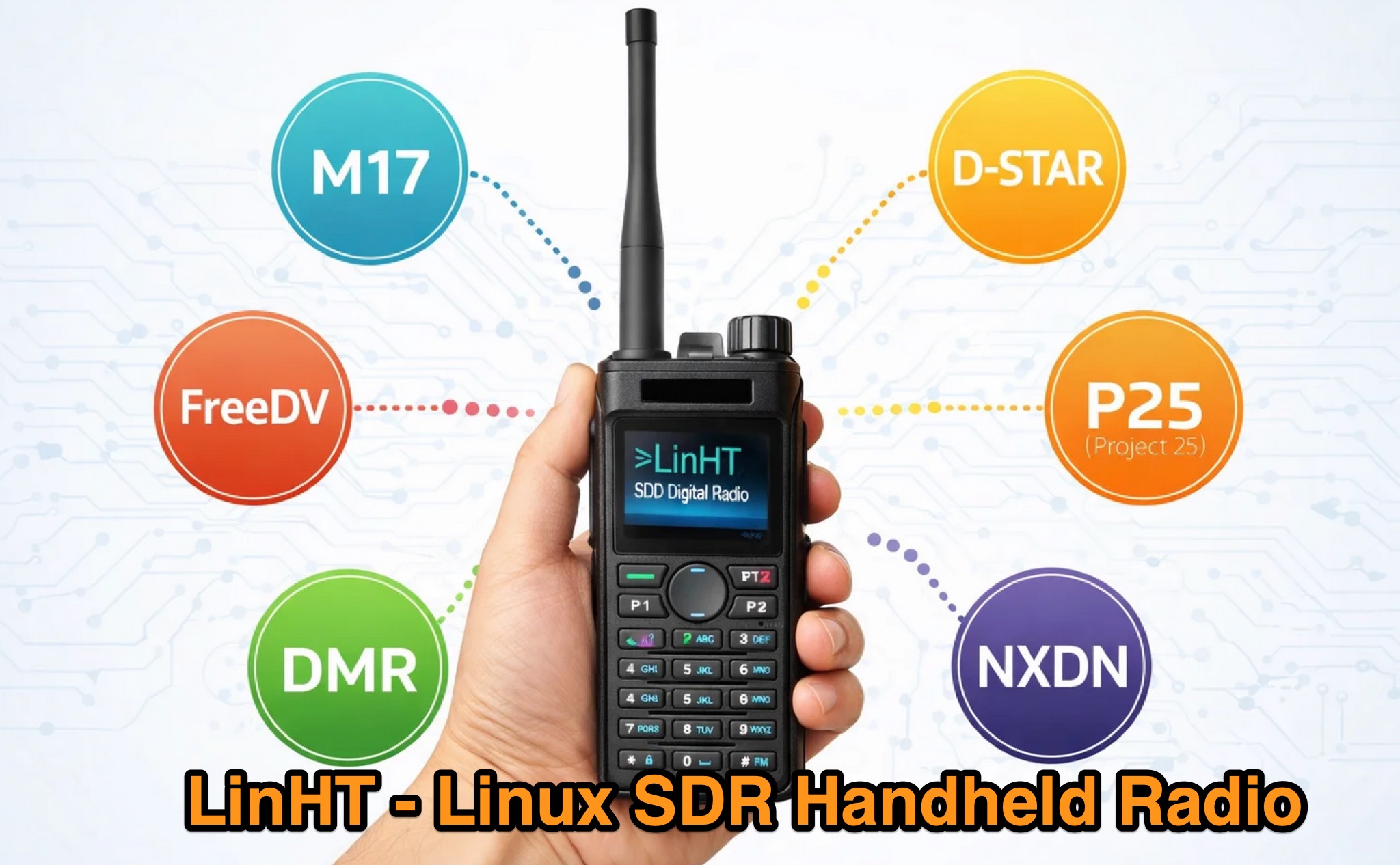 Learn about the LinHT handheld SDR radio, an open-source, Linux-based project that is shaking up the ham radio and SDR communities. This guide is perfect for hams new to digital voice and interested in exploring experimental radio platforms. Discover what sets LinHT apart from traditional handheld radios, how it leverages SDR technology and Linux operating system, and why it's generating buzz in the ham radio landscape. Dive into the world of software-defined handheld radios with this beginner-friendly overview.
 -
 Morse Walker is a web-based tool for amateur radio operators to practice CW skills. Inspired by Morse Runner by VE3NEA, it simulates pileup scenarios and contest formats like POTA, CWT, and SST. Modes include single-caller exchanges and basic contests, offering realistic experiences to improve speed, accuracy, and QSO handling. Ideal for contest preparation or honing activation skills, Morse Walker helps operators enhance proficiency in CW communication. Start your training today at MorseWalker.com
 -
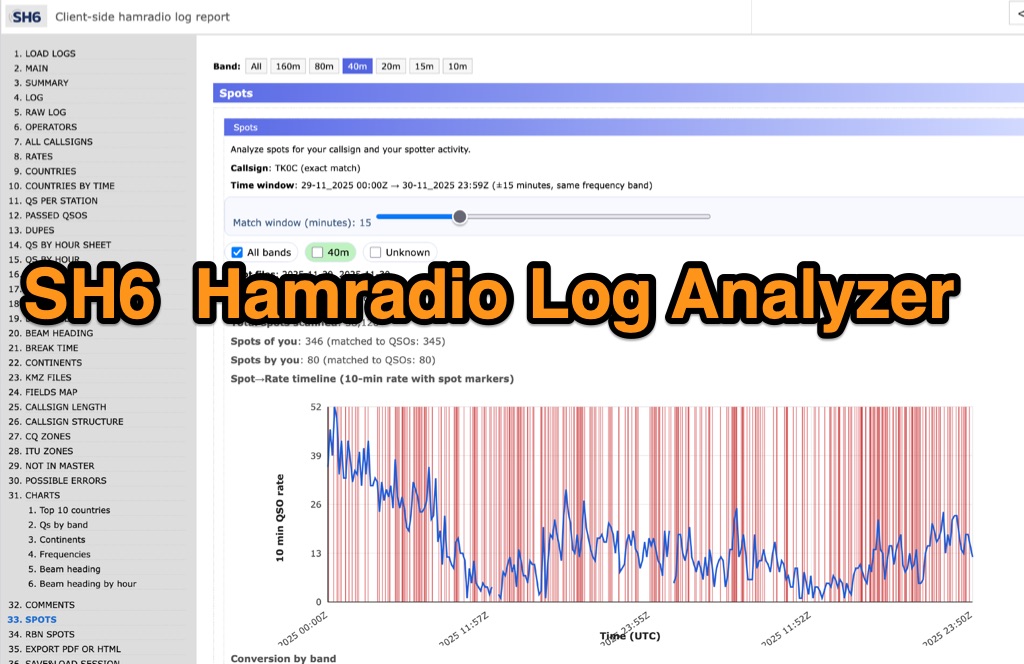 SH6 is a versatile, browser-based utility designed for the detailed analysis and visualization of amateur radio contest logs. Supporting standard formats such as Cabrillo and ADIF, the tool allows operators to upload personal files via drag-and-drop or access a searchable public archive containing over one million logs. Key capabilities include comprehensive performance metrics, offering summaries of band breakdowns, QSO rates, and beam headings. Furthermore, SH6 provides advanced geographic visualization through interactive maps, analyzing contacts by country, zone, and continent. A standout feature is the side-by-side comparison mode, enabling users to contrast two distinct logs for strategic assessment. SH6 transforms raw log data into actionable insights regarding operator performance without requiring software installation.
 -
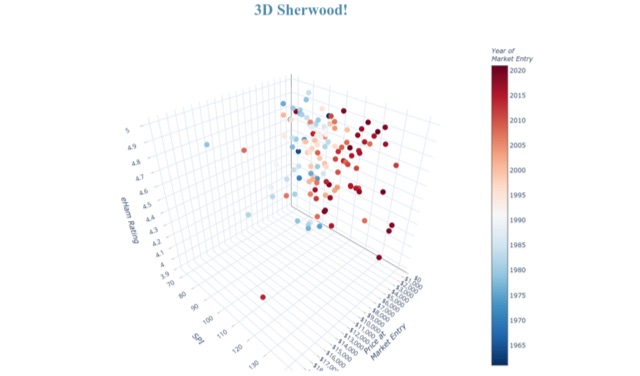 A growing set of pages with tools and analyses of various elements of data elements based on Sherwood RX tests
 -
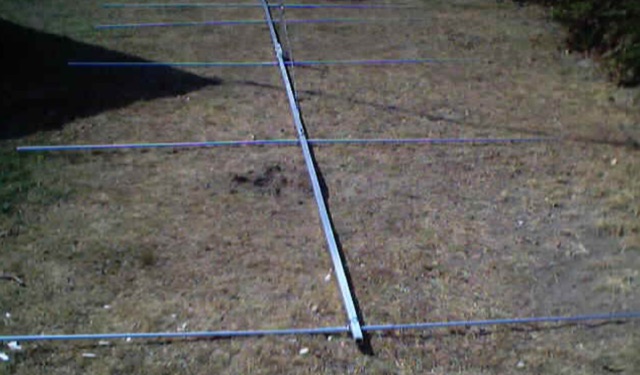 This is a design based on the QuickYagi 4 software by WA7RAI with some changes for practical reasons. The beam uses 6.5 metres of standard 25mm square boom, 12mm diameter elements without tapers. The actual boom length used is 6.3 metres and all parts are readily available.
 -
 Guide to AllStarLink the world wide network of Amateur Radio repeaters, remote base stations and hot spots accessible to each other via the Internet and/or private IP networks.