DSP Resources
Digital Signal Processing for Ham Radio Operators

Digital Signal Processing (DSP) has transformed amateur radio, allowing operators to extract weak signals from noise and implement complex modulation schemes. Many modern transceivers include built-in DSP capabilities for noise reduction, filtering, and advanced digital modes. This technology enables hams to achieve reliable QSOs even under challenging propagation conditions, making the most of every frequency on the bands.
This category provides resources on various digital modes, from keyboard-to-keyboard chat modes like PSK31 and PSK63 to robust data transfer protocols such as PACTOR-III and WinMor. Operators can find technical specifications for modes like Clover and Domino, along with information on using FFT programs for signal analysis. There are also guides for integrating DSP noise canceling solutions with popular radios from Icom, Yaesu, and Kenwood, enhancing station performance for all types of amateur radio activity.
Related Categories
-
 With spectrum analysis of beacon signals, it's possible to see features relating to various propagation phenomonen.
 -
 Nino porcino documentation about CHIP64 digital mode
 -
 This page is a 404 error, indicating the original content about Clover digital mode technical specifications is no longer available.
 -
 CLOVER-2000 is a faster version of CLOVER (about four times faster) that uses eight tone pulses, each of which is 250 Hz wide, spaced at 250-Hz centers, contained within a 2 kHz bandwidth between 500 and 2,500 Hz
 -
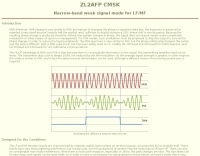 CMSK is a narrow-band weak signal digital mode for LF and MF ham radio bands defined by ZL2AFP. CMSK63 is the windows client program.
 -
 Frequently asked questions on Digital Signal Processing
 -
 Domino is the name given by the developers to a family of IFK coded coherent phase single tone MFSK keyed modes, using sequential tone-pairs in two alternate fields arranged as orthogonal but interleaved tone sets.
 -
 This document describes the DIFFERENCE of mode HAM to the official broadcast DRM standard
 -
 G-TOR is a trademark of Kantronics, Inc. G-TOR (Golay-Teleprinting Over Radio) can be viewed, in part, as a variant of the Automatic Link Establishment (ALE) protocol, outlined in MIL-STD-188-141A.
 -
 An introduction to PSK31, MT63, and Hellschreiber, John DeGood NU3E Trenton Computer Festival in PDF
 -
 The home of Radio Facsimile wefax & SSTV.
 -
 MFSK is an easy-to-use chat mode for real-time amateur contacts, nets and bulletin transmissions, but not intended for contesting or Bulletin Board System (BBS) use. It is a half-duplex non-Automatic Repeat ReQuest (ARQ) forward-error-correcting (FEC) mode. It performs well on long-path fading conditions and in the presence of interference
 -
 MFSK is an easy-to-use chat mode for real-time amateur contacts, nets and bulletin transmissions, but not intended for contesting or Bulletin Board System (BBS) use. It is a half-duplex non-Automatic Repeat ReQuest (ARQ) forward-error-correcting (FEC) mode. It performs well on long-path fading conditions and in the presence of interference
 -
 The MT-63 modem, constructed around a high speed DSP processor, either in a dedicated external DSP unit like the Motorola EVM, or in PC software using the PC sound card, transmits 64 tones spaced 15.625 Hz apart, in the 1 kHz bandwidth.
 -
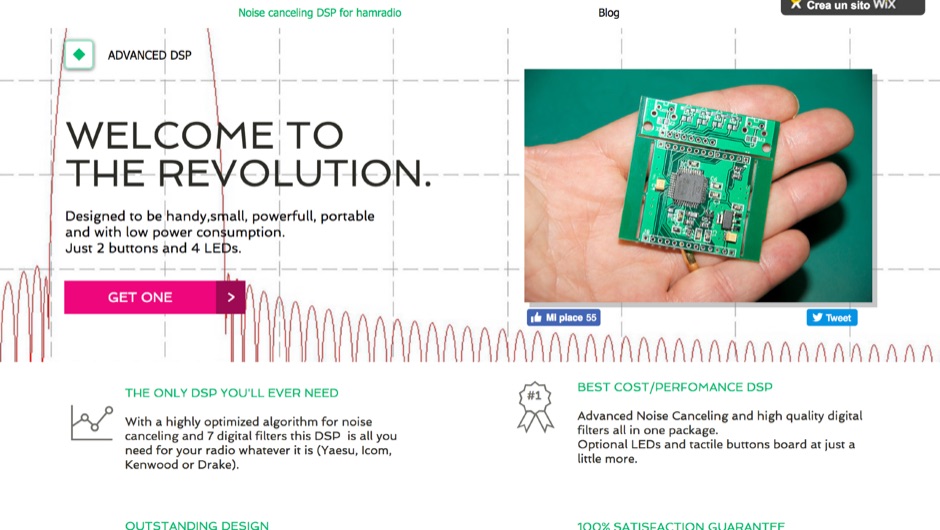 Noise canceling DSP for ham radio good for Icom, Yaeu, Kenwood and any kind of radio
 -
 The Olivia transmission system is constructed of two layers: the lower, modulation layer is an (almost) classical Multi-Frequency Shift Keying (MFSK) and the higher layer is a Forward Error-Correcting (FEC) code based on Walsh functions.
 -
 OliviaData the OLIVIA Yahoo group ham radio
 -
 PACTOR can be viewed as a combination of two earlier digital modes, packet radio and AMateur Teleprinting Over Radio (AMTOR). PACTOR provides improved throughput because its transmission speed adapts to the quality of the link and it uses Huffman compressed characters.
 -
 PACTOR-II is a fully backward-compatible improvement to the original PACTOR system. It is an adaptive mode that applies different modulation and encoding methods depending on the channel quality.
 -
 PACTOR-III is a software upgrade for existing PACTOR-II modems that provides a new data transmission mode for improved speed and robustness. PACTOR-III is not a new modem or hardware device. Most current PACTOR-II modems are upgradeable to use PACTOR-III via a software update since PACTOR-II firmware accommodates the new PACTOR-III software
 -
 PSK31 is a digital communications mode which is intended for live keyboard-to-keyboard conversations, similar to radioteletype. Its data rate is 31.25 bauds (about 50 word-per-minute), and its narrow bandwidth (approximately 60 Hz at -26 dB) reduces its susceptibility to noise.
 -
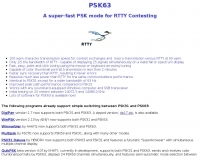 A super-fast PSK mode for RTTY Contesting, 100 wpm character transmission speed for contest exchanges and macro transmission versus RTTY at 60 wpm
 -
 Q15X25 is a packet modem with a KISS/AX.25 interface designed for HF transmission of AX.25 packets and TCP/IP using Automatic Repeat reQuest (ARQ) and forward error correction (FEC).
 -
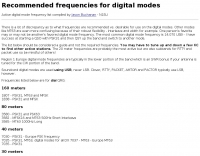 Active digital mode frequency list compiled by Jason Buchanan - N1SU
 -
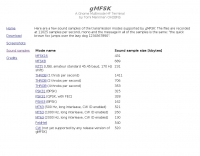 Sound samples of the transmission modes recorded at 11025 samples per second, mono and the message in all of the samples is the same: "the quick brown fox jumps over the lazy dog 1234567890".
 -
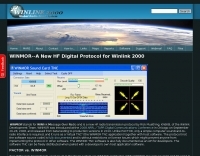 A new HF transmission protocol for Winlink 2000
 -
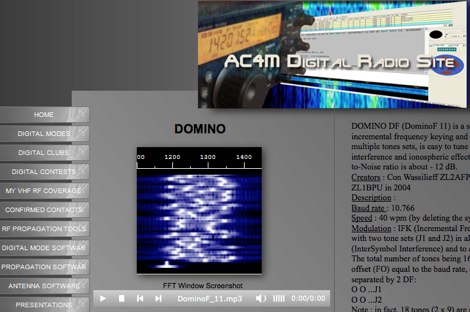 DOMINO DF is a sensitive mode which, due to its incremental frequency keying and thanks to its interleaved multiple tones sets, is easy to tune and is few sensitive to interference and ionospheric effects. Domino faeture a great signal to noise ratio.