Search results
Query: radio projects
Links: 187 | Categories: 54
Categories
- Ham Radio > Ham Radio News
- Technical Reference > 3D Printed Projects
- Technical Reference > HF Radios
- Antennas > 2M
- Technical Reference > Alternative Power
- Operating Modes > Amateur Television
- Technical Reference > Arduino
- Manufacturers > Arduino
- Technical Reference > Audio
- Technical Reference > Batteries
- Antennas > Bazooka
- Ham Radio > Blogs
- Ham Radio > Personal Pages > Brazil
- Technical Reference > Calculators
- Software > Circuit Design
- Operating Modes > Satellites > Clubs
- Technical Reference > Components > Component Database
- Technical Reference > DTMF
- Technical Reference > Electronics
- Shopping and Services > Electronics
- Ham Radio > Blogs > Europe
- Ham Radio > Clubs > Europe > France
- Technical Reference > Frequency Counter
- Software > Front Panel Design
- Technical Reference > Headsets and Speakers
- Radio Equipment > HF Transceivers > Icom IC-705
- Ham Radio > Blogs > Asia > India
- Ham Radio > Personal Pages > Europe > Italy
- Technical Reference > Keyers
- Shopping and Services > Kits and Components
-
 This simple and cost effective interface circuit is designed for use with any ICOM amateur radio equipment with CIV interface
 -
 The future of two way radio is digital.
 -
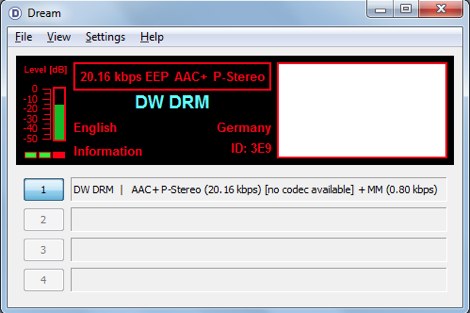 Open-Source Software Implementation of a DRM (Digital Radio Mondiale) Receiver. Dream runs on virtually any pc and requires a receiver front-end to work as a real radio.
 -
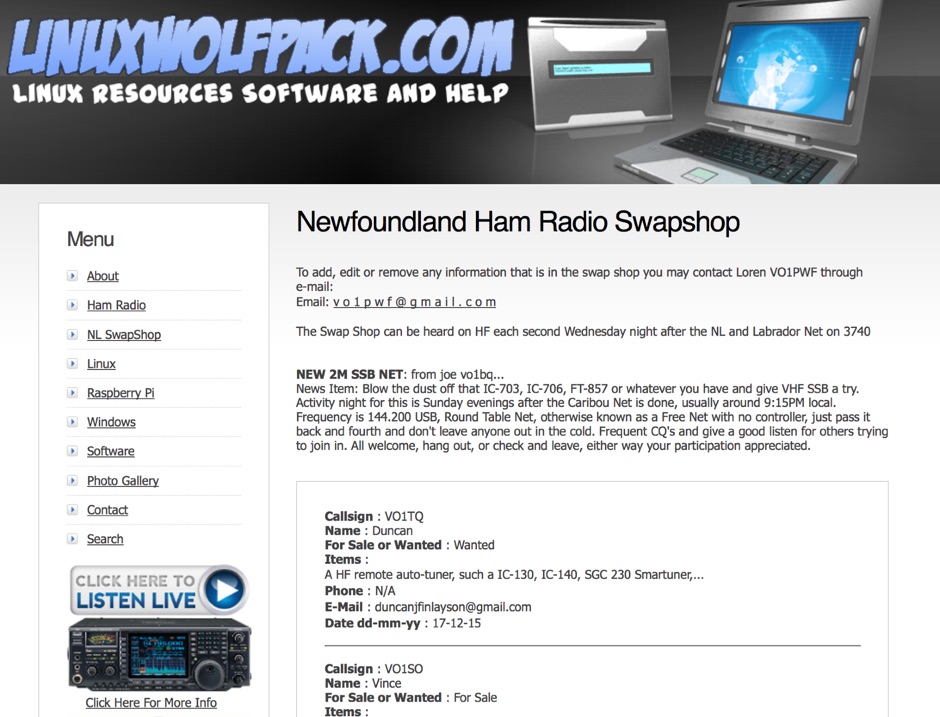 The NL Ham Radio Swap Shop is an online platform dedicated to connecting amateur radio operators in Newfoundland and Labrador with opportunities to buy, sell, and trade radio equipment. This service caters to both seasoned operators and newcomers, providing a space for exchanging second-hand gear, military radios, antique radios, and radio tubes. Users can browse listings, post their own items, and find unique equipment that may not be available in traditional retail outlets. In addition to facilitating transactions, the Swap Shop also serves as a community hub for local hams. It encourages networking among operators, sharing of knowledge, and collaboration on projects. Whether you are looking for a rare piece of equipment or simply want to declutter your shack, the NL Ham Radio Swap Shop is an essential resource for anyone involved in the amateur radio hobby in the region.
 -
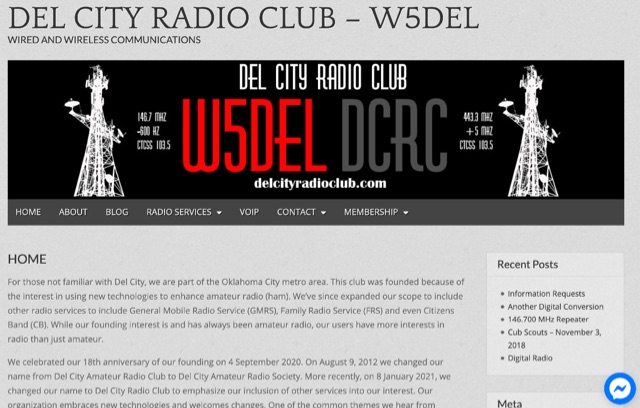 Showcases the Del City Amateur Radio Club (W5DEL), an organization serving the amateur radio community in Del City, Oklahoma. The club facilitates local ham radio activities and provides a platform for members to connect. It emphasizes community engagement through various events and resources, supporting the interests of local operators. The club's online presence, while functional, appears to be a repurposed template, with some content not directly relevant to amateur radio. Members can access information on club dues, upcoming events, and community guidelines. The site mentions a focus on VoIP, suggesting an interest in **digital voice modes** and **internet-linked radio systems**. Although specific technical projects or operating achievements are not detailed, the club aims to foster camaraderie and provide a local point of contact for hams in the Del City area.
 -
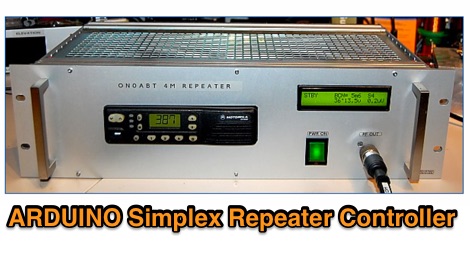 This project hereby presented is a complete HAM radio simplex 'smart' repeater, built around a Motorola GM-350/950, Arduino NANO board and a WINBOND audio recording integrated circuit
 -
 An open collaborated project for creating base libraries and applications to allow the passing of information from the host computer to the D-STAR radio and vice versa.
 -
 EggsHam is a PalmOS application that generates (and grades) _practice_ amateur radio licensing exams. It is for people interested in obtaining an amateur radio license in the US, who want to practice for the Technician, General, or Extra written exam.
 -
 Website for radio Amateurs in the Hastings, Peterborough, and Northumberland Counties of East Central Ontario, Canada. Propagation information as well as antenna designs and home brew projects and Club News. Many links to Amateur Radio information
 -
 Electronics and Radio Today for electronics and radio information, projects parctical information and introductory articles. Especially useful for those taking GCSE Electronics in the UK and around the world.
 -
 The ARRL Foundation is devoted to providing valuable programs to serve the ham community, whether those served are ARRL members or not. Established in 1973 by the American Radio Relay League, Inc. (ARRL) as an independent and separate 501(c)(3) organization, the ARRL Foundation administers programs to support the Amateur Radio community. The ARRL Foundation advances the art, science and societal benefits of the amateur radio service by awarding financial grants and scholarships to individuals and organizations in support of their charitable, educational and scientific efforts. Funded entirely by the generous contributions of radio amateurs and friends, ARRL Foundation administers programs for Amateur Radio award scholarships for higher education, award grants for Amateur Radio projects, and award special Amateur Radio program grants for The Victor C. Clark Youth Incentive Program and The Jesse A. Bieberman Meritorious Membership Program.
 -
 Demonstrates various practical amateur radio projects and technical discussions through video episodes. One episode details cutting and retuning a _1/4 wave shorted stub_ from 101.7 MHz to 107.5 MHz to safeguard a transmitter's driver stage, alongside insights into advanced _160-meter antenna systems_ like eight-circle arrays and beverage antennas. Another segment covers upgrading firmware on an _ATS-20+_ receiver using AverDudes for improved display and functionality, and a detailed guide on using D-Star DR mode on an _ICOM ID-52A_ for international repeater programming. Additional content includes a deep dive into _OpenHamClock_ as a potential replacement for the HamClock project, updates on _Raspberry Pi 5_ running Trixie OS, and a review of the Choyong LC90 Internet radio with AI integration. The series also features "Ham College" episodes, which meticulously prepare viewers for the Technician Exam by covering topics such as antenna and transmission line measurements, SWR interpretation, and the functions of basic electronic components like rectifiers, relays, and transistors. Practical advice on coaxial cable characteristics, dummy loads, and proper soldering techniques is also provided.
 -
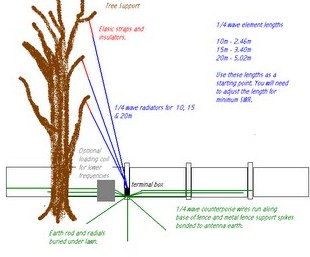 An indeal stealth antenna made by multiple quarter wave verticals, supported by a tree.
 -
 News of latest radio activity, initial contacts list, recordings of EME signals, information about station, and overview of latest projects.
 -
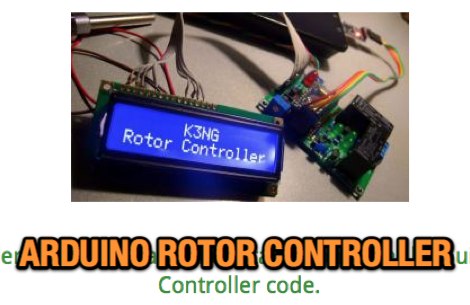 Aduino-based Amateur Radio Antenna Rotator Controller that can emulate the Yaesu GS-232A or GS-232B interface by K3NG
 -
 The Speaky HF SSB transceiver and other homebrew projects Homebrew of radio equipment, antennas, tuner, etc.
 -
 Tips on winding wire coils used as inductive loads, traps, band-pass filters, are implemented in a number of amateur radio projects especially antenna projects
 -
 a website by vu2fd with theory lessons, details on rules and regulations and planty of homebrew projects for radio amateurs, java calculators.
 -
 The FieldComm Association, based in Central Virginia, operates as a specialized amateur radio club with a primary interest in emergency communications. Members engage in various technical aspects of radio, including digital modes, QRP operations, and DXing. The association provides a platform for hams to develop skills in field deployment and reliable communication under challenging conditions, often leveraging modern digital protocols. This organization's activities support the practical application of amateur radio for public service, emphasizing readiness and operational proficiency. Members collaborate on projects and share knowledge, fostering expertise in areas like portable station setup and efficient data transmission. The focus on emergency communications distinguishes its operational priorities from general interest clubs, aligning its efforts with community preparedness.
 -
 The ÖVSV website provides extensive resources for Austrian radio amateurs, including details on its nine **Landesverbände** (regional sections) and the Austrian Military Radio Society (AMRS). It features information on licensing, legal frameworks, and **band plans** for both HF and VHF/UHF operations. The site also covers various amateur radio activities such as contests (HF, VHF/Microwave, Alpe-Adria, SOTA, ARDF), technical projects like WRAN, and educational content explaining what amateur radio is and how to become a licensed operator. Recent news items highlight events like the "Laa Funk '26" exhibition, the "OE5XLM" club station's participation in the CQ WW Contest, and the "International Marconi Day 2026" activation by "OE26M" from Küniglberg. The site lists upcoming events, including a 160m OE-Aktivitätsrunde, a seminar on Baluns/Ununs, and various club meetings and flea markets. Membership is facilitated through regional sections, and the site emphasizes amateur radio's role in independent communication during crises.
 -
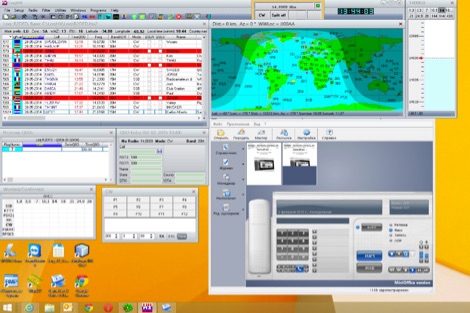 Operating a modern amateur radio station often involves integrating various software tools, and LogHX aims to provide a unified environment for Windows users. The software facilitates comprehensive QSO accounting, allowing operators to track contacts and manage both e-QSL and traditional paper QSL exchanges, including via QSL managers or direct methods. It also offers real-time QSO preview and integrates with popular callbook data for quick lookups. LogHX supports various logbook database searches and maintains statistics for numerous awards, a critical feature for serious DXers and contesters. The program handles logbook import and export in widely used formats such as _ADIF_ and _Cabrillo_, ensuring compatibility with other logging applications. Furthermore, it interoperates with Telnet clusters and third-party ham radio software, enhancing its utility in a networked shack environment. Key functionalities include antenna rotator control, editable macros for PSK, RTTY, CW, and SSB operations, and CAT control via _OmniRig_ or direct interfaces. Embedded modules like MMVari, MMTTY, and CWServer streamline digital mode operations, while its multi-window structure allows users to customize their screen layout, preserving valuable monitor space.
 -
 Do you want to measure antenna impedance at resonance? With this Antenna Scope, you have a simple RF Bridge for getting started in an exciting part of Ham Radio, building your own Antennas that work well
 -
 The **KC0KJF** personal amateur radio page provides a collection of resources for fellow hams, particularly those interested in operations within southwest Missouri. It offers detailed listings for **Missouri repeaters** on both 2 meters and 70 centimeters, serving as a practical reference for local VHF/UHF communication. The site also includes information about the operator's station setup and antenna projects, such as a dipole and a bazooka antenna, which can offer insights into basic antenna construction and deployment. Beyond local repeater data, the page features links to the FCC Part 97 rules, essential for understanding amateur radio regulations. The operator, licensed as a Technician Class since April 16, 2001, shares his journey from Citizen's Band Radio to amateur radio, driven by a lifelong fascination with shortwave listening. This narrative provides context for the resource's focus on practical operating information and foundational regulatory knowledge. Additional content covers specific equipment like the 2-meter/70-centimeter Arrow Antenna, useful for hams considering portable or fixed station VHF/UHF setups.
 -
 For radio amateurs and electronics enthusiasts requiring specialized wiring solutions, Multi/Cable Corporation provides custom multi-conductor cable manufacturing services. They focus on made-to-order constructions, offering a broad range of specialty cable products including composite, instrumentation, electronic, flexible cord, thermocouple, high-temperature, and Mil-Spec wire and cable. Their capabilities extend to extensive customization of all cable components, ensuring precise adaptation to specific application requirements, which can be critical for bespoke shack setups or antenna control lines. With over 50 years in business, Multi/Cable emphasizes low minimum orders, quick turnarounds, and competitive pricing, making custom cable solutions accessible even for smaller projects. A case study highlights their role in helping an emergency vehicle lighting company expand offerings by providing versatile and cost-effective wire bundles, demonstrating their ability to support diverse technical needs beyond typical off-the-shelf options. They also provide reference data and guides on choosing conductors, insulation, and jacketing materials.
 -
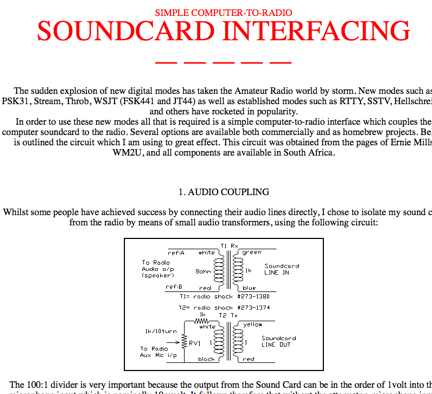 Homebrew your PC sound card to radio interface with this circuit obtained from the pages of Ernie Mills WM2U.
 -
-
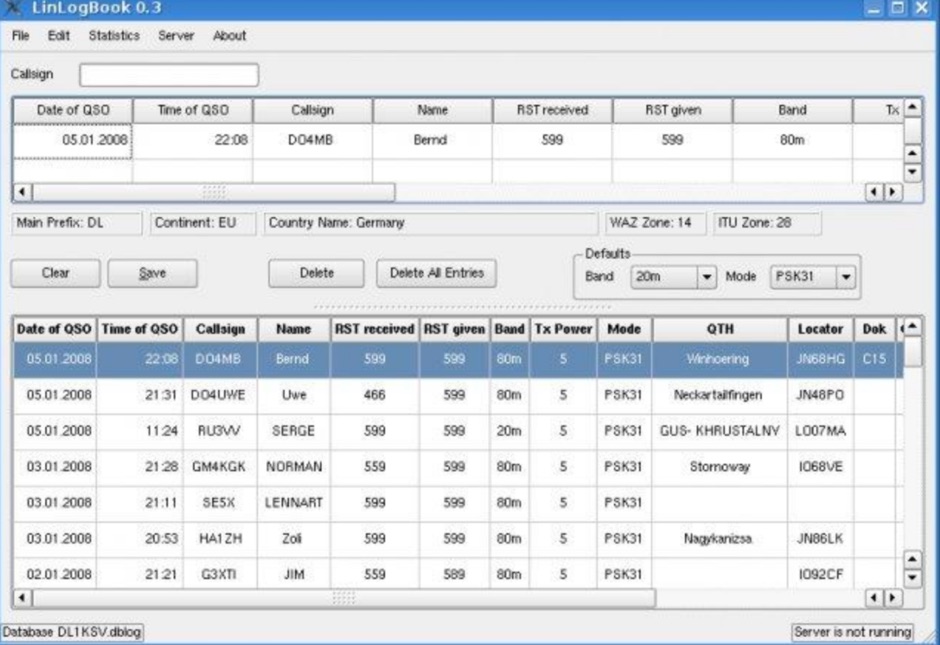 LinLogBook is an logbook for hamradio and it is based on an sql database. It can be widely configured by the user.
 -
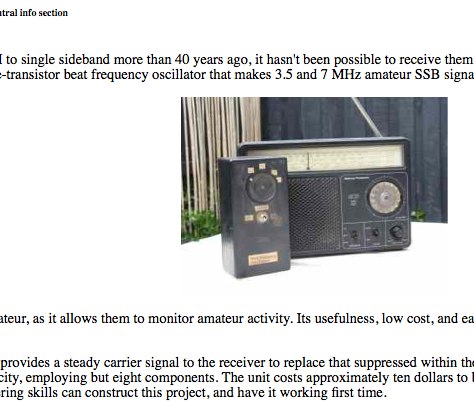 Allow the reception of amateur signals on domestic AM-only short wave receivers article and project by VK3YE
 -
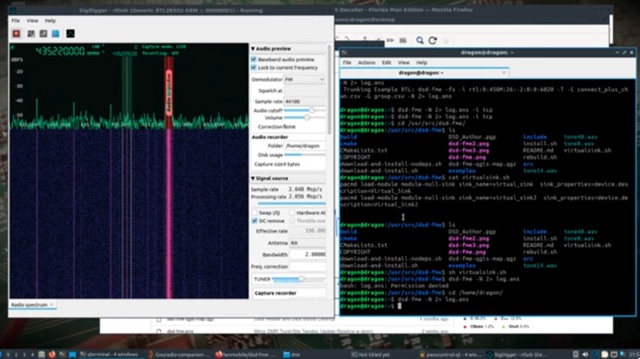 DragonOS is a linux distribution dedicate to Software Defined Radio. It leverages the portability, security, and power of Lubuntu Linux as a delivery package and operating environment for a pre-installed suite of the most powerful and accessible open source SDR software. DragonOS has verified support for a range of inexpensive and powerful SDR hardware, including RTL-SDR, HackRF One, LimeSDR, BladeRF, and many others.
 -
 Presents Eagle Stainless Tube & Fabrication as a certified distributor specializing in various tubing products essential for antenna construction and other amateur radio projects. It details their offerings, which include aluminum tubes in fractional, metric, and heavy wall specifications, alongside stainless steel bar stock in round, square, and flat profiles. The resource highlights the availability of a diameter sizing chart and direct contact options for specialists, indicating a focus on providing specific material dimensions and expert support for custom fabrication needs. The company emphasizes its role as a supplier of raw materials, crucial for hams engaged in DIY antenna builds or structural components for their shacks. Their inventory supports the precise mechanical requirements often encountered in radio frequency engineering, where material strength, weight, and corrosion resistance are critical design factors for outdoor installations. The site primarily serves as a product catalog and contact point for sourcing specialized metal tubing and bar stock, providing technical specifications and material grades relevant to robust amateur radio infrastructure.
 -
 The idea makes use of a very simple direct conversion receiver on the band of interest.
 -
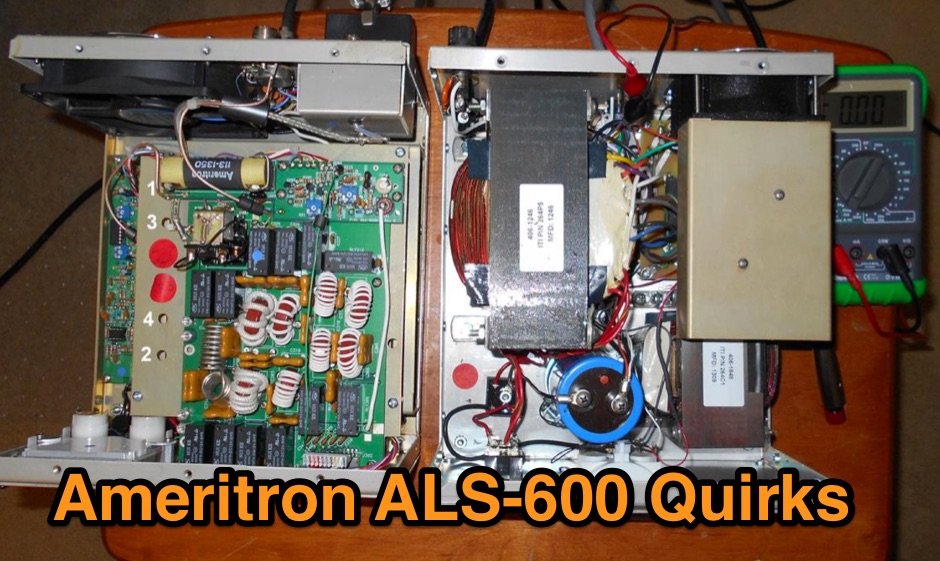 A collection of modifications and improvements to the Ameritron ALS-600 ham radio RF power amplifier
 -
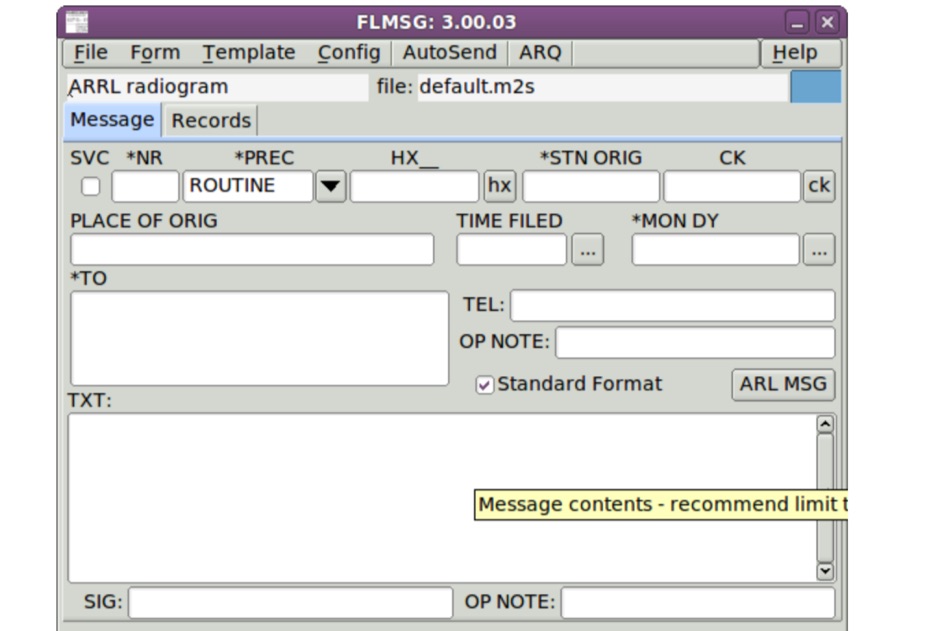 FLMSG is a simple forms management editor for the amateur radio supported standard message formats. Form data can be transferred between computers either using standard internet email or via radio frequency broadcasts typically made by an amateur radio operator on your behalf.
 -
 Explains the fundamental principles of Software Defined Radio (SDR) and Digital Signal Processing (DSP) within the amateur radio context, serving as an initial entry point for hams interested in these technologies. It covers the architectural shift from traditional analog hardware to software-centric radio systems, detailing how digital signal processing algorithms are applied to modulate, demodulate, and filter radio signals. The resource compiles a list of external links to _white papers_ and project pages, offering further technical depth. This page provides a foundational understanding of SDR/DSP, enabling operators to grasp concepts like direct sampling and quadrature mixing. It references various projects and discussions, allowing users to explore practical implementations and theoretical underpinnings. The curated links direct users to resources that might cover specific SDR hardware platforms or software applications, facilitating deeper research into the subject.
 -
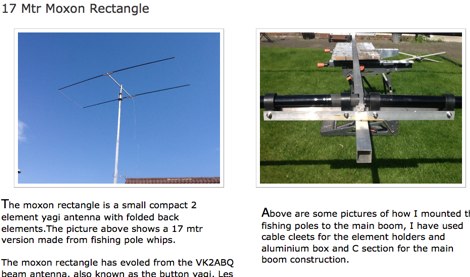 Constructing a compact directional antenna for the 17-meter band, this resource details the build process for a Moxon rectangle, a two-element Yagi variant with folded-back elements. It covers the antenna's evolution from the _VK2ABQ beam_ and provides specific dimensions for a version built using fishing pole whips. The content includes a discussion of the antenna's radiation pattern, feedpoint impedance, and its inherent front-to-back ratio, which is often superior to a standard two-element Yagi. Practical considerations for element spacing and material choices are also addressed, alongside a visual representation of the antenna's physical layout. Performance data presented includes a comparison showing the Moxon rectangle's **2.5 dB gain** over a half-wave dipole and a front-to-back ratio of **20 dB**. The resource also touches upon the antenna's relatively wide bandwidth for a two-element beam and its suitability for portable operations due to its compact footprint. It offers insights into optimizing the design for specific operating conditions and discusses the advantages of its lower take-off angle compared to omnidirectional wire antennas, making it effective for DX contacts on the 17-meter band.
 -
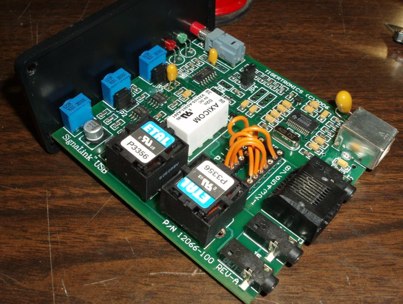 Some modifications for the Tigertronics Signalink USB sound card radio interface
 -
 The CAT and audio interface version 3 project by PA5CA presents a comprehensive solution for integrating amateur radio transceivers with computer sound cards, facilitating digital mode operation and CAT control. It includes detailed schematics for the interface circuitry, illustrating the isolation transformers for audio paths and optocouplers for CAT data lines, ensuring robust electrical separation between radio and PC. The resource also provides PCB layouts, enabling constructors to fabricate their own boards for this specific design. The project outlines the component selection and assembly process, emphasizing the use of readily available parts to build a reliable interface. It addresses common challenges in sound card interfacing, such as ground loops and RF interference, through its isolated design. This construction guide offers practical insights into building a functional interface, making it suitable for hams interested in DIY radio accessories for digital modes like FT8, RTTY, and PSK31.
 -
 Announces the retirement of Brand Electronics, a manufacturer specializing in **power meters** and various ham radio accessories, effective 2025. The company has served the amateur radio community for over 35 years, providing equipment for station setup and operation. The product line historically included accessories compatible with major transceivers from Icom, Yaesu, and Kenwood, alongside components and technical references for homebrew projects. Their offerings supported accurate RF power measurement, crucial for optimizing antenna systems and ensuring legal limit compliance. This notice serves as a final update regarding the company's operational status, marking the cessation of manufacturing and sales activities. The site provides no further details on product support or inventory liquidation.
 -
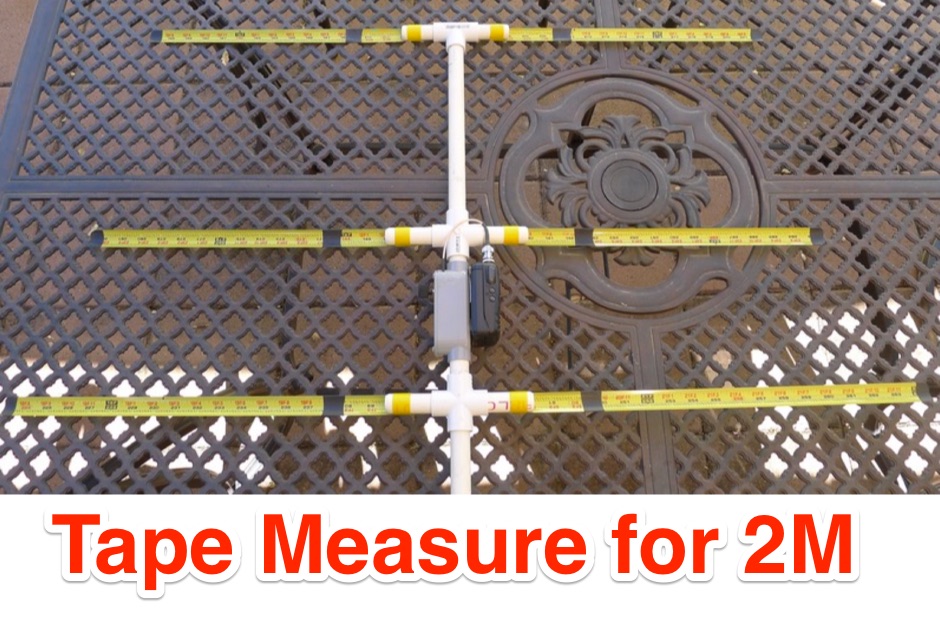 A Tape Measure Beam Antenna for Radio Direction Finding based on WB2HOL design.
 -
 Crystal receivers, construction projects and plans, old-time crystal sets, hints, crystal receiver store.
 -
 Constructing a digital interface for the Elecraft K2 transceiver, this resource details the "Fat Wire" design by WG4S. It demonstrates how to integrate a sound card for digital modes, outlining specific connections to the K2's microphone jack and internal audio path. The author shares practical insights from his build, including the use of _RG-62_ coax for its flexible braid and the strategic placement of components like the 2.2K resistor and _2N2222_ transistor. The guide provides a breakdown of the interface's internal wiring, specifying connections for AF In (pin 1), AF Out (pin 5), PTT (pin 2), and Ground (pin 7) on the K2's microphone connector. It also covers the external connections to a laptop's headphone and line-in jacks, along with a DB-9 connector for PTT control via _DTR_ or RTS lines. The author notes that his laptop's headphone output level was sufficient for the K2, negating the need for an attenuator. Reflecting on the design, the author, Dan WG4S, acknowledges a later suggestion to house the components directly within the DB-9 shell for a more compact build. This iterative feedback highlights the ongoing evolution of DIY ham radio projects and the community's collaborative spirit in refining designs.
 -
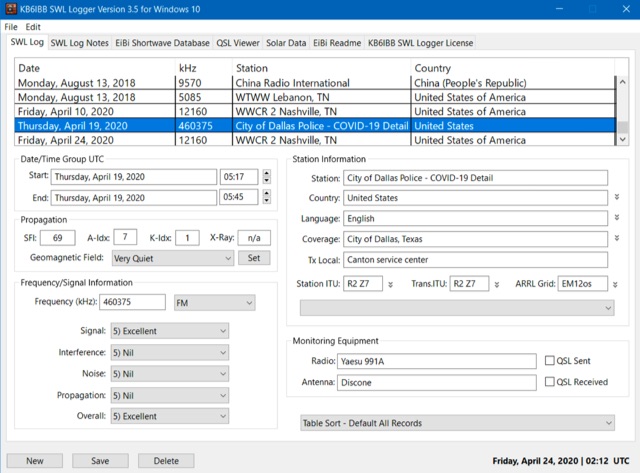 A shortwave radio listeners log book runs on Windows and MacOS Catalina and above. The KB6IBB SWL Logger is a program designed for the shortwave radio listener. It offers shortwave specific logging of stations, with most tasks handled automatically. The program also incorporates the use of EiBi shortwave database for logging and looking up various known shortwave stations world wide.
 -
 Describes Atlantic Tower Services (ATS), a company specializing in antenna tower erection and maintenance, operating from Orlando, Florida. ATS offers a range of services including site maintenance, structural repairs, system modifications, and complete tower installations for various communication needs. The company emphasizes its capability to handle diverse tower projects, from routine inspections to complex upgrades, ensuring structural integrity and optimal performance for amateur radio and commercial installations. ATS focuses on delivering reliable infrastructure solutions, supporting the backbone of communication systems. Their service portfolio covers critical aspects of tower ownership, addressing both preventative care and reactive solutions for existing structures. They are equipped to manage projects involving different tower types and heights, adhering to safety standards and operational best practices. Services include **site maintenance** and _structural modifications_.
 -
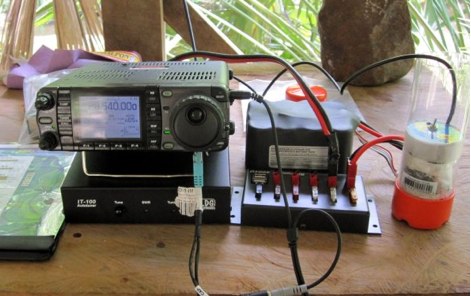 A Picaxe Morse Code keyer project with source code and links to useful resources by K6ACJ
 -
 Twenty-four repeaters, including D-STAR and Fusion systems, are maintained and operated by MARCA Inc., primarily located on Arizona mountaintops and around the Phoenix metropolitan area. The organization, holding the callsign _W7MOT_, facilitates a wide range of amateur radio activities, such as ARRL Field Day events near Forest Lakes, Arizona, and participation in ARRL FMT contests. Members engage in antenna experimentation, construction, and maintenance trips to repeater sites. The club's interests span diverse topics, including HF voice, digital modes like _WSPR_, _WSJT-X_ (FT8, FT4), and CW, alongside DXing, MESH networking, and EOC operations. It supports technologies from SDR radio building to antique radio restoration and computer-based operations like Echolink, fostering a Single Board Computer (SBC) and Raspberry Pi group. Monthly meetings, held on the third Tuesday, feature business discussions and guest presentations, with informal summer gatherings and an annual holiday dinner in December. Monthly VE testing sessions for Technician, General, and Extra Class licenses are conducted by Ray Vasquez, K4RMV. Post-meeting discussions often cover specialized interests such as repeater operations, technical topics, D-STAR, SDR, APRS, Fusion, and Raspberry Pi projects.
 -
 Simple QRP projects, 10m, 6m, WSPR beaconing, sub-9kHz and other random stuff
 -
 Constructing a dip oscillator provides radio amateurs with a fundamental piece of test equipment for resonant circuit analysis. This particular design, adapted by VK3YE from a concept by _Drew Diamond VK3XU_, details a practical build using readily available components. The unit incorporates four plug-in coils, covering a frequency range from **2.6 MHz to 55 MHz**, mounted on 5-pin DIN plugs for versatility. A salvaged two-gang air dielectric variable capacitor, fitted with a vernier reduction drive, serves as the tuning mechanism, with the smaller gang optimizing bandspread at higher frequencies. In practical application, the dip oscillator is used by setting the meter needle to approximately two-thirds scale. When the instrument's coil is brought near a tuned circuit under test, a noticeable dip in the meter reading indicates resonance. This allows for precise measurement of resonant frequencies in antennas, filters, and other RF circuitry, proving invaluable for homebrewing and troubleshooting. The design emphasizes short wire runs for stable operation, particularly at the higher end of its operational range.
 -
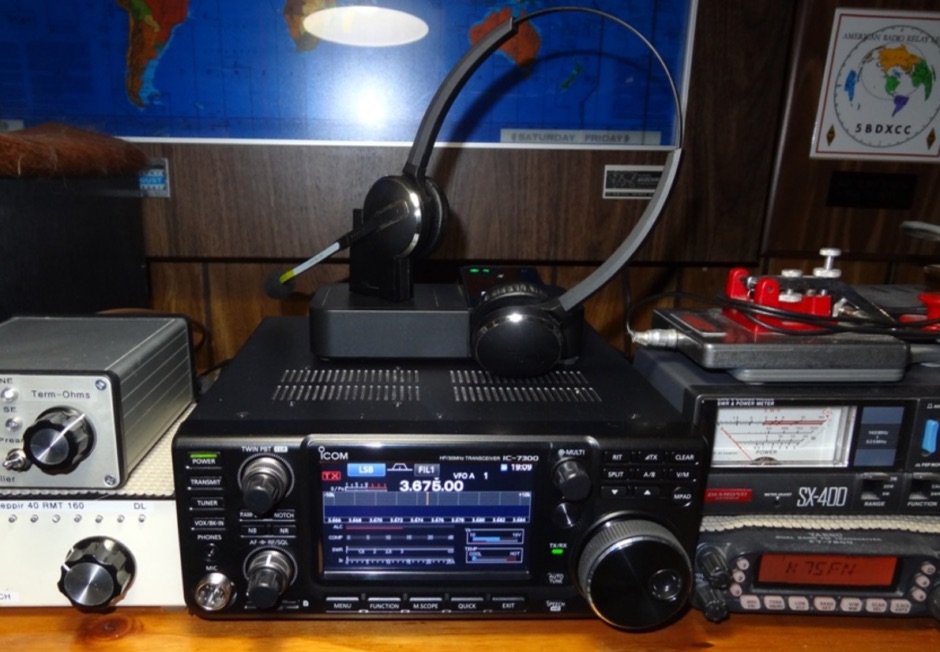 Interfacing the Jabra 9450 flex wireless headset to the Icom IC 7300 ham radio trasceiver.
 -
 Projects in ham radio, programming, and robotics. Specializing in amateur satellite operations.
 -