VHF UHF Operating Modes and Resources
Find resources for VHF and UHF operating, including weak signal, DX, contesting, repeaters, and propagation.

VHF and UHF bands offer hams exciting opportunities for local QSOs, DX, and experimental work beyond the typical HF experience. Operators use these frequencies for everything from casual chats on repeaters to challenging weak-signal contacts via meteor scatter, aurora, or even Earth-Moon-Earth (EME) paths. These bands are also popular for contests, where stations often deploy large antenna arrays and specialized transceivers to maximize their range and score.
This category provides resources for VHF and UHF operators, including propagation forecasts and activity reports for regions like EI and the USA. Hams can find information on band plans, beacon lists, and tools for RF path planning. There are also guides for weak signal operation, EME basics, and software for antenna design and contest logging. Experimenters will find projects and tips for pushing the limits on bands up to 10 GHz, with insights from pioneers like K3PGP.
-
 A website and email reflector for hobbyists in the unlicensed 49MHz low-power band.
 -
 Online map creation using AZ_PROJ
 -
 Web based VHF-UHF RF planning powered by SPLAT! and Google Maps. Access via website, Android App or dynamic Google Earth interface.
 -
 "Shows who is ""active"" on VHF in EI, Solar Auroral and Tropo information, Vhf logs and maps."
 -
 Ultimate VHF/UHF DX resource site
 -
 VHF/UHF DX site showing latest propagation, software, radio dealers, awards, maps etc.
 -
 With VHF Hamradio Software
 -
 GM4JJJ, David with EME on 144 MHz and Astronomy.
 -
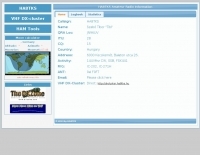 HA8TKS website dedicated to amateur radio VHF DXing include a dx-cluster map & list, HAM tools, QRB calculator and personal statistics
 -
 VHF an above weak siganl site
 -
 Covers experimental work from VLF through laser by K3PGP, one of the EME pioneers.
 -
 Bandplans, Beacons and many useful info on VHF operations
 -
 VHF from Scandinavia, EME, Tropo, Aurora and expeditions.
 -
 VHF DX Announcements
 -
 Scannist Pages for Upstate NY
 -
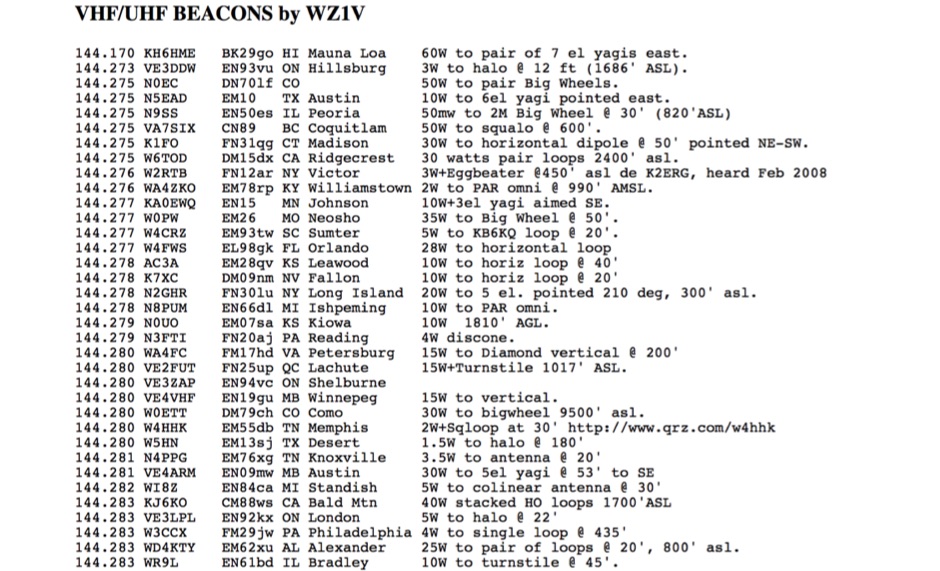 List of north america beacons transmitting on vhf and uhf bands compiled by WZ1V
 -
 Information about traffic on SHF, 10GHz band
 -
 Homepage of radio club oz1als, contest results, pictures etc
 -
 Programming a new VHF/UHF radio usually proves to be a frustrating experience for most new amateur radio operators. A new radio must first be programmed for simplex and repeater operation before it can be used to communicate with local hams.
 -
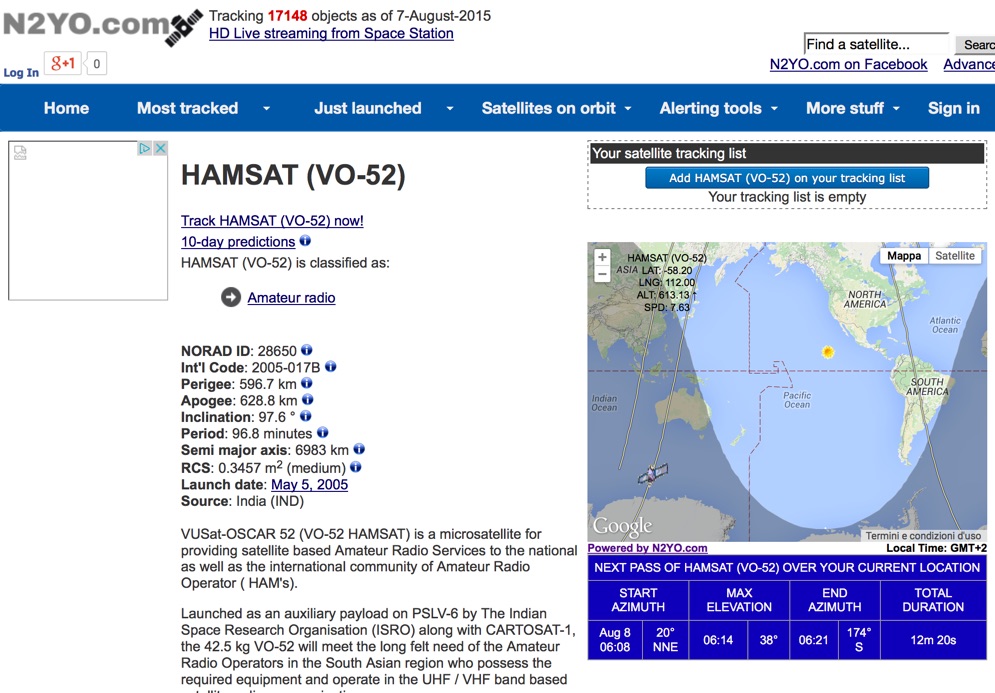 Select your favorite satellite and watch its trajectory on Google Maps in real time! Includes ISS tracking, Weather, Geostationary, GPS Military, and of course Amateur radio satellites. N2YO provides comprehensive real-time satellite tracking with particular emphasis on amateur radio satellites. The service offers precise pass predictions calculated for user-specific locations, displaying upcoming passes with azimuth, elevation, and duration data essential for ham operators planning satellite contacts. N2YO features dedicated tracking for amateur radio satellites including FM, linear transponder, and digital satellites, with frequency information and downlink/uplink details. The platform delivers live tracking visualizations on interactive maps, Doppler shift calculations, and automated email notifications for upcoming passes. This free resource integrates weather satellite tracking alongside NOAA imagery, making it invaluable for radio enthusiasts pursuing satellite communications.
 -
 Refractive Index maps forecast for Europe
 -
 All about VHF, UHF, SHF amateur radio communication in Russia
 -
 If you want to build a repeater, this is the right place to start. Includes construction projects and reviews of repeater hardware available in the market.
 -
 New User Tips for VHF-UHF Operation by Dave Schultheis WB6KHP
 -
 Troposcatter, 50 MHz meteor scatter, ground gain for eme, radiation angle, by OZ1RH
 -
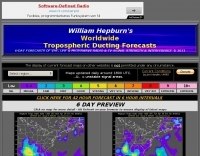 William Hepburn's Daily Tropospheric Ducting Forecast.
 -
 Two meter fm simplex ham radio list.
 -
 VHF UHF Microwave EME Standings, a Who's Who on top in USA
 -
 Reccomendations and tips for VHF-UHF operation
 -
 The MMMonVHF database, maintained by DL8EBW, indexes 63,455 VHF operators globally, enabling searchable mapping for DXing and contesting activities.
 -
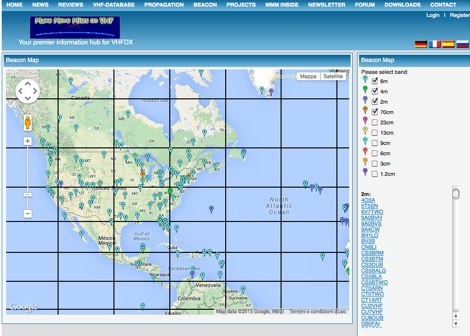 MMMonVHF maintains the data for 6m, 2m, 70cm and 23cm bands in collaboration to LA0BY. This site allow display of a beacon map and latest beacon spots.
 -
 VHF UHF SHF Toplist including DXCC and EME-Initials
 -
 Looking for Hams that want to experiment on VHF/UHF PSK/digital modes
 -
 High speed meteor scatter and contest information
 -
 Amateur SSTV from MIR, a 2 meter antenna for bicycles, working the AO-27 satellite portable, and photographs.
 -
 A complete guide to operating the weak signal modes on VHF/UHF/Microwaves. VHF Contesting honor role for the western states, rover, eme basics and vhf contesting.
 -
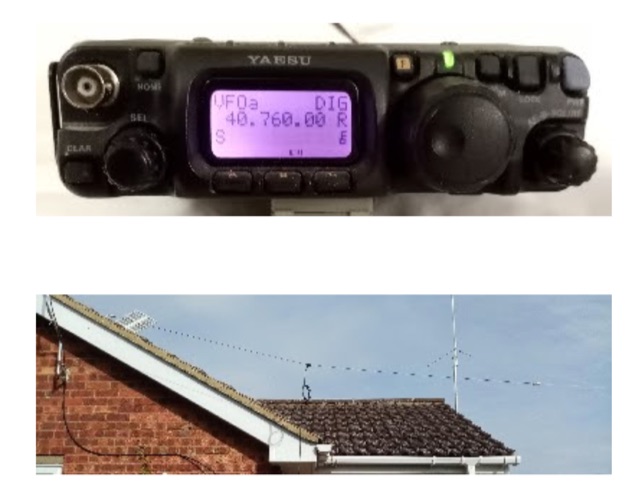 The 8m ISM band, a unique frequency range between 10m and 6m, holds potential for amateur radio enthusiasts, yet it remains largely unallocated. This spectrum offers fertile ground for research and self-training. The author's experience with low-power transmissions and WSPR testing highlights the band's capabilities and the need for a narrow, speech-free amateur allocation to encourage experimentation. Discover the world of 8m ISM radio exploration and its future possibilities.
 -
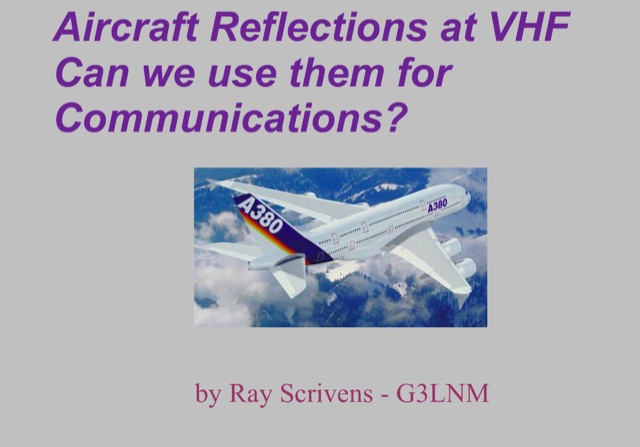 This PDF presentation explores using aircraft reflections for VHF communication. It explores the characteristics of reflected signals, including how they cause fading and vary in frequency due to aircraft movement. The feasibility of using such signals for communication is then examined. The presentation highlights challenges like requiring very narrow filters and strong frequency stability. It explores Slow-Feld, a slow version of Hellschreiber, as a potential modulation mode due to its tolerance for weak signals and frequency variations. While successful communication via aircraft reflections has been achieved, the data rate was slow and intermittent. The potential for communication over long distances, especially with busy air traffic, is discussed.
 -
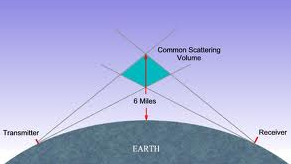 A collection of ad Hoc empirical comments on VHF radio waves propagation by Pete Heins N6ZE
 -
 Free to download PDF book about operating The VHF/UHF bands written in the early to mid-1990s by a team of experienced VHF/UHF DXers and equipment developers, in an effort to pass on their knowledge and stimulate further developments.
 -
 When new to the 2-meter FM transceiver, securing a quiet frequency for chatter seems straightforward, but it's essential to navigate FCC rules and band plans effectively. Even though frequency allocations are consistent above 50 MHz for Technician licenses, adherence to specific segments within the 2m band—ranging from 144 MHz to 148 MHz—is crucial. This includes respecting designations for different modes like CW, SSB, and FM to prevent interference, particularly with satellites and exotic modes like EME. Understanding and following the structured band plans not only ensures legal compliance but also optimizes frequency use and minimizes disruptions in the amateur radio community.