Understanding and Preventing Key Clicks in CW Transmissions
Learn what causes key clicks in CW signals and find solutions to mitigate their impact on ham radio operations.

Key clicks are a common issue in CW operation, where the rapid switching of a transmitter during Morse code sends unwanted broadband noise across the band. These clicks can interfere with other operators trying to copy weak signals, making it harder to complete QSOs, especially during contests or crowded band conditions. Understanding the causes and characteristics of key clicks is essential for maintaining a clean signal and being a good neighbor on the air.
This category provides technical explanations of what causes key clicks, often involving the rise and fall times of the CW envelope. Operators can find detailed articles on how to identify key click problems through spectral analysis, along with practical solutions for specific transceivers like the Yaesu FT-1000 series. Resources here also cover the necessary bandwidth for CW signals and methods for preventing key clicks to ensure clean transmissions.
-
 Modification to solve key clicks on FT 1000 MP
 -
 How much bandwidth does it take to send Morse code? by Mark Amos, W8XR
 -
 High speed telegraphy without key clicks by SM5BSZ
 -
 How to correct keyclick problem in ft1000 and ft1000d radios.
 -
 Clicks are most problematic when we try to copy weak signals next to moderately strong signals. How to recognize them, and how to identify clicks problems
 -
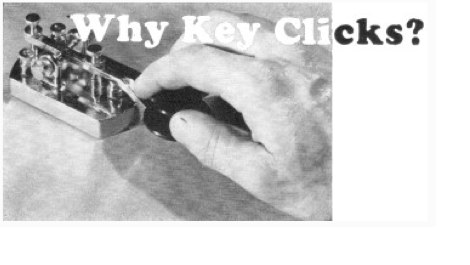 The Necessary Bandwidth for CW Signals By George Grammer W1DF
 -
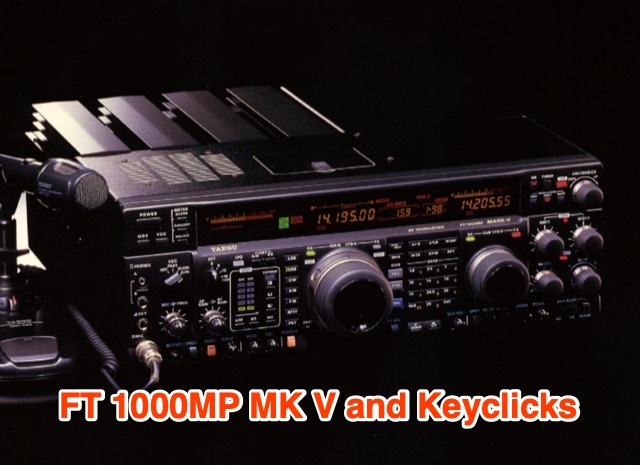 YaesuFT1000MK V stands out with improved close-spaced SSB transmit performance, reversing a trend seen in other modern radios. Featuring a class-A mode, it offers clean HV finals when kept out of ALC. However, two significant flaws persist: the noise blanker causes receiver IM distortion, and the transmitter lacks wave-shaping on CW, resulting in pronounced keyclicks. Preliminary tests reveal strong keyclicks +1kHz and -1kHz, prompting a combined modification to address both issues.
 -
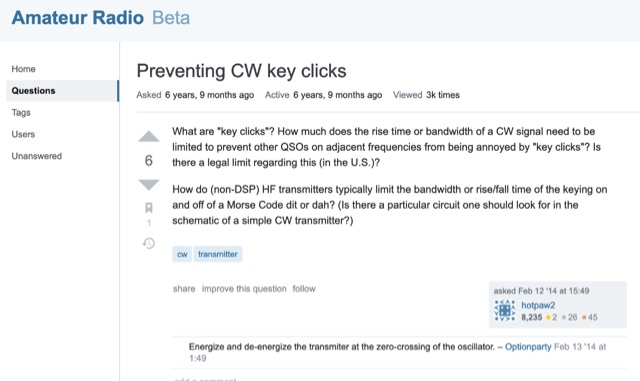 Key clicks are generally undesired clicks or thumps generated by a CW transmitter as the key is put down or let up. How much does the rise time or bandwidth of a CW signal need to be limited to prevent other QSOs on adjacent frequencies from being annoyed by key clicks?