Attenuator Circuits and Projects for Amateur Radio
Find schematics, construction guides, and calculators for building various RF attenuators for your ham radio station.

Attenuators are essential tools for ham radio operators, allowing precise control over signal levels in various applications. Whether reducing strong signals to prevent receiver overload, calibrating test equipment, or aiding in transmitter hunting, these devices ensure optimal performance and accurate measurements. Hams often homebrew attenuators for specific needs, adapting designs for different frequency bands and power levels.
Operators can find numerous projects for building fixed and step attenuators, useful for receiver sensitivity evaluations or setting defined levels for calibration. Designs range from simple passive attenuators, like the adjustable "waveguide beyond cutoff," to more complex active attenuators often used in fox hunts. Resources also include RF attenuator calculators to determine resistor values and performance characteristics, helping operators like Joe Moell, K0OV, refine their antenna projects and test setups.
Related Categories
-
 The 40dB fixed attenuator is derived from two 20dB Pi attenuation pads
 -
 This attenuator is worth your attention. Built like the proverbial brick outhouse, it's one you can easily duplicate by N9SFX Pdf file
 -
 Make your own rf step attenuator
 -
 How to get the most from attenuators and preamps
 -
 An Offset Attenuator for fox hunts.
 -
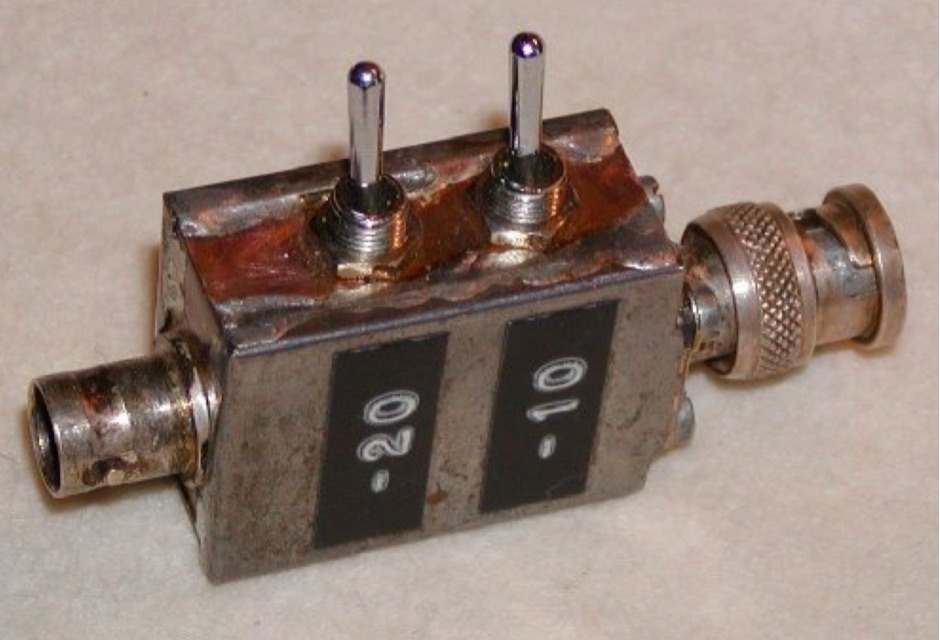 Construction of attenuator, suitable for fox hunts at 144mhz
 -
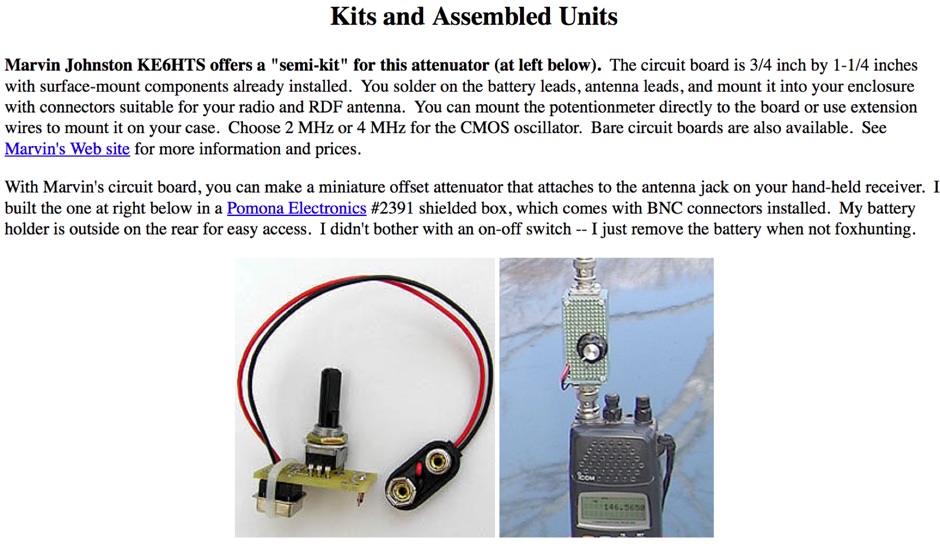 Build An Offset Attenuator by Joe Moell K0OV as featured in Homing In for May 1998
 -
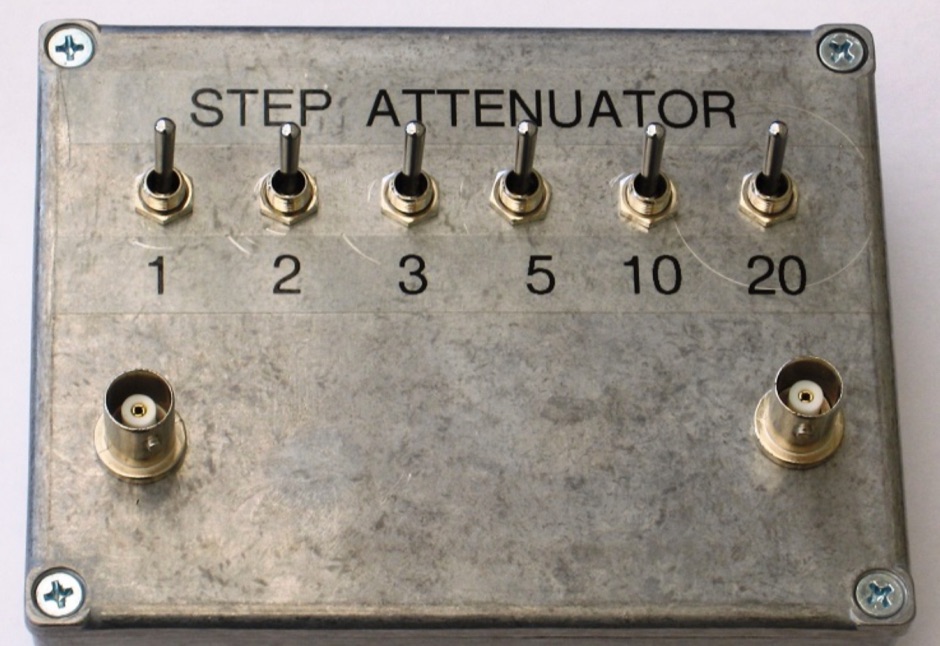 A DIY step attenuator project for 0-30 MHz, featuring switchable Pi attenuation pads and resistor value calculations for receiver sensitivity evaluation.
 -
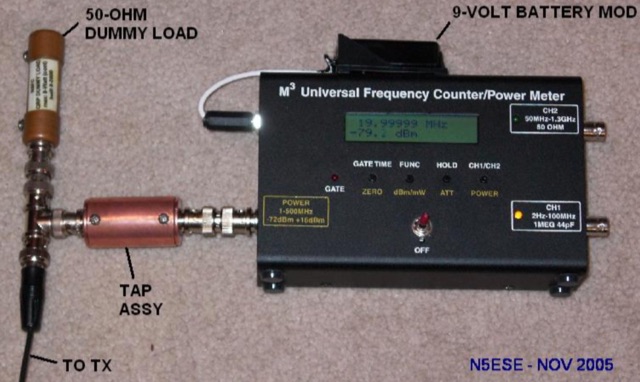 A 40 dB tap attenuator taht need only dissipate 2.3 watts, while delivering the same 0.02 watts to the input sensor.
 -
 The KI7CX 2.4 GHz Cheap & Easy antenna/feed
 -
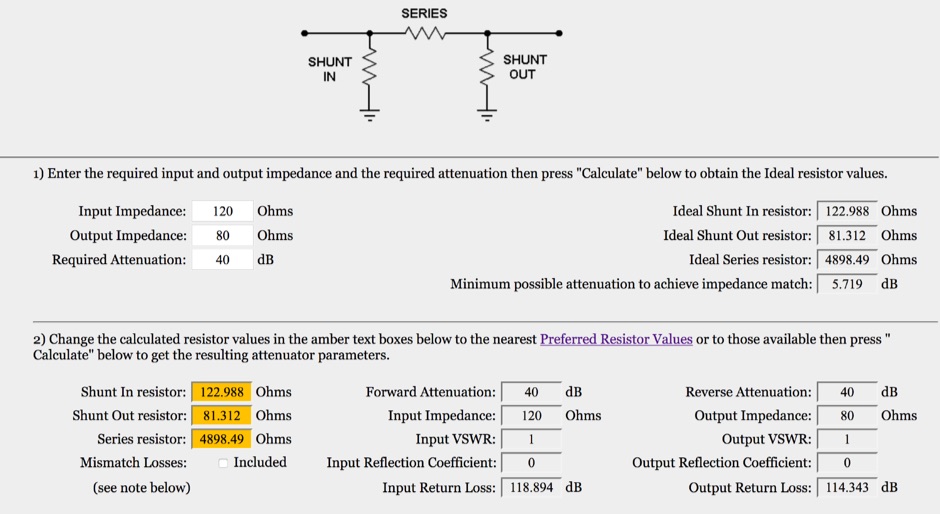 This is an on-line rf attenuator calculator provided free in order to promote the FLEXI-BOX. Calculates the resistor values, attenuation, minimum attenuation, impedance, reflection coefficient, VSWR and return loss of a matching Pi attenuator