Radio Frequency Design Principles and Circuits
Explore technical articles and practical guides covering RF mixers, signal-to-noise ratio, frequency multipliers, and receiver sensitivity.

RF design is fundamental for hams who build or modify their own radio equipment. Understanding how radio frequency circuits work allows operators to homebrew transceivers, amplifiers, and antenna matching units, ensuring optimal performance across the amateur bands. This technical knowledge helps in troubleshooting station issues and improving signal quality for DX and local QSOs.
This section provides insights into core RF concepts, explaining topics like Signal-to-Noise Ratio (SNR) and receiver sensitivity, which are critical for weak-signal operation. Operators can learn about essential circuit blocks such as RF mixers and frequency multipliers, which are key components in modern radios. There are also practical demonstrations, like visualizing AM sidebands with an SDR, to deepen understanding of how signals behave on the air.
Related Categories
-
 An introduction to RF mixes and their main characteristics, article with diagrams and illustrations by VA3IUL
 -
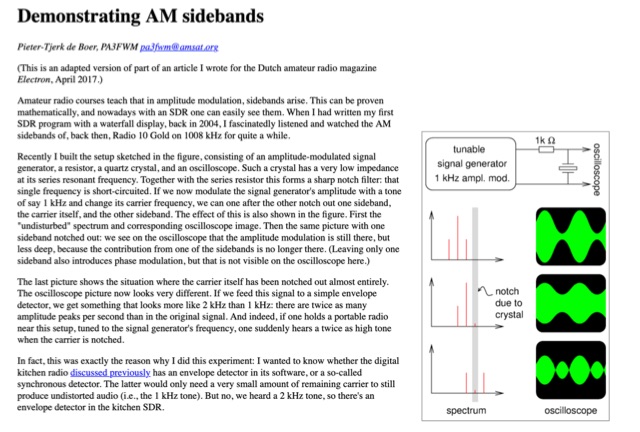 Amateur radio courses teach that in amplitude modulation, sidebands arise. This can be proven mathematically, and nowadays with an SDR one can easily see them.
 -
 An exaustive document on frequency multipliers with a particular attention on ways to generate high frequency signals for microwave
 -
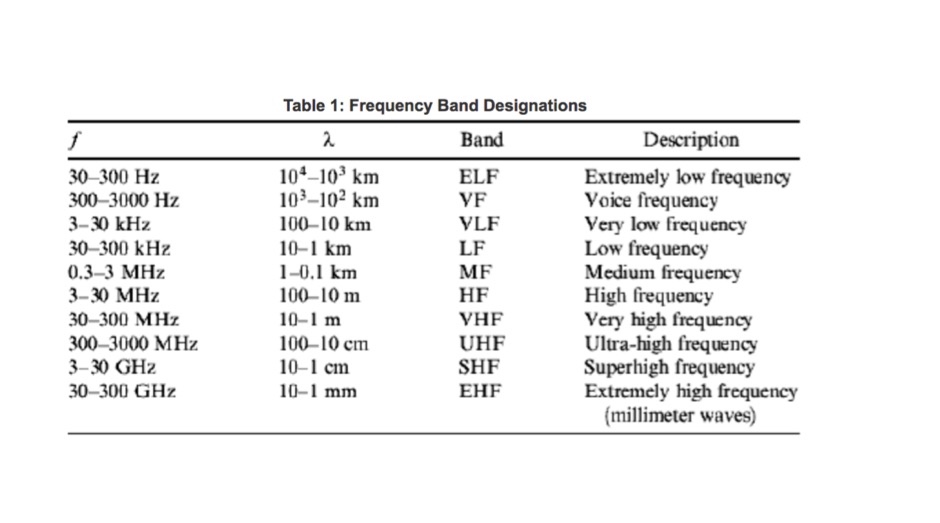 This tutorial covers an introduction to RF, wireless, and high-frequency signals and systems, includes explaination of what is RF, why operate at Higher Frequencies, Frequency Shifting through Frequency Mixing.
 -
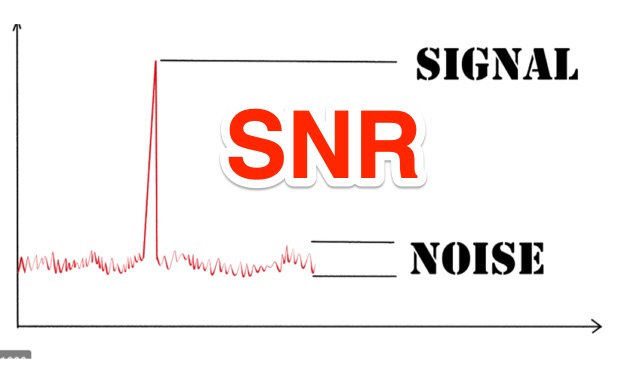 Signal to Noise Ratio, definition and application to Radio Communications. Signal to Noise Ratio (SNR) is a figure of merit that compares the level of a desired signal to the level of background noise.