Low Frequency Software Tools for Amateur Radio
Find software for QRSS, WSPR, PSK, Hellschreiber, and other low frequency digital modes used by ham radio operators.

Operating on Low Frequency (LF) bands, typically below 500 kHz, presents unique challenges and opportunities for ham radio operators. These bands are characterized by long-distance groundwave propagation during the day and skywave propagation at night, often requiring specialized antennas and sensitive receivers to detect weak signals. Many hams enjoy experimenting with very slow Morse code (QRSS) and other narrow-band digital modes to achieve impressive DX with minimal power.
To navigate the LF spectrum and decode these faint signals, operators rely on specialized software tools. This category features various signal analysis programs, such as Spectrum Lab and Baudline, which provide detailed spectrograms and real-time audio filtering for modes like QRSS, DFCW, and MTHELL. Tools like WSPR are popular for propagation research, while programs like Argo and glfer assist with both reception and transmission of slow-speed modes, helping hams make QSOs on these challenging bands.
Related Categories
-
 Argo is a freeware Windows application for decoding MTHELL, Slow CW (QRSS, DFCW), and other weak signal modes, useful for EME.
 -
 Allows you to automaticaly upload ARGO screen captures to your webpage in a convenient way. by ON7YD
 -
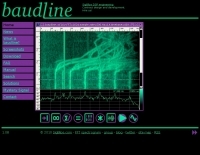 A Linux based FFT spectrum analyzer designed for time-frequency browsing and scientific data visualization. Oscilloscope waveform, statistical histogram, accumulated spectral trace,Weak Signal reception, continuos data logging, FFT Analyzer and specialized measurement windows.
 -
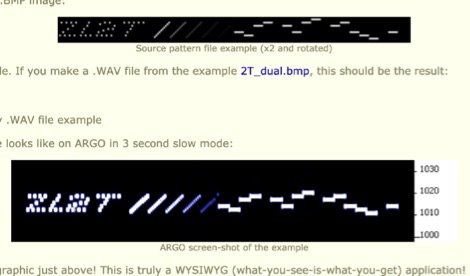 ChirpPix converts a bitmap image to a wave file, which can then be sent by a SSB transmitter and received on spectrogram waterfall displays Image Transmission using ChirpPix and ChirpHell. Click to donwload ChirpPix zip file.
 -
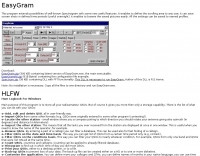 This Windows MTHELL QRSS NDB and DFCW program extends possibilities of well-known Spectrogram with some new useful features. It enables to define the scrolling area to any size, it can save screen shots in defined time periods , it enables to browse the saved pictures easily by OK1FIG
 -
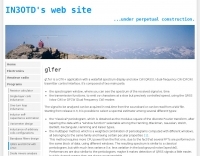 glfer is a program for reception and transmission of QRSS/DFCW signals. It is composed of two main parts: the spectrogram window, where you can see the spectrum of the received signal vs. time the transmission functions, to emit cw characters at a slow but precisely controlled speed, using the QRSS (slow CW) or DFCW (Dual Frequency CW) modes
 -
 An open source software defined receiver for Linux, Free DSP and Windows
 -
 Multiplatoform freeware DSP software. Linrad has its origin in software that was developed for 144 MHz EME CW but it is quite general and should be seen more like a kit for designing a receiver that a receiver for some particular usage. It can be used as a CW receiver with a small time delay and a fast waterfall graph. A dsp for conventional receiver to imporve signals readability, a spectrum analyzer.
 -
 MT-Hell software for 16 bit Soundblaster cards. Sends seven parallel tones with careful dot shaping for minimum interference, and transmits a very nice sound by G3PPT
 -
 ON7YD slow CW and DFCW TX program for Windows, works with Argo. By Rik Strobbe
 -
 Program designed to do spectral analysis and real-time audio filtering on reception of audio signals for EME, VLF, SETI applications. Offer support for MTHELL, QRSS, DFCW, NDB, WSJT by I2PHD
 -
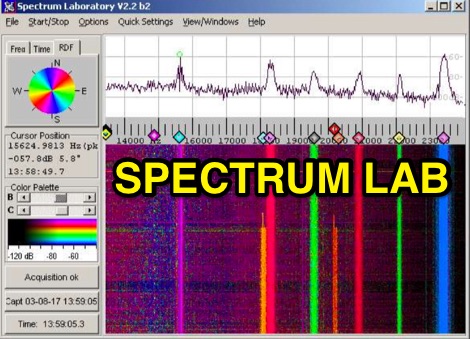 Audio Spectrum Analyser Spectrum Lab or Speclab started as a simple FFT program running under DOS a long time ago, but it is now a specialized audio analyzer, filter, frequency converter, hum filter, data logger and more. Can be used for MTHELL QRSS, DFCW, PSK, MSK, Castle. Spectrum Lab is a free audio analysis tool, lets you see the hidden world of sound. It analyzes live audio or recordings, showing you the exact frequencies present. Watch sounds change over time with a waterfall display. Need to clean up your audio? It can filter out noise in real-time. Even play with radio signals by decoding and creating special modes! While ideal for amateur radio enthusiasts, anyone can explore the science of sound for free.