Loop Antennas Projects
Loop Antennas for Amateur Radio

Loop antennas are a popular choice for many ham radio operators, offering good performance across various bands. These closed-loop designs can be built in many configurations, from full-wave skywires to compact magnetic loops, and are often favored for their efficiency and reduced noise pickup compared to open-ended wire antennas. Hams frequently use them for DXing and general QSOs on HF bands, appreciating their versatility for both transmitting and receiving.
This category provides numerous antenna projects and design articles for building effective loop antennas. Operators can find detailed plans for multi-band HF loops, such as the Skywire or W0MHS Loop, which perform well on 80 and 40-10 meters. There are also specialized designs like the hanging rectangular loop for specific installations, and resources discussing the theory and practical experiments with horizontal loop antennas, including insights from G2PL and ZS6AKA.
-
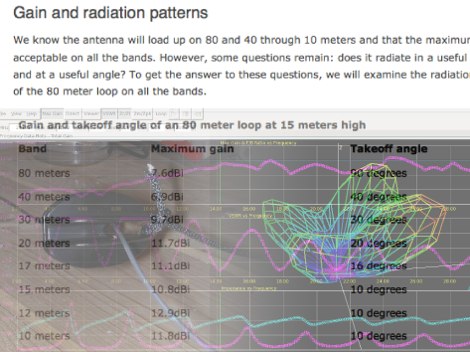 A detailed construction guide for an 86-meter (282-foot) multi-band HF loop antenna, optimized for 80 through 10 meters. Includes design, gain, radiation
 -
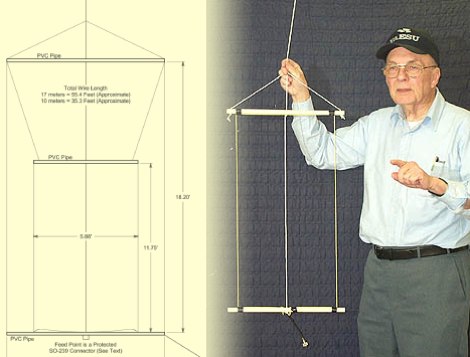 Construction guide for a dual-band 10/17 meter hanging rectangular loop antenna, designed for tree suspension. Offers 3 dBd gain and broad azimuth pattern.
 -
 A Wire resonant loop antenna for 160 meters band article by N4KC
 -
 Also known as W0MHS Loop Skywire or Full Wave Loop Antenna, here you can find N1SU interesting observations on this antennas.
 -
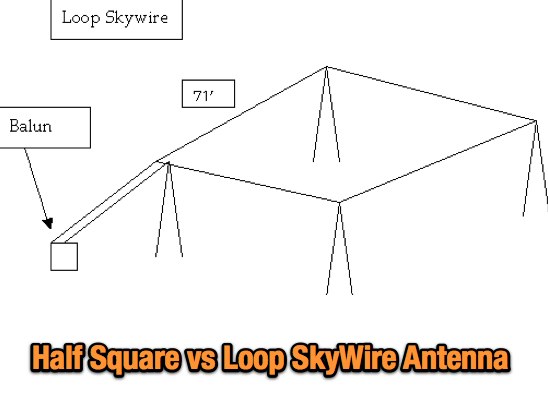 An article at NFARL web site about differences in setting up a half-square antenna versus a Loop Skywire by W4QO
 -
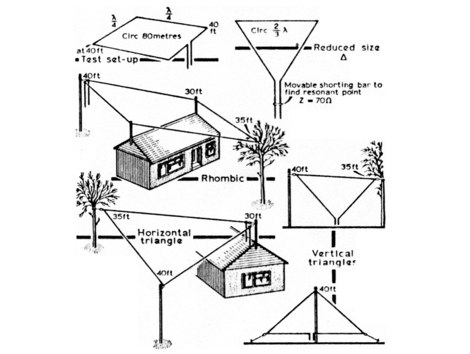 Theory of horizontal loop antennas, as discovered by G2PL using a lowered quad antenna and theorized by ZS6AKA
 -
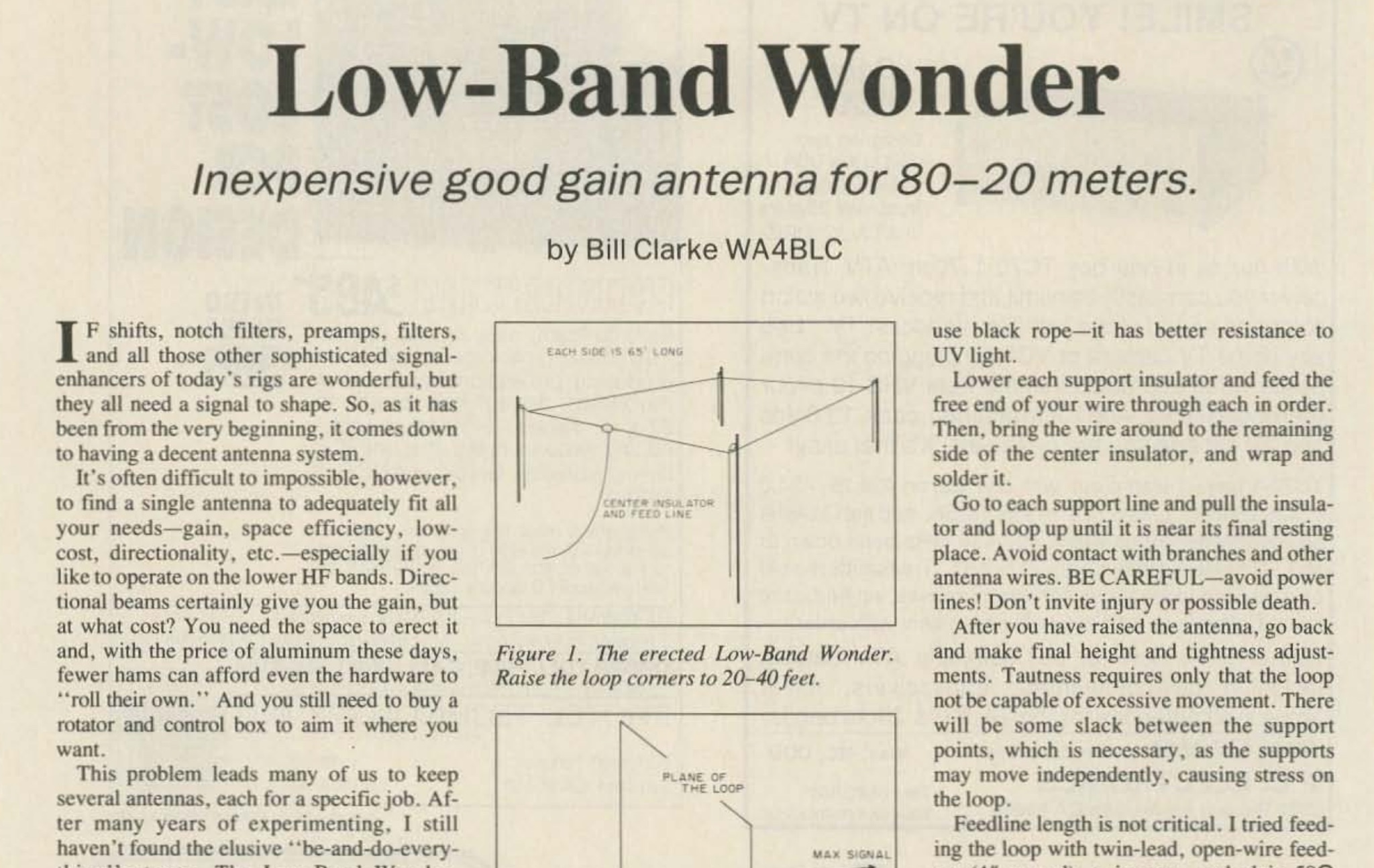 An cheap and efficient wire antenna for lower HF bands. This closed loop antenna, radiates perpendicular to its plane with a bi-directional radiation pattern. With a gain of 2 dB over a diplole it is a low noise sensible antenna. Requires a tuner if you want to use as a multiband antenna.
 -
 AF4AR/W6ARQ KC5BBP modified square loop antenna
 -
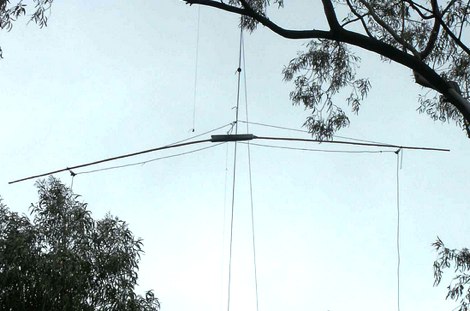 K6SGH hamloop antenna for 15 meters band
 -
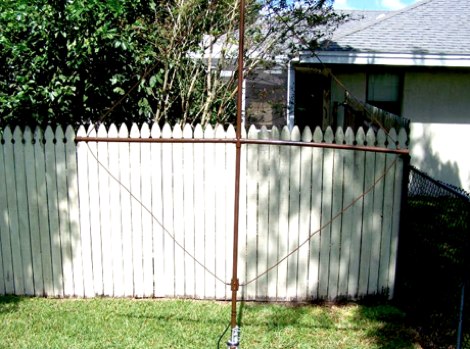 This document by W4HM explains the construction and usage of a 160 meter balanced coaxial receiving loop antenna, which can be easily adapted for the 40 and 80 meters bands. The content provides detailed instructions on building the antenna, its advantages, and how to optimize its performance for amateur radio operations. It is a valuable resource for radio amateurs looking to improve their receiving capabilities and enhance their overall radio communication experience.
 -
 KC22TX receiving loop antenna for 160 meter band
 -
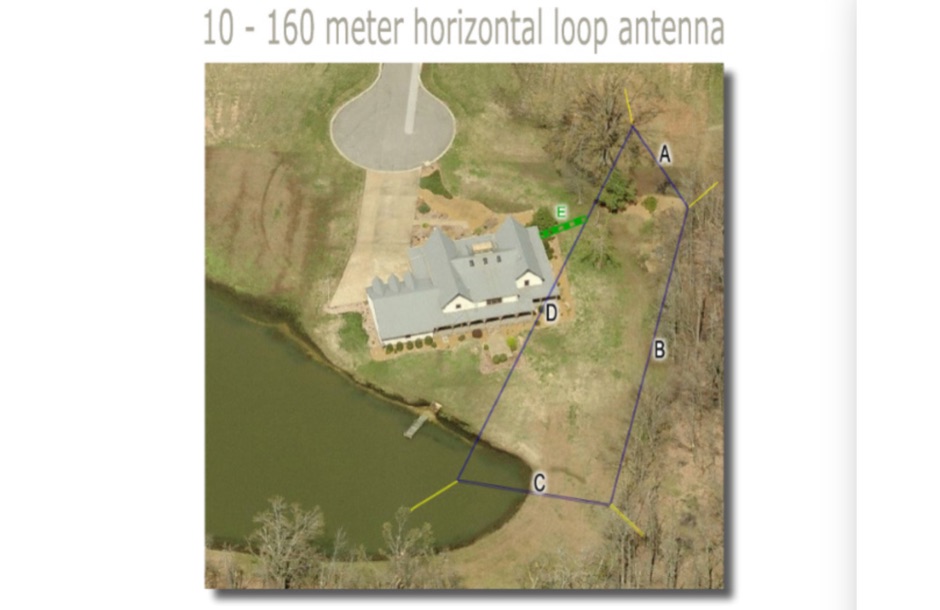 The antenna is a 10 - 160 meter horizontal loop fed with 450 ohm ladder line all the way into the ham shack to an Palstar AT1500BAL balanced line antenna tuner
 -
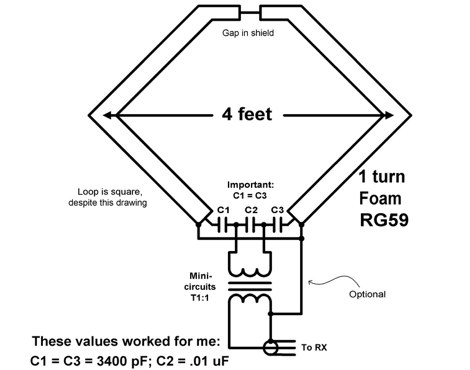 N6RK receive only loop antenna
 -
 The page provides a detailed guide on building a successful 160 Meter short TX loop antenna, with specific dimensions and tuning instructions. It includes information on the design, construction, and tuning of the antenna, as well as the materials required. The intended audience is amateur radio operators looking to build an effective antenna for the 160 Meter band.
 -
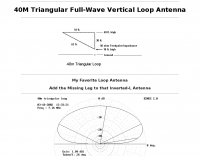 A 40 meters band full wave antenna project plan with model, adding the Missing Leg to the Inverted-L Antenna
 -
 A 40-meter antenna that provides good local and regional coverage during the day and good DX capability at night
 -
 An horizontal full wave wire loop antenna for the 80 meters band by W4HM
 -
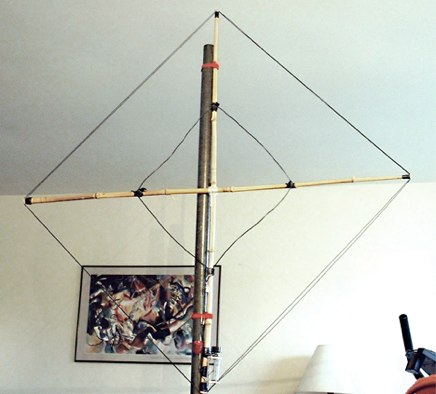 N3OX 80m/160m rx loop
 -
 Antenna data, and design note for this horizontal loop antenna resonating on 80 Meters by K0ZE
 -
 VE3HCR article of a home made loop antenna for 80 meters band
 -
 Low noise, receive only coax loop antennas for 160 - 10 meters HF bands
 -
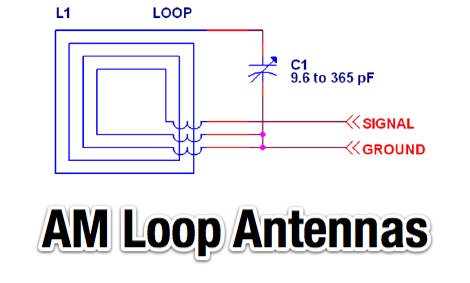 Author evaluated a custom-built passive AM loop antenna, achieving notable DX reception including KLBJ Austin (230 miles) and WWL New Orleans (700 miles). The antenna operates solely on resonant inductive coupling, enhancing weak signal reception without external amplification. This project illustrates how fundamental RF design—calculating inductance, capacitance, and Q factor—can significantly boost performance of consumer-grade radios. Detailed construction techniques, theoretical background, and optimization strategies for effective loop antenna design are presented for amateur and experimental use.
 -
 A collection of ARRL articles on HF loop antennas, covering various designs and construction techniques for amateur radio operators.
 -
 The antenna is nothing more than a simple 2.4 metre square loop drawing pinned to the internal brick wall of the spare bedroom. Yep, thats right, the inside wall of the spare bedroom - ideal for flat dwellers, hotel rooms or whinging neighbours, The loop has a simple switched inductance at the top of the square loop and uses a simple coaxial stub to tune the antenna. An additional variable capacitor placed across the feedpoint can be used to fine tune the resonance of the antenna, by Andy G0FTD
 -
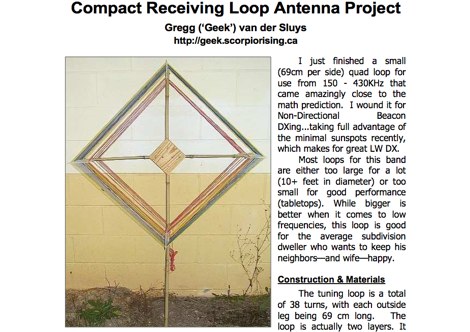 A receiving loop antenna project suitable for 150-430 KHz reception by Gregg van der Sluys
 -
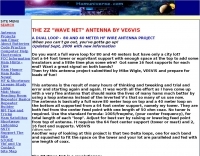 A dual loop antenna, ZZ Wave Net HF Wire Antenna Project by VE6VIS. The antenna is basically a full wave 80 meter loop on top and a 40 meter loop on the bottom all supported from a 64 foot center support
 -
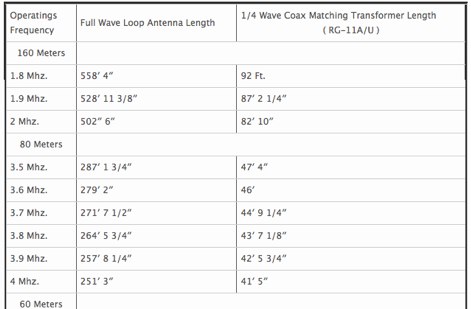 Measurements for building a full wave loop using wire
 -
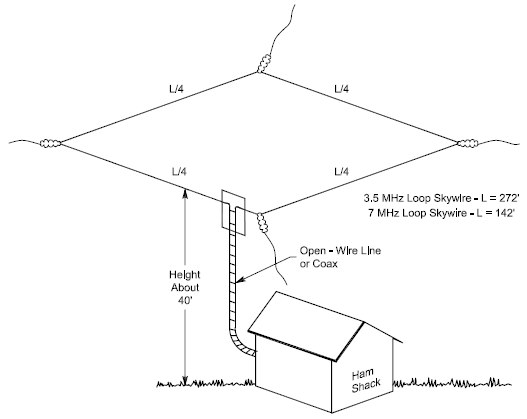
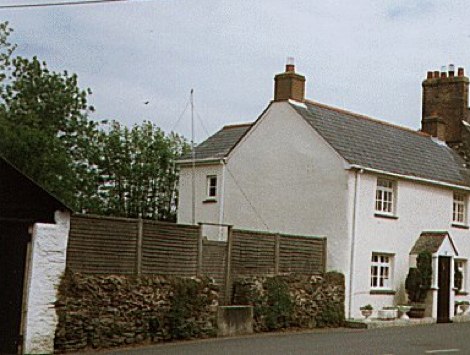 This simple antenna is capable of remarkable results on 160, 80 and 40 metres. Forming a triangle from around 50 feet of satellite TV coaxial cable, the top of the triangle can be as low as 15 feet, and the lower side just high enough to prevent a passer by hanging themselves
 -
 The HF horizontal loop has been around for many years now. This article includes a YouTube video and discusses the reasons for looking at this antenna, its design, and its installation. There are some on-air comparisons against three regular double bazooka (coax) dipoles and the Par SWL End-Fed antenna.
 -
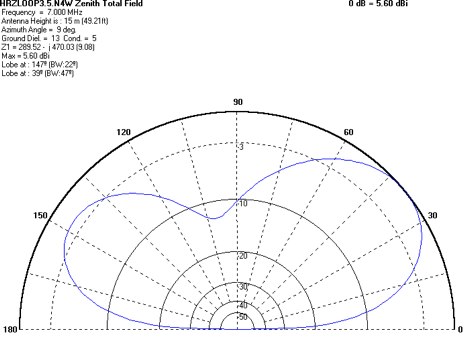 Modelling an horizontal Loop antenna at 3.5 MHz
 -
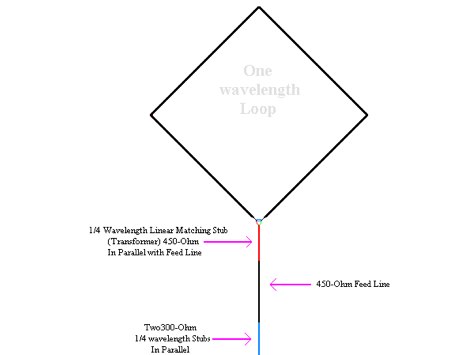 A Loop antenna plan with a gain over one Dipole of 3DB or 5.15DBi
 -
 A Quad Loop antenna for 17 meter band
 -
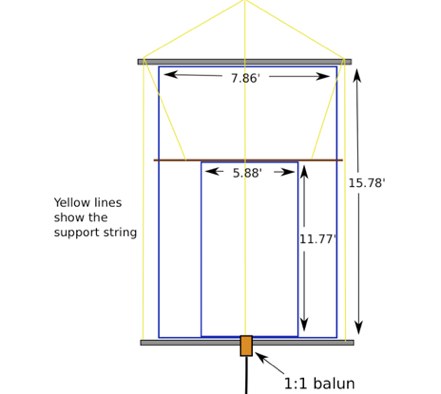 Dual band rectangular loop antenna for 15m and 10m
 -
 Here you will find many information on loop antennas.
 -
 This is the Loop Antenna Group to Ask Your Questions, Get Answers and Information about Loop Antennas for improved your Radio Listening and Enjoyment.
 -
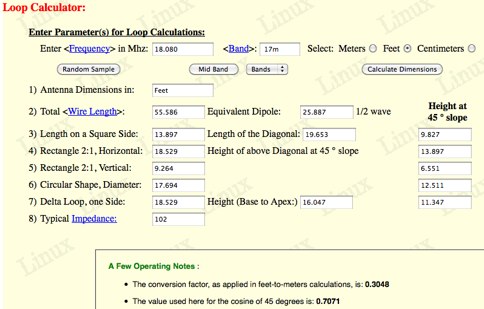 KA1FSB loop calculator give you a quick overview of the feasibility of "squeezing" a loop into your available yard or apartment space. The easy calculator yields a reasonable approximation of dimensions, to within 5% over the amateur bands, using typical wire gauges ranging from 12-18 AWG.
 -
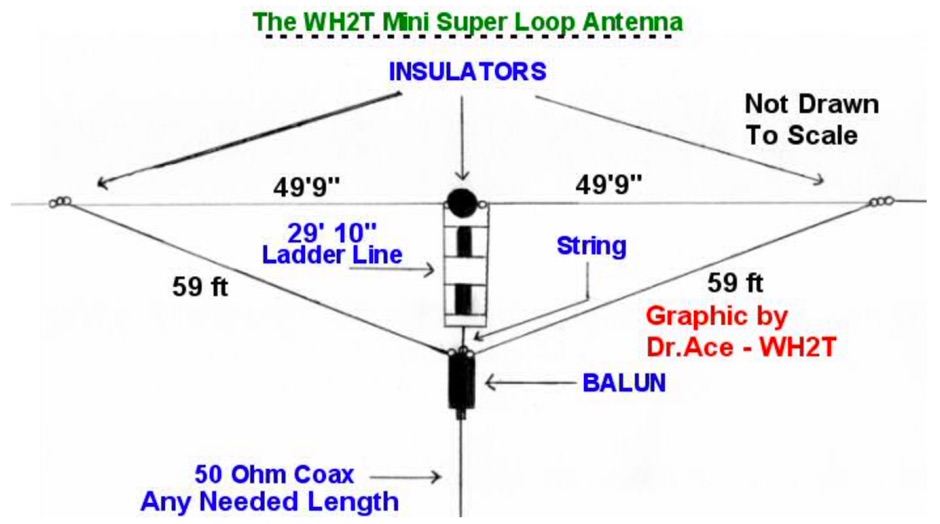 How to make the Super antenna. To build this antenna you need a lot that is at least 100 feet across. Antenna covers all bands 80-10 meters + 30, 17, 12 meter WARC Bands This antenna works as a Full Wave Loop on 80 Meters and also works as a 2 wavelength open loop or Bi-Square on the 40 Meter band
 -
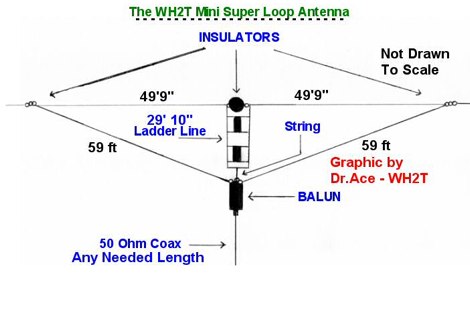 Antenna covers all bands 80-10 meters + 30, 17, 12 meter WARC bands, need a lot that is at least 100 feet across.
 -
 Experiments on remote receiving loops antenna by Lyle Koehler, K0LR
 -
 Flag antenna project for 160 meters band
 -
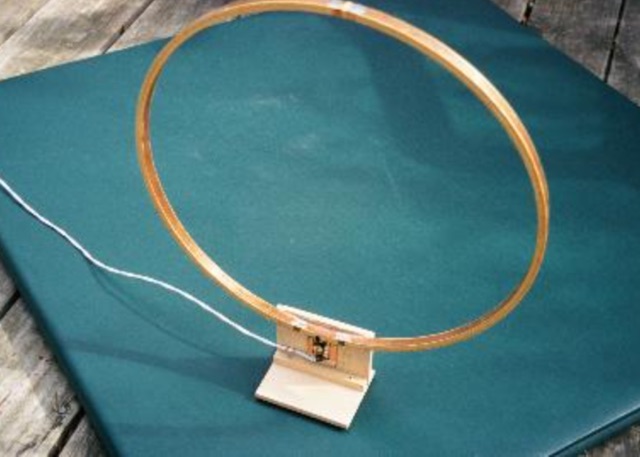 Schematics, mechanical drawings and picture of a Receiving loop antenna by N5ESE - N5FC
 -
 The Super Loop Antenna page, designed by Jim W4FTU, provides detailed information on the RadioWorks \'Superloop III\' antenna as an alternative for operators with limited space. The page discusses the physical variations of the antenna, including dimensions and materials used, as well as its electrical characteristics such as the 30\' ladder line. The content is useful for amateur radio operators looking for antenna options for the 80 and 40 meter bands, especially those with small lots or zoning restrictions. The page is well-organized and informative, making it a valuable resource for antenna enthusiasts.
 -
 These omnidirectional antennas offer Horizontal polarization, and about 2.1 dbd of gain. They are much quieter than a dipole or a vertical, have a broader bandwidth and will usually out perform a dipole antenna.
 -
 High performance indoor shortwave antenna, the Carpet Loop II is an ideal step upward for the listener who wants something better than a random wire but doesn't want the expensive dice roll of an active antenna.
 -
 This relatively unknown antenna does an amazing job pulling weak low band signals out of man-made noise backgrounds
 -
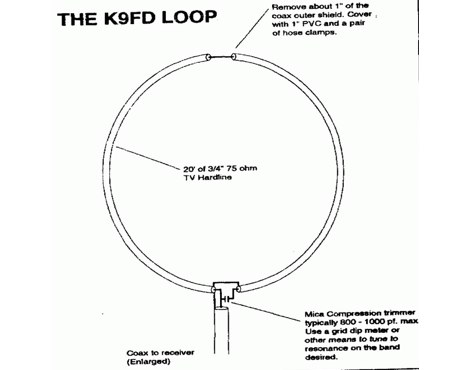 The Answer To Suburban DXing On the Low Bands - by Merv Schweigert, K9FD
 -
 AM loop antenna for 75/80 meters band
 -
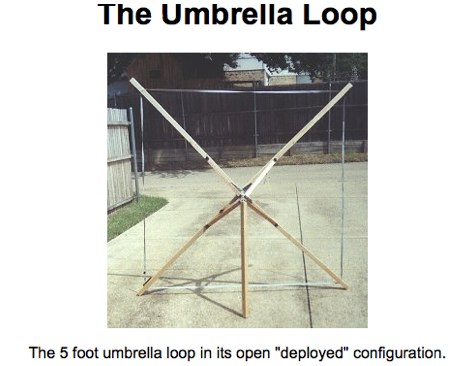 Contruction notes of an Umbrella Loop antenna for AM shortwave listenings
 -
 A detailed construction guide for the W1TAG LF Receiving Loop, a 6-foot square, 14-turn antenna built with PVC and #12 THHN wire, designed for LF
 -
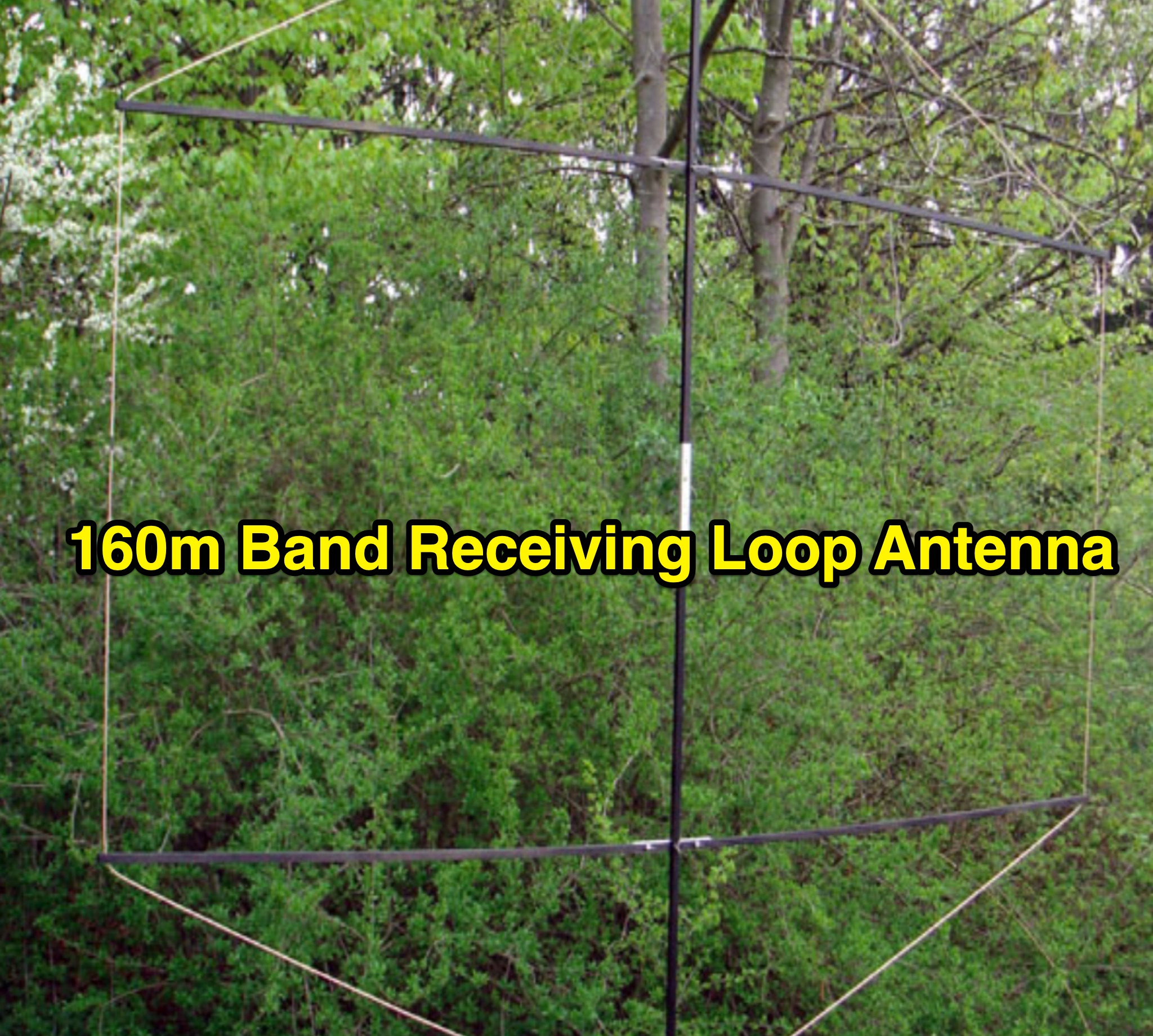 Learn how to build a portable receiving antenna for the 160 meter band. This guide provides detailed instructions on constructing a loop antenna using a coaxial cable RG-316 with SMA connectors. The antenna weighs 1.7 kg and has dimensions of 2m in height and 1.892m in width. The wooden frame consists of four 0.945m long pieces and two 1m long pieces. Perfect for hams looking to enhance their 160m band reception during travel or portable operations.
 -
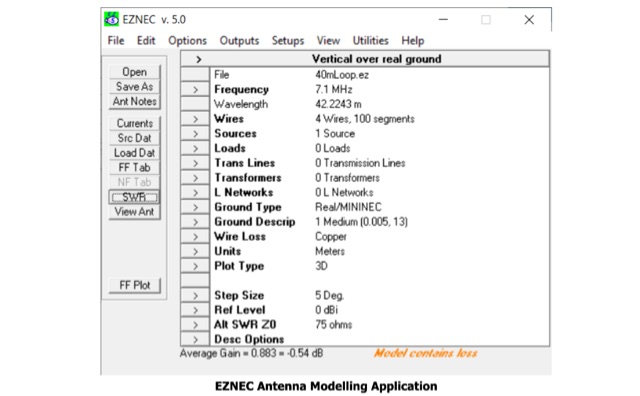 This project is a full wavelength, horizontal, loop antenna for the 40 metre Amateur Radio band, built using insulated copper wire in a diamond shape, supported by egg insulators, tethered to 4 masts, each 6.5m high
 -
 Delta loop antennas for 40 meters plans and comparison of some models
 -
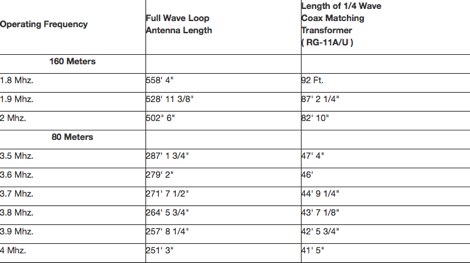 This article contains the measurements for building a full wave loop using wire and length of 1/4 Wave Coax Matching Transformer
 -
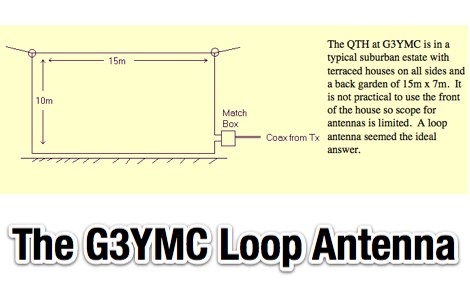 Experiences with Loop antennas at G3YMC include some loop antenna tests and theory by G3LHZ
 -
 A really simple LF receiving loop antenna
 -
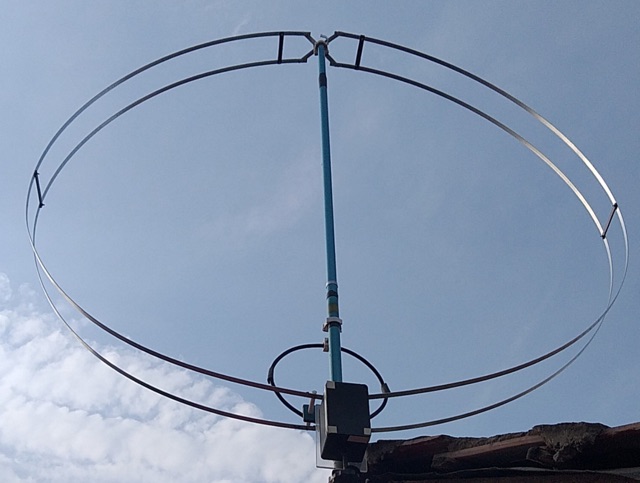 A loop antenna for 80 and 40 meters band, the main loop is based by a crossed line using aluminium strip lines. The main loop diameter is 150 cm.
 -
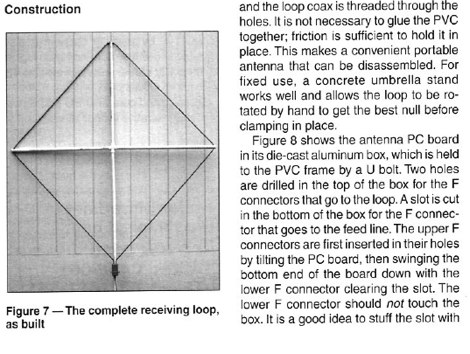 An improved feed network for loop-type receiving antennas article published in NCJ October 2009 issue
 -
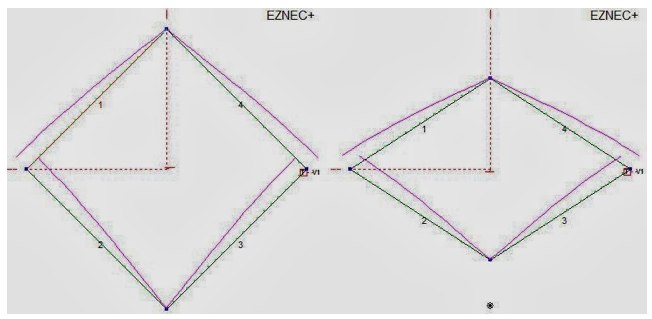 Antenna model for a diamond loop wire antenna for the 40 meter band
 -
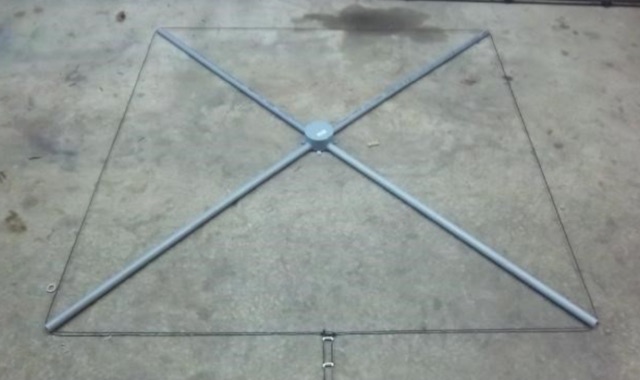 Building A Full-Wave Quad Loop Antenna for 6 Meters. This is an easy antenna to build and the materials cost about $15-20. It exhibits 1.8dB gain over a 1/2-wave dipole. Using an open-wire parallel feedline (commonly called ladder line) with an antenna tuner, it tunes up on the 10m band as a 5/8-wave loop as well
 -
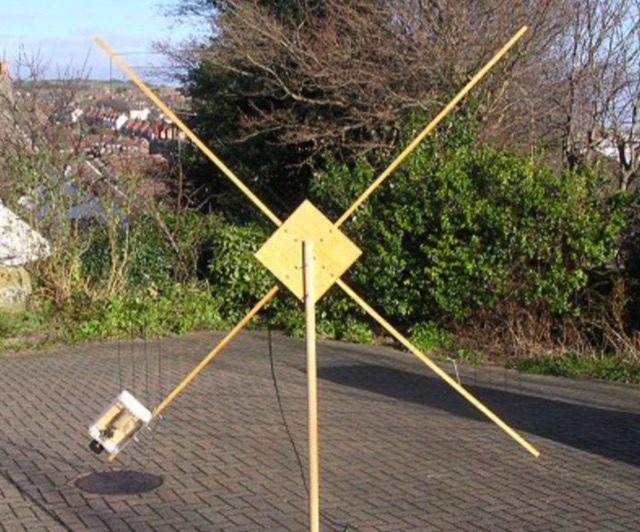 Four or Five turn one meter loop antenna for 80 and 160 meter band. This home made receive only antena can be assembled in a small place.
 -
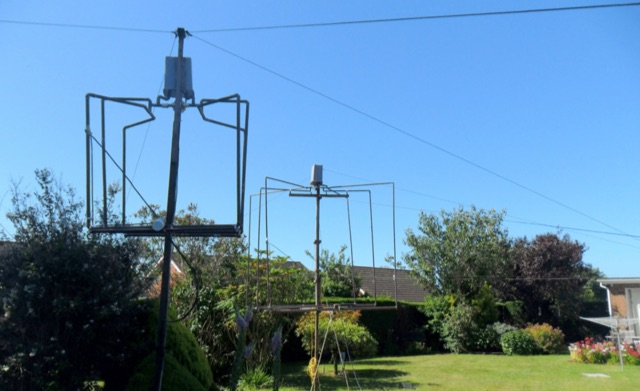 This article describes the development of two tunable antennas each consisting of three interconnected small loops and capable of providing excellent DX performance. The aerials are home-constructed, and located in a very small garden with a minimum of visual impact on the neighbours and are low enough in height to avoid the attention of UK planning authorities.
 -
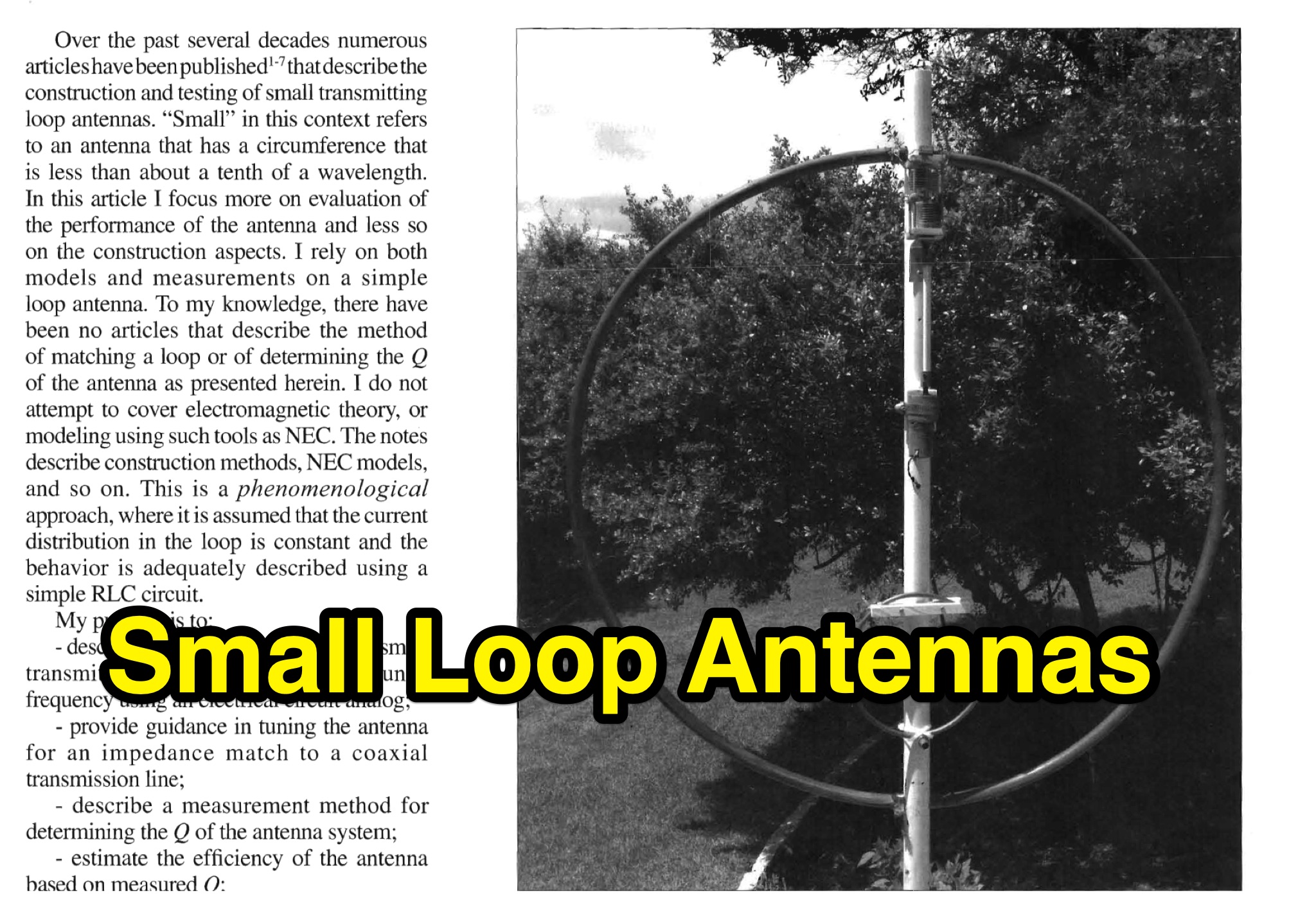 This PDF document provides detailed information on small loop antennas for hams. It covers the design, construction, and usage of small loop antennas for amateur radio operators. The guide includes practical tips and recommendations for optimizing the performance of small loop antennas in various operating conditions. Whether you are a beginner or an experienced ham radio operator looking to improve your antenna setup, this guide has valuable insights to offer.
 -
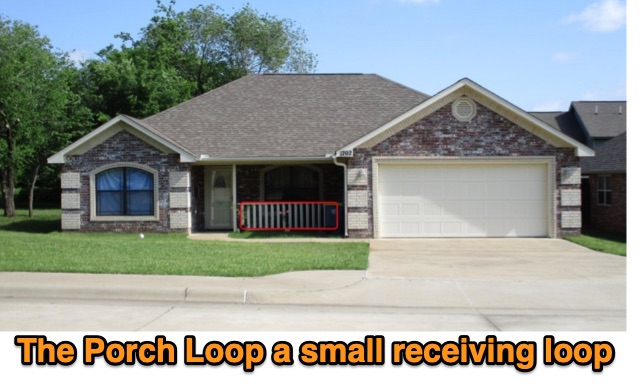 The small receiving loop (SRL) is a versatile and efficient antenna that can be simply built from common materials. It is designed for reception on the MF and HF bands and may be put in a variety of shapes and sizes. Despite its unusual installation, the porch loop in this case operated admirably, producing several DX spots on the 40m band. The SRL can be a great option for people looking to boost their reception on the MF and LF bands.
 -
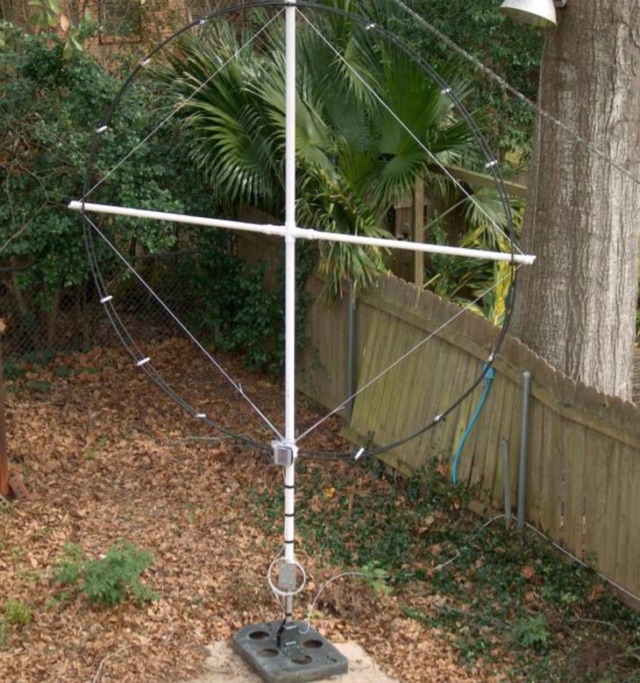 A Shielded Low Frequency Loop Antenna, allows Simultaneous Transmission and Reception at the Same Site.
 -
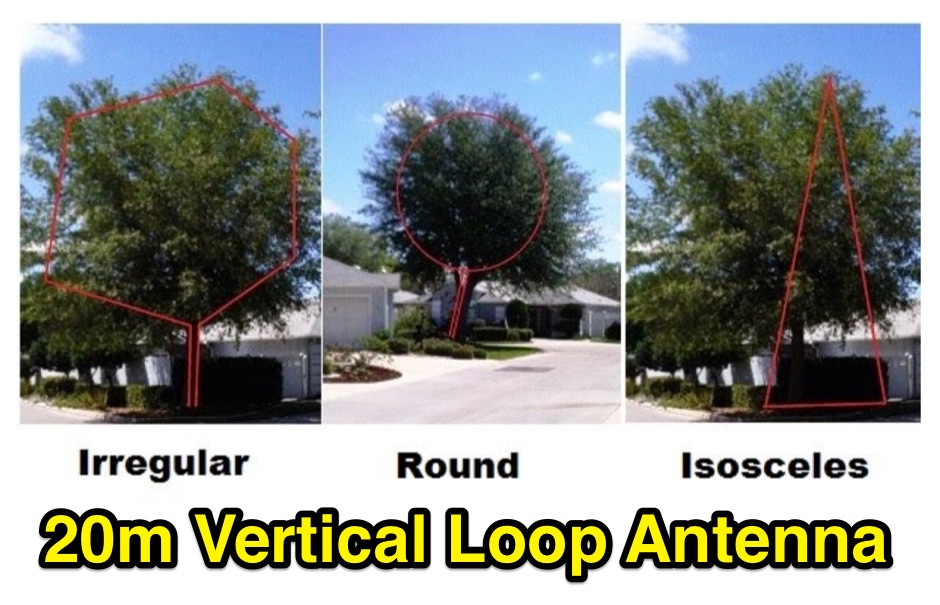 Consider installing a stealth vertical loop antenna if you live in a place with no antenna restrictions. Full wave loop wire antennas allow you to be on the air without installing evidente external aerials.
 -
 A comparative study of vertical vs. horizontal active loop antenna reception on HF bands, analyzing FT8 signal performance in a dense QRM environment.